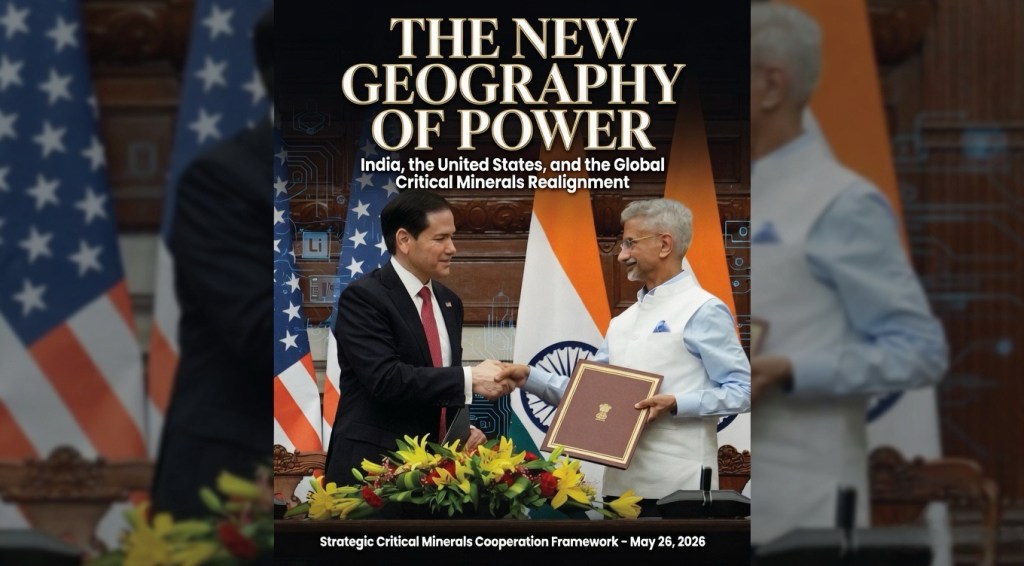
On May 26, 2026, on the sidelines of the Quad foreign ministers’ meeting in New Delhi, India and the United States signed a transformative bilateral Strategic Critical Minerals Cooperation Framework. This landmark agreement represents a watershed moment in Indo-Pacific economic statecraft. Signed at Hyderabad House by US Secretary of State Marco Rubio and India’s External Affairs Minister S. Jaishankar, the pact elevates critical minerals from an industrial commodity to a frontline national security asset.
This diplomatic breakthrough is a calculated, strategic response to China’s overwhelming hegemony over the processing and supply of rare earth elements and minerals indispensable to modern technology. Operating alongside a newly unveiled Quad Critical Minerals Initiative pledging up to $20 billion in public and private capital, this framework signals a definitive shift from transactional resource consumption to integrated, allied supply chain security.
The Strategic Imperative: Breaking the Chinese Monopoly
The modern global economy runs on critical minerals, and currently, the road to acquiring them passes almost entirely through Beijing. China controls approximately 60% to 70% of global rare earth mining and an astonishing 90% of global rare earth processing capacity. This creates a dangerous bottleneck. Even when minerals are extracted in the West, South America, or Africa, they are frequently shipped to Chinese facilities for refining and chemical conversion.
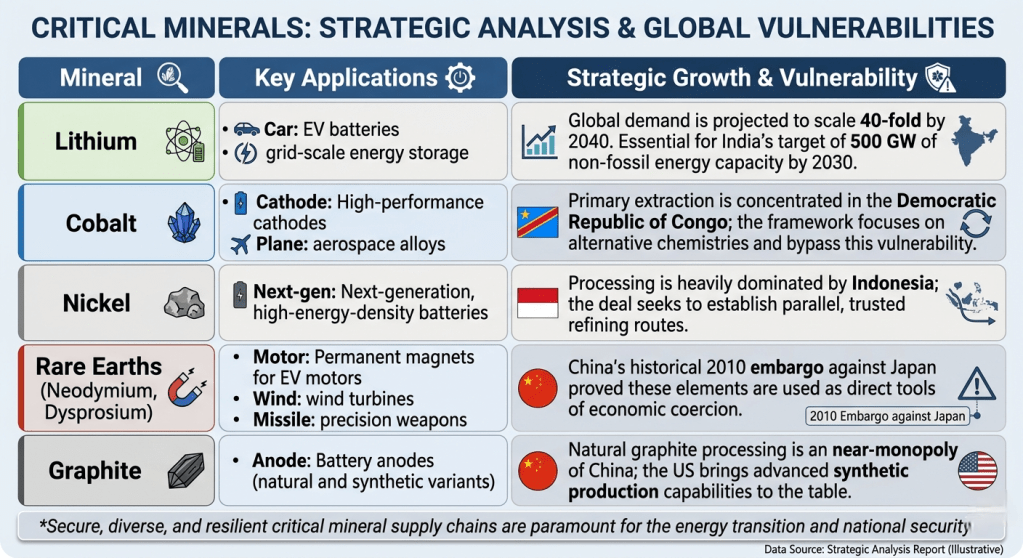
Beijing has demonstrated a willingness to use this leverage, imposing strict export controls on strategic metals like gallium, germanium, and graphite to signal its geopolitical displeasure. For Washington and New Delhi, this dependency represents an acute vulnerability. The materials covered under this framework—lithium, cobalt, nickel, graphite, and rare earth elements—form the bedrock of the 21st-century industrial complex:
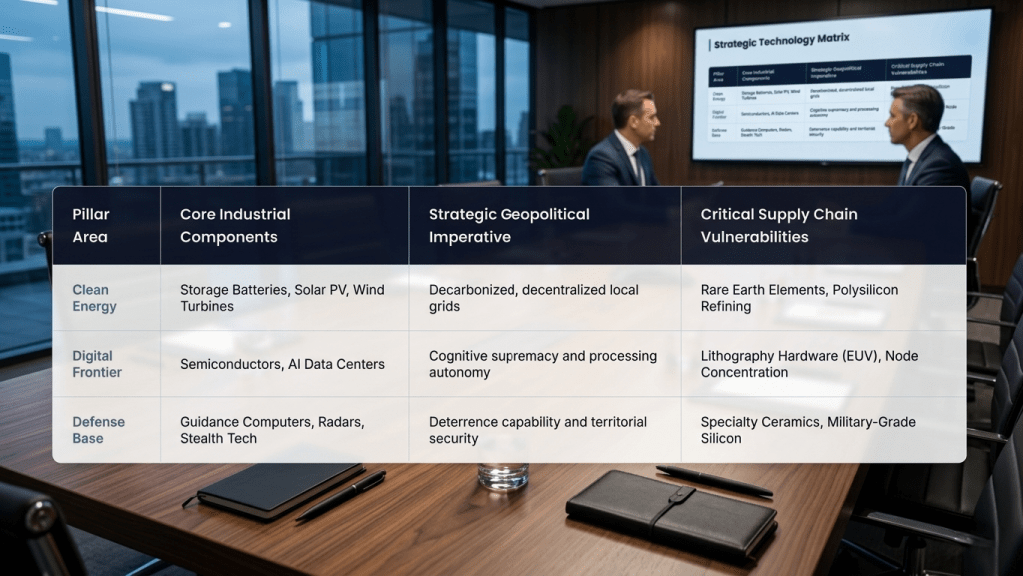
Without a diversified, trusted network to extract and process these materials, both nations face severe constraints on their technological sovereignty and defense readiness.
Comprehensive Scope: From Mine to Recycling Site
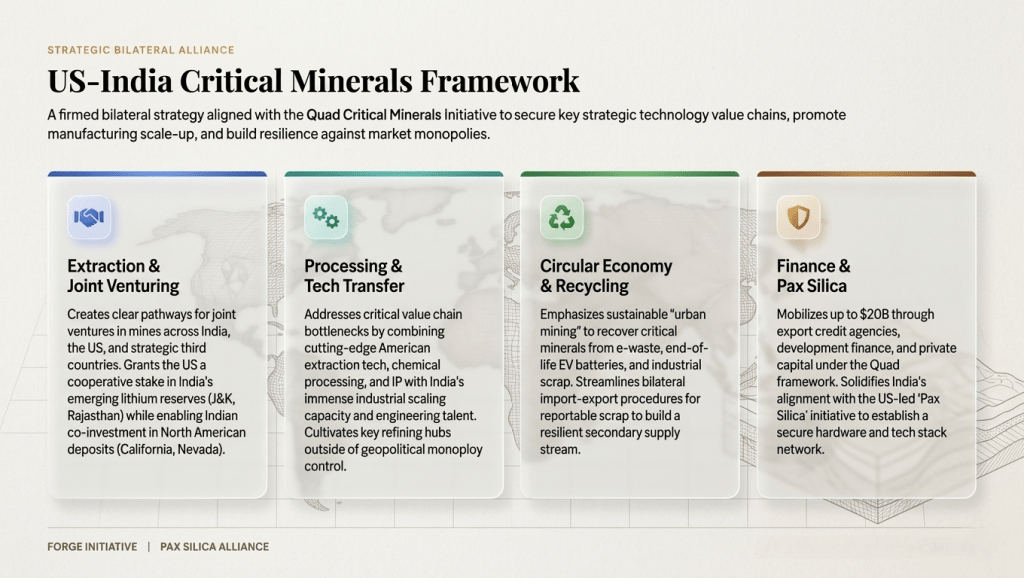
Unlike previous bilateral agreements that focused narrowly on exploration data or trade lip service, the 2026 framework takes a holistic, end-to-end approach to the supply chain. It acknowledges that security cannot be achieved simply by finding new deposits; it requires building entirely parallel processing architectures.
1. Extraction and Joint Venturing
The framework creates clear pathways for joint ventures in mines across India, the United States, and strategic third countries. This grants the US a cooperative stake in India’s emerging lithium reserves in regions like Jammu and Kashmir and Rajasthan. Simultaneously, it facilitates Indian co-investment in North American deposits, such as those in California and Nevada, establishing a diversified geographical footprint.
2. Processing, Refining, and Technology Transfer
This is the core bottleneck of the supply chain. The United States brings cutting-edge extraction technologies and refining techniques, including chemical processing innovations. India offers immense industrial scaling capacity, a massive domestic market, and a highly skilled engineering workforce. By marrying American intellectual property with Indian manufacturing scale, the deal aims to foster alternative refining hubs outside of China’s sphere of influence.
3. Circular Economy and Recycling
Recognizing that primary extraction is ecologically and politically costly, the pact places heavy emphasis on “urban mining”—recovering critical minerals from e-waste, end-of-life electric vehicle (EV) batteries, and industrial scrap. The framework aims to streamline import-export procedures for recyclable scrap between the two nations, cultivating a secondary domestic supply stream less vulnerable to geopolitical shocks.
4. Financial Mobilization and Pax Silica
The broader ‘Quad Critical Minerals Initiative Framework’ reinforces the bilateral agreement, which plans to mobilize up to $20 billion through export credit agencies, development finance institutions, and private capital. Furthermore, India’s alignment with the US-led ‘Pax Silica’ initiative ensures that these strategic frameworks operate within a unified network of trusted democratic partners.
The premium status of the minerals highlighted in the agreement is driven by their specific, irreplaceable roles in civilian and military manufacturing:
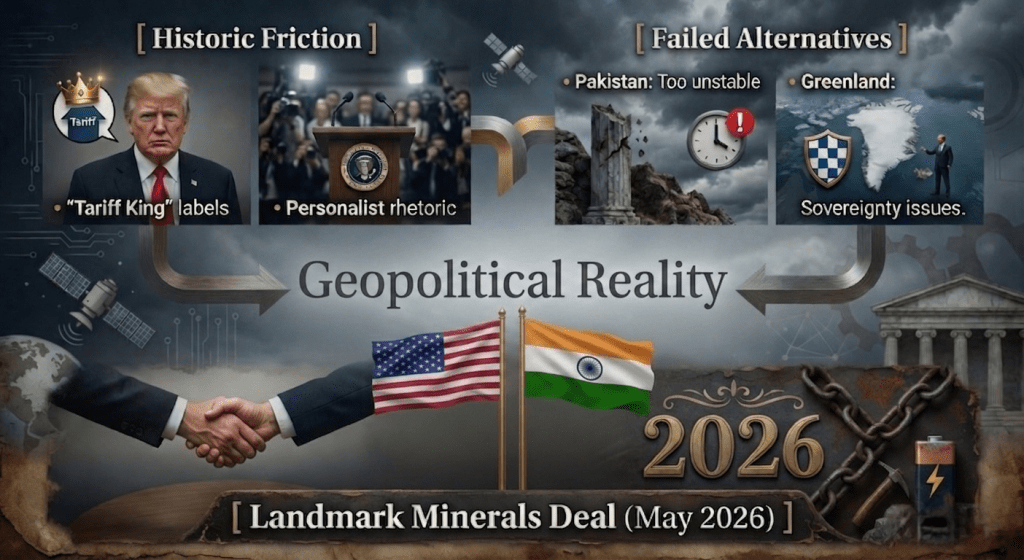
US Returns to India, Failure of the Pakistan Exploration, Greenland Miscalculation
To appreciate the significance of this deal, one must look past diplomatic pleasantries and examine the cold strategic mathematics driving Washington. The US decision to anchor its critical mineral security in India comes after a series of geopolitical experiments elsewhere that yielded little success.
In 2024 and 2025, Washington quietly explored critical minerals cooperation with Pakistan, eyeing the vast copper and gold deposits in the Reko Diq region of Balochistan. However, Islamabad ultimately proved to be an unviable long-term anchor for American supply chains due to structural deficits.
Deep economic crises and political volatility mean Pakistan lacks the predictable 10-to-15-year planning horizons required for capital-intensive mining infrastructure. Pakistan’s “all-weather” reliance on Beijing via the China-Pakistan Economic Corridor (CPEC) meant that the US would always be playing catch-up in an environment heavily influenced by Chinese intelligence and economic leverage.
Similarly, past American rhetorical overtures toward purchasing Greenland crashed against the hard realities of international law and practical geography. Greenland is an autonomous territory of Denmark; the transaction-based approach insulted a close NATO ally and disregarded local sovereignty. Furthermore, the extreme Arctic climate and near-total lack of deepwater port and transport infrastructure rendered any rapid extraction plans prohibitively expensive.
Moving Beyond Past Frictions
For India, navigating this partnership has required a masterclass in strategic patience and realpolitik. New Delhi has not forgotten past frictions, such as former US President Donald Trump’s sharp rhetoric labeling India a “tariff king” or threatening punitive trade measures during his first term.
However, India’s civilizational statecraft operates on multi-decade horizons, not weekly news cycles. The Indian government recognizes that personalist rhetoric is secondary to structural alignment. The foundational architecture of this deal—including the ‘Initiative on Critical and Emerging Technology (iCET)’ was ironically advanced during that same period, proving that institutional security goals go beyond political showmanship.
India is not acting out of sentimentality; it is participating because the benefits are strictly mutual. Access to American capital, deep-sea extraction technology, and advanced processing IP advances India’s goal of becoming a global manufacturing powerhouse under its ‘Make in India’ directive.
The Fractured Front: Why Pakistan is Racing Back to China
While India and the US were cementing their supply chain alliance in New Delhi, an entirely different geopolitical drama was unfolding in Beijing. On May 25, 2026—just 24 hours prior to the India-US signing—Pakistan’s Prime Minister Shehbaz Sharif and Chief of Defence Forces Field Marshal Asim Munir met with Chinese President Xi Jinping to announce a “new broad consensus” to accelerate CPEC and upgrade the Karakoram Highway.
This sudden pivot to China marks the definitive end of the temporary, highly transactional US-Pakistan rapprochement observed between 2024 and 2025. That short-lived “honeymoon” collapsed because Islamabad repeatedly ran counter to Washington’s core strategic interests:
1. The Middle East & Iran Frictions
Pakistan attempted to position itself as a diplomatic mediator in the escalating US-Israel-Iran tensions. However, this role collapsed when reports emerged that Iranian military aircraft were permitted to utilize Pakistani airbases during regional skirmishes. For Washington, a partner hosting the assets of a direct adversary is a structural dealbreaker.
2. Rejection of the Abraham Accords
US lawmakers, led by prominent senators like Lindsey Graham, aggressively pressured Pakistan to join the Abraham Accords and normalize relations with Israel as a prerequisite for deeper security assistance. Pakistan’s leadership flatly refused, citing deep domestic political risks and long-standing ideological commitments, signaling to Capitol Hill that Islamabad would not align with US Middle East policy.
3. Escalating Congressional Backlash
The reaction from Washington has been swift and severe. In Senate hearings, lawmakers openly voiced their distrust, accusing Islamabad of double-dealing.
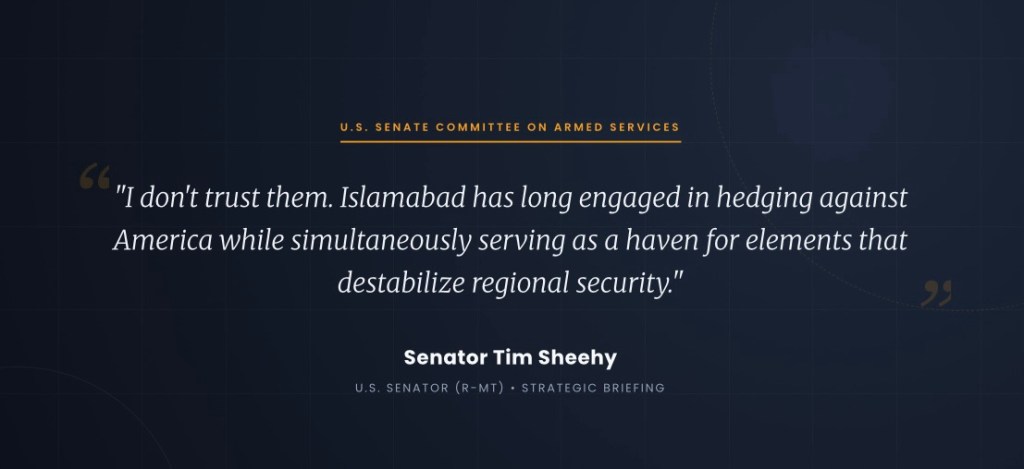
Faced with an intensifying backlash from US senators, an unsustainable balance-of-payments crisis, and stringent IMF austerity measures, a desperate Pakistan ran back to the only major power willing to tolerate its internal contradictions.
China has welcomed Pakistan’s return, not because Islamabad is a flawless partner, but because an unstable, dependent Pakistan serves as a persistent maritime and territorial counterweight to India. Beijing’s willingness to absorb the security risks of keeping CPEC afloat reflects its broader ambition to maintain a permanent footprint on the Arabian Sea via Gwadar Port.
Conclusion: The Strategic Blueprint vs. The Cronyism Vulnerability
The events of late May 2026 have drawn a clear line across the geopolitical landscape of the Indo-Pacific. The India-US Strategic Critical Minerals Cooperation Framework demonstrates what a mature, modern alliance looks like: a shared commitment to building institutional resilience and breaking China’s monopoly over the physical ingredients of the future. However, the strategic integrity of this framework faces an immediate, destabilizing test from the vulnerabilities of political cronyism. The recent revelation that the White House intervened to secure a $620 million Pentagon contract for Vulcan Elements—a rare-earth materials startup backed by Donald Trump Jr. just months prior—exposes a profound risk. White House adviser Peter Navarro’s direct pressure to award this massive loan from the Office of Strategic Capital, which actually exceeds Vulcan’s entire corporate valuation, raises severe ethical concerns about favoritism and the misdirection of national security funds for personal political enrichment.
This transaction highlights exactly why India must tread carefully and navigate this partnership with heightened caution. When strategic bilateral defense initiatives become tethered to the private financial interests of a ruling political family, they invite severe policy volatility, market distortions, and unpredictable congressional oversight or budget freezes. If the US prioritizes politically connected startups over established, highly capable technological partners, the supply chain loses its efficiency and reliability. For India, this creates an asymmetric geopolitical risk, where New Delhi’s long-term industrial strategies could be tied to under-qualified, over-leveraged US firms whose primary asset is partisan access rather than manufacturing merit.
Ultimately, the success of this framework will depend on bureaucratic execution, private sector compliance, and India’s ability to actively insulate its critical mineral security from the transactional impulses of Washington’s political elite. Yet, its philosophical foundation remains secure. In an era defined by great power competition, control over processing facilities and critical mineral loops has become just as vital as control over sea lanes or airspace. By demanding ironclad, merit-based guardrails for future joint ventures, India can protect its investments and solidify its position not merely as a regional actor, but as an indispensable, resilient pillar of the global technological supply chain.


 Insightful Geopolitics
Leave a Reply