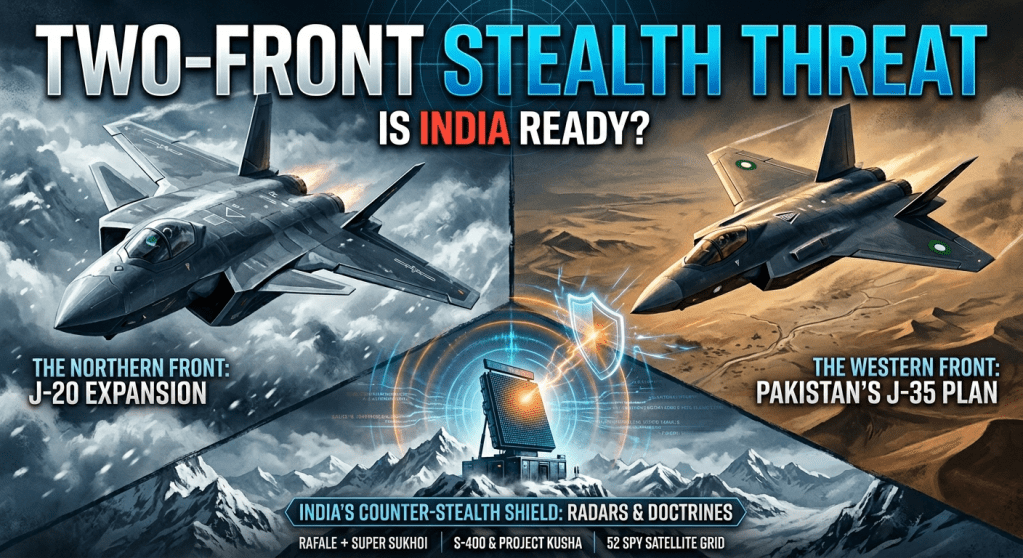
The borders in the Indian subcontinent are witnessing an unprecedented and dangerous shift. For decades, the Indian Air Force maintained a strong qualitative edge over its neighbors. However, China’s massive military modernization has fundamentally changed the rules of aerial warfare along the Line of Actual Control. China is no longer just experimenting with its fifth-generation stealth fighter, the Chengdu J-20 “Mighty Dragon.” It is churning them out at an industrial scale, treating them as regular frontline jets rather than rare assets. More worryingly for New Delhi, Beijing is now actively setting up a secondary stealth front by planning to supply Pakistan with its new Shenyang J-35 medium stealth fighter. With Chinese stealth fighters stationed along India’s northern borders and Pakistan preparing to receive its own stealth fleet, India is officially facing a two-front stealth threat. To counter this, India is rapidly upgrading its radar technology, altering its air combat doctrines, and developing a sophisticated anti-stealth defense network.
In modern defense strategy, a stealth fighter program is not just judged by how invisible a plane is to radar. It is defined by factory floor space, assembly-line speed, and the speed at which a nation can replace older aircraft. China’s Aviation Industry Corporation has fully embraced this mass-production mindset. Commercial satellite images show that China has expanded its main J-20 manufacturing plant in Chengdu by a massive 3 million square feet. This brings the total production area to over 8 million square feet, making it even larger than the famous Lockheed Martin F-35 factory in Texas, USA. Incidentally, HAL has 1.3 million square feet dedicated to Tejas production. By using advanced robotics, automated guided vehicles, and AI-driven “dark factories,” China has more than doubled its aircraft production efficiency. HAL also uses advanced robotics but has not integrated AI in the production line.
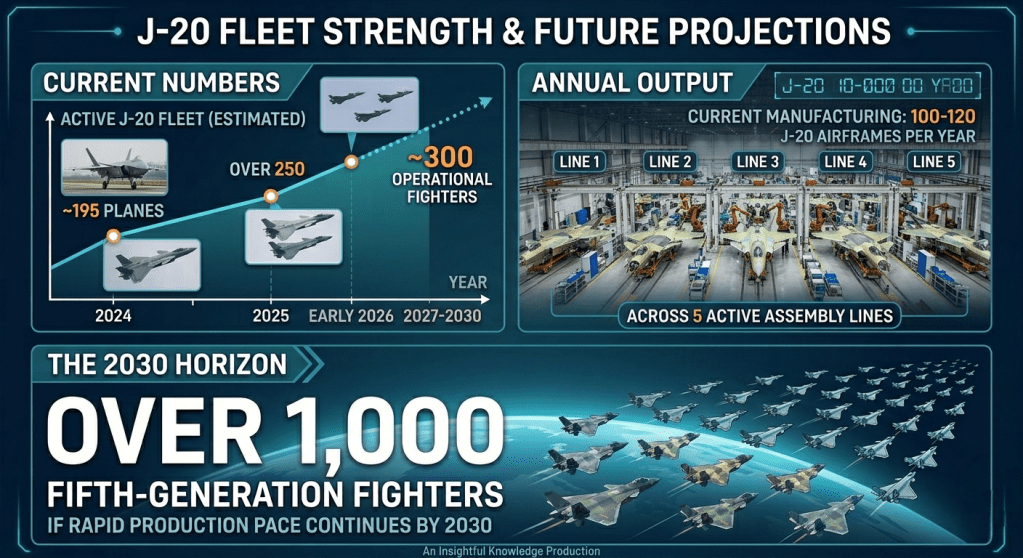
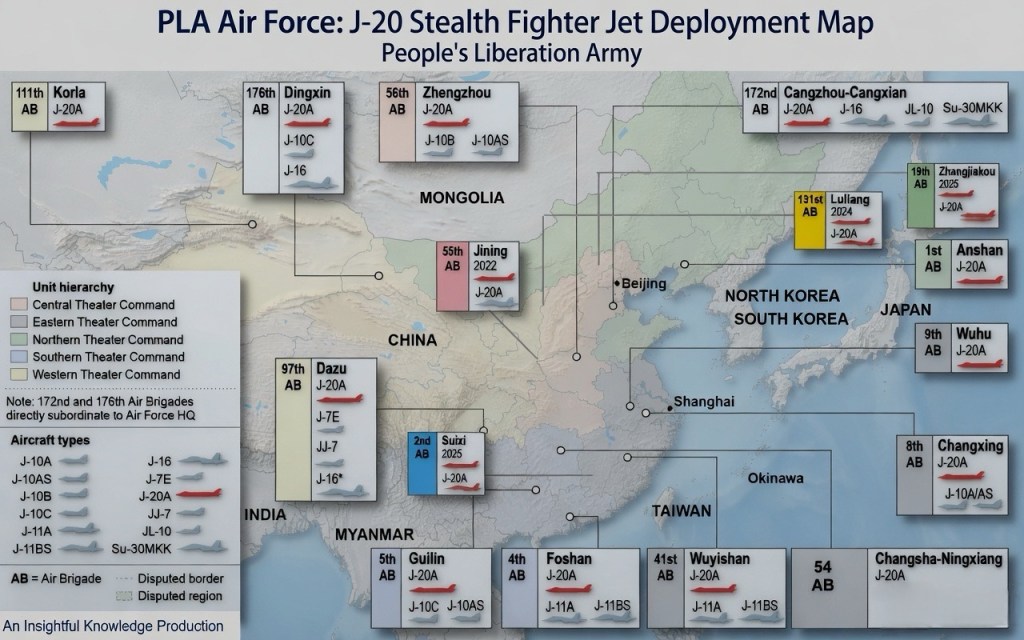
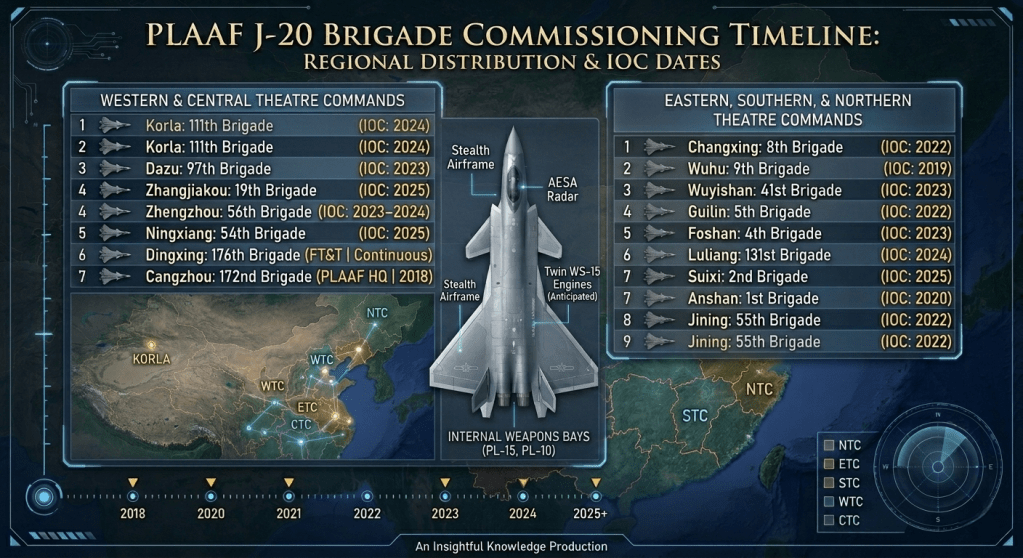
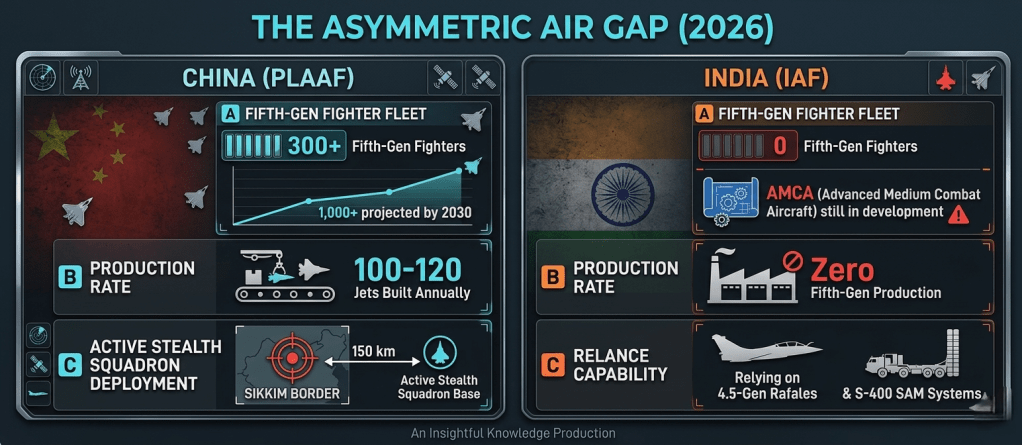
Resultant, the active J-20 fleet grew from roughly 195 planes in 2024 to over 250 in 2025. By early 2026, the PLAAF reached approximately 300 operational J-20 fighters. China’s factories are currently manufacturing between 100 and 120 J-20 airframes every single year across five active assembly lines. If this rapid production pace continues, the PLAAF will easily field over 1,000 fifth-generation fighters by 2030. Today, the J-20 is operated by 16 distinct PLAAF air brigades, with three brigades using it exclusively. Its deployment spans across the Northern, Eastern, and Southern Theater Commands. Furthermore, in 2025, China introduced the J-20S variant, which is the world’s first two-seat stealth fighter. The second pilot acts as a Mission Systems Officer, whose job is to control electronic warfare and command swarms of accompanying loyal wingman drones in mid-air.
While China previously kept its J-20s far away—such as at Hotan airbase in Xinjiang during the 2020 Ladakh standoff—recent movements show a highly aggressive forward posture. Satellite data has confirmed that a permanent squadron of at least six J-20 stealth fighters is now stationed at Shigatse Airport in Tibet. This high-altitude base is positioned critically in the strategic landscape, sitting less than 150 kilometers away from the Sikkim border and right next to the strategically sensitive Doklam tri-junction area between India, Bhutan, and China. This puts them barely 290 kilometers away from India’s Hasimara Air Force Station in West Bengal, where the Indian Air Force bases its second squadron of advanced Dassault Rafale fighters.
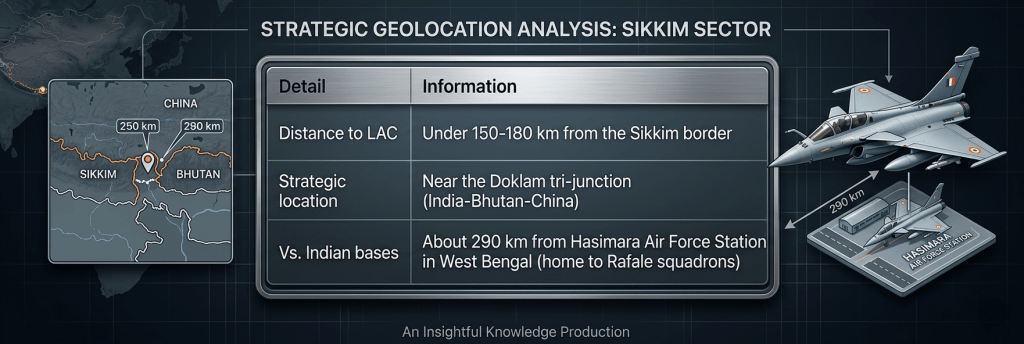
The immediate military impact of this forward deployment creates a critical response time crisis. Because Shigatse is so close to the border, the reaction time for the Indian Air Force is reduced to mere minutes. A Chinese J-20 flying well within Tibetan airspace can fire a missile and strike an Indian plane or base deep within Assam, West Bengal, or Sikkim. Shigatse is also within striking distance of the Siliguri Corridor, known as the “Chicken’s Neck.” This narrow strip of land, just 20 kilometers wide at its tightest point, connects mainland India to the northeastern states. If a conflict breaks out, J-20s could be used to target local Indian air defense positions and sever the rail and road links, isolating the Northeast.
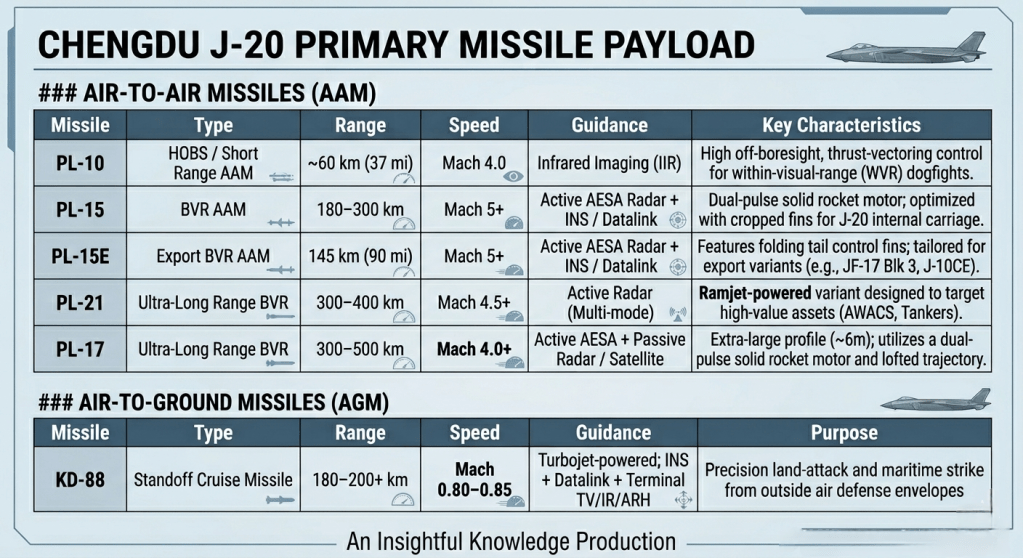
India’s Ground and Air Defense Countermeasures
Stealth aircraft evade standard fighter jets and anti-aircraft systems by geometrically deflecting high-frequency X-band radar waves. However, they remain vulnerable to low-frequency long-wave radars and passive sensors. To exploit this flaw, India’s DRDO and private defense firms are building a layered counter-stealth shield.
Key Components of the Shield:
- Mission Sudarshan Chakra (Passive Radars): India is deploying Passive Coherent Location (PCL) systems along its borders. Unlike traditional radars that broadcast signals, PCL radars emit nothing. Instead, they silently monitor ambient radio waves (FM, TV, and mobile signals). When a stealth fighter flies through, it disrupts this “soup” of waves. The PCL system captures these minute distortions to track the aircraft without alerting the pilot’s radar warning receivers.
- Arudhra 4D Multi-Function Radar: Developed by Bharat Electronics Limited, this powerful phased-array radar features a 400-kilometer range. While stealth jets minimize their radar signatures from the front, they expose their profiles when turning or banking. Arudhra’s software is optimized to detect these brief profile changes. Rugged units are being deployed across the mountain valleys of Jammu and Kashmir, and Arunachal Pradesh to prevent enemy jets from hiding behind peaks.
- Anālakṣhya Camouflage: To protect India’s own assets from electronic threats, IIT Kanpur and DRDO developed Anālakṣhya. This advanced metamaterial camouflage coating absorbs incoming synthetic-aperture radar waves rather than reflecting them, effectively hiding forward command centers and radar stations from enemy sensors.
To intercept fifth-generation stealth threats before they reach Indian airspace, ground-based tracking is not enough. Consequently, New Delhi has fast-tracked two massive airborne early warning (“eyes-in-the-sky”) programs to maintain non-stop, real-time monitoring of the China-Pakistan stealth axis.
The Eye in the Sky
ISTAR Aircraft Project (Air):
In July 2025, the Defence Acquisition Council cleared a 10,000-crore rupee project to procure three Intelligence, Surveillance, Target Acquisition, and Reconnaissance (ISTAR) aircraft for the Indian Air Force.
- The Hardware: India is buying three corporate jet frames via open tender, while the core sensors and software are completely indigenous, designed by the Centre for Airborne Systems.
- Performance: Operates above 40,000 feet with an 8-hour endurance.
- Capabilities: Equipped with a Synthetic Aperture Radar (SAR) with a 200+ km range and a Ground-Moving Target Indicator (GMTI) with a 150 km range.
- Strategic Impact: Provides real-time mapping of the ground battlespace to track enemy mobile missile launchers, fuel trucks, and airfield movements, enabling long-range precision strikes.
Space-Based Surveillance Phase-III (Space):
To counter a China-backed Pakistani upgrade of six Earth-observation satellites, India’s Cabinet Committee on Security approved a 26,968-crore rupee package for the Space-Based Surveillance Phase-III (SBS-III) project.
- The Mega-Constellation: India will deploy 52 military-grade spy satellites across Low Earth and Geostationary Orbits. ISRO is developing 21 satellites (some with France), while private Indian startups will build and launch the remaining 31.
- Advanced Tech: The satellites feature onboard AI for autonomous inter-satellite communication and data analysis, immediately alerting the Defence Space Agency of verified threats. They utilize SAR for night-vision and all-weather imaging through clouds and Himalayan snow.
- Timeline: The first batch launches by late 2026, with the full constellation active by 2029 to maintain unbreakable surveillance over India’s borders and the Indian Ocean.
The Fifth-Generation Conundrum
India’s strategy against Pakistan’s upcoming J-35 stealth fighter fleet focuses on disrupting the complex network of data links, satellite communications, and airborne early warning aircraft that fifth-generation jets rely on to remain effective. Instead of traditional close-range dogfights, the Indian Air Force (IAF) plans to employ high-tech electronic suppression. By utilizing heavy electronic jammer suites like the Rafale’s SPECTRA system, the IAF aims to scramble Chinese-supplied data networks and completely isolate J-35 pilots from their ground controllers in mid-air.
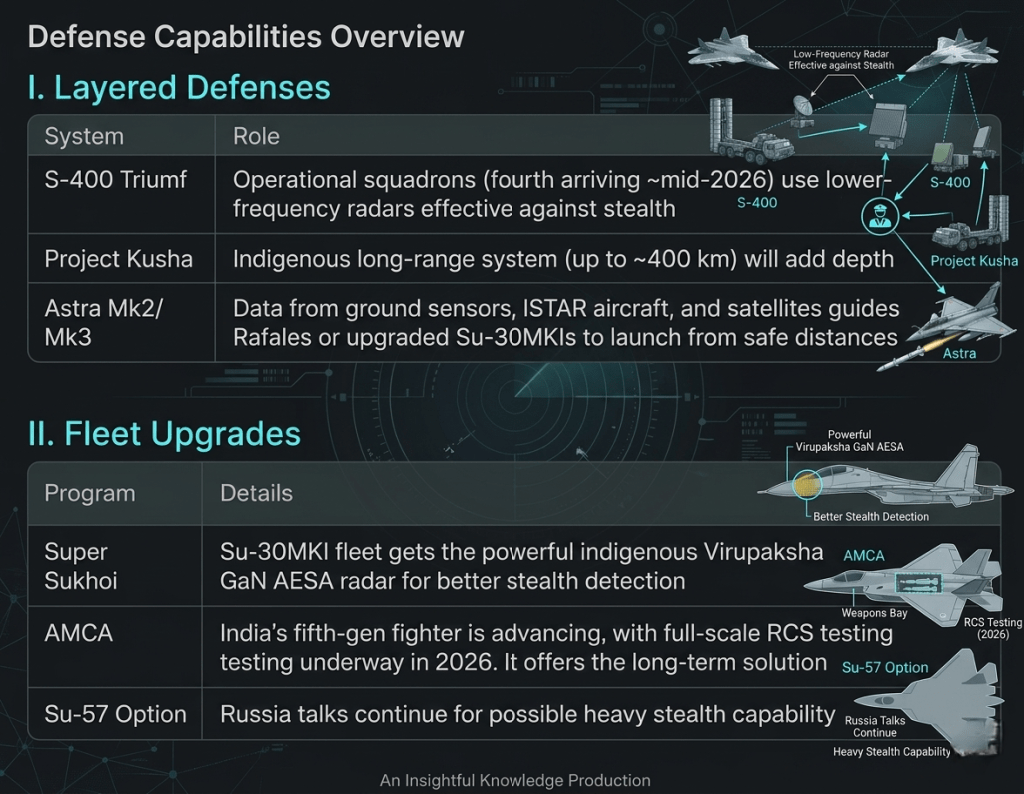
To intercept these low-observable threats, India will leverage a multi-layered air defense grid. The Russian-origin S-400 Triumf and the upcoming indigenous Project Kusha systems utilize specialized low-frequency target acquisition radars capable of tracking stealth aircraft at comfortable distances. Once this ground-based grid or the space-based SBS-III network detects a target, the tracking data is fed directly to Indian 4.5-generation jets like the Rafale or upgraded Su-30MKI. This allows them to launch long-range Astra Mk2 and Astra Mk3 air-to-air missiles into the target zone from safe distances, avoiding detection by the J-35’s radar.
As a stopgap measure while the indigenous Advanced Medium Combat Aircraft (AMCA) progresses through radar testing, India is aggressively modernizing its current fleet and exploring heavy stealth options. The Su-30MKI fleet is undergoing a “Super Sukhoi” upgrade featuring the powerful indigenous Virupaksha AESA radar, designed to blind enemy defences and track stealth threats. Concurrently, New Delhi is discussing the potential local assembly of Russia’s heavy Su-57 fifth-generation fighter—contingent on source code sharing—to secure a platform that completely outmatches the lighter J-35 in range, speed, and payload capacity.
While the sheer production numbers of the Chinese J-20 and the upcoming Pakistani J-35 paint an intimidating picture, a deeper look into the world of fifth-generation aviation reveals a massive hidden flaw in operational readiness. Developing a stealth fighter is one thing, but keeping it fit to fly every morning is an entirely different battle. Across the globe, high-tech fifth-generation fleets are severely struggling to maintain availability.
Even the world’s most advanced air forces are facing a sharp decline in aircraft readiness. A stark reminder came from a June 2026 US Government Accountability Office report, which officially revealed that the American F-35 Lightning II fleet’s general Mission Capable rate has plummeted to just 44%. Worse, its Full Mission Capable rate—the percentage of planes capable of executing every single one of their designed combat tasks—dropped to an all-time low of 25%. However, China’s J-20 is facing an even more severe crisis. Analysts estimate that the J-20’s Mission Capable rate sits at a meager 35% to 40%.
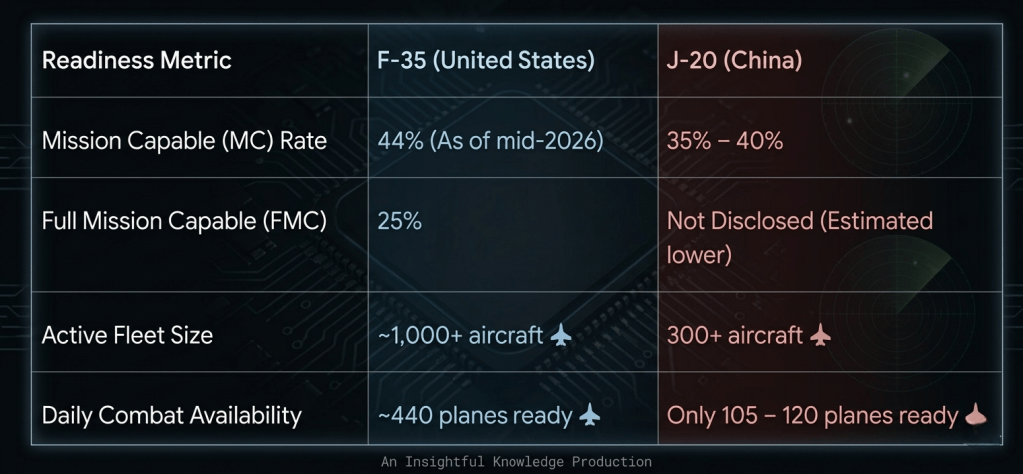
The primary culprit behind China’s low availability rates is its persistent jet engine crisis. While China has rushed the J-20 into service, the aircraft still heavily relies on modified WS-10C engines, which have commercial design roots, because its true fifth-generation engine, the WS-15, has faced perpetual metallurgical delays. This engine mismatch causes deep complications. The intense heat of high-altitude operations in Tibet causes microscopic structural cracks in the turbine blades, forcing frequent, time-consuming engine overhauls. Furthermore, the makeshift exhausts of the current engines disrupt the plane’s rear radar cross-section, meaning it hardly acts as a true stealth fighter in everyday sorties. Out of China’s claimed fleet of over 300 J-20s, only about 105 to 120 aircraft are actually ready for combat on any given morning. When distributed across three massive theater commands, the actual number of J-20s capable of launching an immediate strike against India from Tibet drops to just a handful.
Breathing Space But Don’t Be Complacent
This global stealth crisis opens a vital tactical window for New Delhi. The incoming threat of a Chinese-Pakistani stealth axis is undoubtedly a dangerous challenge for India. However, air warfare has proved time and again that on the day of battle, the aircraft parked on the tarmac due to maintenance issues do not count. If the Indian Air Force can successfully maintain an operational availability rate of 75% to 80% across its 4.5-generation fleet of Dassault Rafales and heavily upgraded Sukhoi Su-30MKIs, the tactical equation shifts dramatically.
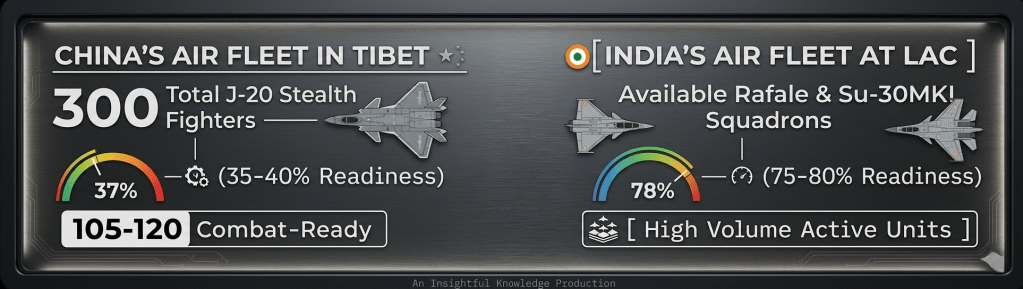
A 4.5-generation fighter with high readiness, integrated seamlessly with an active anti-stealth network like Mission Sudarshan Chakra, can comfortably hold the line against a technically superior stealth asset that cannot fly. By focusing heavily on creating localized spare part lines, expanding domestic maintenance depots, and fast-tracking the electronic upgrades of the “Super Sukhoi,” India can ensure its frontline fighters are always mission-ready. In a prolonged air campaign across the Himalayas or the western borders, a high-availability fleet turns a numbers game on its head. As the old military adage goes, sometimes the quantity of available aircraft has a quality of its own.
The arrival of the J-20 near Sikkim and Pakistan’s upcoming induction of the J-35 mean that the skies over the Indian subcontinent are entering a highly contested era. India no longer has the luxury of numerical or easy technological superiority. However, by combining cutting-edge airborne sensors like the 10,000 crore rupee ISTAR planes, an aggressive 52-satellite space network, and ground-based passive radars, New Delhi is methodically stripping away the geometric advantages of Chinese and Pakistani stealth designs. Combined with the fast-tracking of the indigenous Advanced Medium Combat Aircraft program, India is ensuring its air defense remains a tough, unbreakable shield against its neighbors’ ambitions.


Leave a Reply