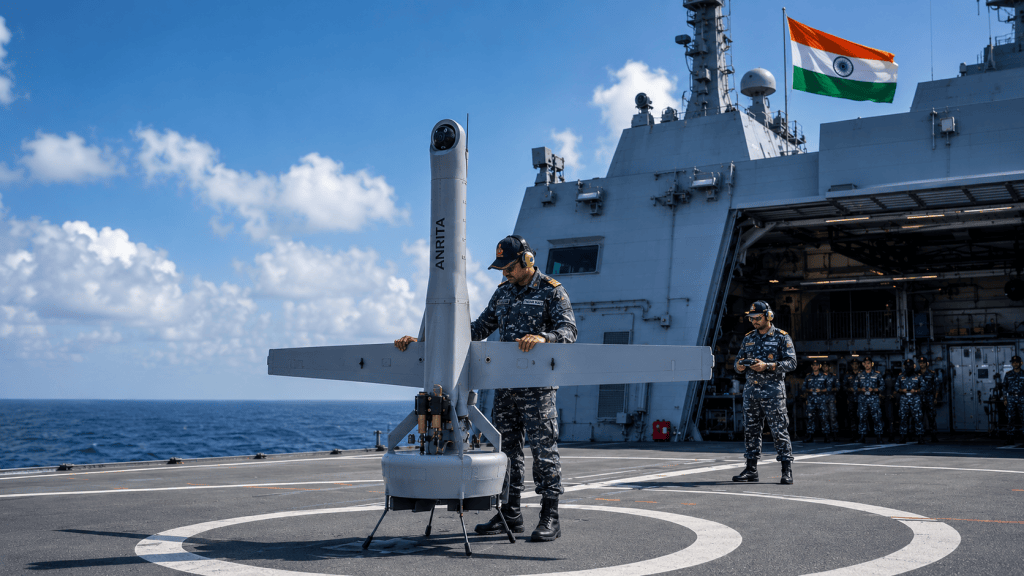
The modern military battlespace is undergoing a fundamental transformation. As traditional, runway-dependent unmanned aerial vehicles (UAVs) face increasing vulnerability from electronic warfare, GPS denial, and infrastructure constraints, defense planners worldwide are shifting toward flexible, highly autonomous tactical systems. Among these, Group 3 vertical take-off and landing (VTOL) platforms have emerged as the linchpin for persistent intelligence, surveillance, and reconnaissance (ISR).
At the forefront of this global evolution stands the V-BAT drone—a true vertical take-off and landing tailsitter engineered around a single ducted-fan architecture. Meanwhile, in India, an ambitious indigenous concept known as ANRITA, spearheaded by Bangalore-based SGPL, aims to address a similar broad operational requirement. However, ANRITA’s scope goes beyond building just one aircraft; it seeks to create an AI-first autonomous aerial platform and an integrated mission-systems ecosystem.
Understanding how these two systems compare, compete, and reflect broader shifts in military aviation offers a vital window into the future of tactical autonomy.
The Classification Framework: Why Group 3 Matters
To fully appreciate the tactical utility of platforms like the V-BAT and ANRITA, one must understand how military UAVs are classified. The most widely used framework is the five-group US Department of Defense (DoD) classification, which categorizes systems based on weight, operating altitude, speed, endurance, and mission role:
- Group 0 (Micro UAVs): Very small, hand-carried systems (e.g., nano-drones, small quadcopters) operating at low altitudes for a few minutes to an hour, providing immediate squad-level situational awareness.
- Group 1 (Small UAVs): Systems typically up to approximately 9 kg, operating below 1,200 feet above ground level (AGL) with low speeds. Examples include the RQ-11 Raven and RQ-20 Puma, used for platoon- and company-level ISR.
- Group 2 (Medium Tactical UAVs): Weighing around 10 to 25 kg, with endurance stretching from four to eight hours. These systems support battalion- and brigade-level surveillance, utilizing catapults, nets, or short runways.
- Group 3 (Large Tactical UAVs): Generally exceeding 25 kg and extending into the several-hundred-kilogram class. Capable of operating up to 20,000–25,000 feet with an endurance of 10 to 24 hours or more, Group 3 systems carry robust payloads like electro-optical/infrared (EO/IR) sensors, synthetic-aperture radar (SAR), and electronic-support measures. The V-BAT and larger tactical MALE-type systems sit firmly in this category.
- Groups 4 & 5 (Large High-Altitude & Strategic UAVs): Weighing upwards of 450 kg, these high-altitude, long-endurance (HALE) platforms (such as the RQ-4 Global Hawk) manage strategic, national-level, and wide-area missions.
In simple operational terms, Groups 0–1 support individual soldiers, Group 2 handles battalion tasks, Group 3 provides persistent tactical and theatre ISR, and Groups 4–5 manage strategic campaigns. Both V-BAT and potential ANRITA configurations target the critical Group 3 space, bridging the gap between small portable drones and runway-dependent heavy assets.
The V-BAT Airframe: Engineering a Tailsitter
The V-BAT’s defining design choice is its true tailsitter architecture. Unlike conventional VTOL aircraft that rely on separate lift motors, tilt-rotors, or complex helicopter rotor systems, the V-BAT takes off and lands vertically on its rear end, subsequently rotating into horizontal, fixed-wing flight.
Principal Design Features
- Composite Fuselage: A sleek, rocket-like body housing modular payload bays.
- Rear-Mounted Wings & No Tail Assembly: Aerodynamic lift is generated via rear-mounted wings during cruise flight, eliminating traditional rudders, elevators, and exposed multirotor propellers.
- Single Rear Ducted Fan: Enclosing the propulsion fan removes exposed blades, maximizing safety for shipboard personnel and troops operating in confined clearances.
- Internal Thrust-Vectoring Vanes: Instead of traditional control surfaces, internal vanes inside or around the ducted-fan flow vector thrust to provide precise pitch, roll, and yaw control during vertical flight and transition.
With a length of approximately 2.74 meters and a wingspan of roughly 2.95 meters, the V-BAT operates in the 55–75 kg class. Powered by heavy-fuel engines (compatible with military fuels like JP-5) in newer variants, it achieves a cruise speed of around 97 km/h, a dash speed of 150–160 km/h, and an endurance of 10 to 13 hours or more while carrying payloads up to 18 kg.
Autonomy at the Core
The V-BAT’s operational potency is inextricably linked to Shield AI’s Hivemind autonomy ecosystem. This integration enables automated take-off, landing, waypoint navigation, and seamless transitions between vertical and horizontal flight. Crucially, it empowers the aircraft to execute missions in GPS- and communications-degraded environments—an indispensable capability in modern electronic warfare theaters.
V-BAT’s Competitive Edge and Global Alternatives
The V-BAT is unique because it combines characteristics rarely found in a single operational UAV: fixed-wing endurance paired with helicopter-like deployment flexibility, a tiny operating footprint, heavy-fuel compatibility, and core AI autonomy. It requires no runway, catapult, arresting net, or recovery vehicle, making it uniquely suited for cramped ship flight decks, rugged mountain positions, and austere forward bases.
The Competitive Landscape
The V-BAT competes directly within the US Army’s Future Tactical Unmanned Aircraft System (FTUAS) requirement against systems such as:
- Griffon Aerospace Valiant: A VTOL fixed-wing tactical UAV built for mobile ISR.
- Sierra Nevada Corporation Voly-T: A tactical VTOL ISR platform.
- Textron Aerosonde Variants: Adapted tactical VTOL evolutions of the proven Aerosonde family.
Globally, architectural alternatives include tilt-rotors, tilt-wings, quad-plus-pusher designs, separate lift-and-cruise aircraft, and conventional helicopter UAVs. While the V-BAT enjoys operational maturity and simplicity, its ducted-fan tailsitter transition remains technically demanding, requiring rigorous flight-control and maintenance expertise.
The Indian ANRITA Concept: A Broader Ecosystem Ambition
While the V-BAT sets the global benchmark for Group 3 tactical VTOL systems, India’s ANRITA concept—developed by Bangalore-based SGPL—approaches the problem with a wider strategic lens. ANRITA is not merely positioned as a single drone model; it is conceived as an AI-first autonomous aerial platform and integrated mission-systems ecosystem.
The ANRITA Architecture
ANRITA relies on a reusable common core designed to support multiple aircraft configurations and mission payloads. Its holistic framework encompasses:
- Airframe design and advanced flight-control systems.
- Autonomous navigation and AI-enabled mission management.
- Onboard computing and modular sensor/payload interfaces.
- Ground-control systems and fleet-management software.
- Digital engineering, digital-twin tools, and lifecycle support.
Rather than relying purely on hardware sales, ANRITA’s business model targets five distinct revenue streams: platform sales, mission-system integration, AI/software subscriptions, support and spares, and professional training services. The core strategic operating principle is clear: Own the brain, control the system, partner the factory, own the customer relationship, and monetise the fleet throughout its lifecycle.
V-BAT vs. ANRITA: A Comparative Analysis
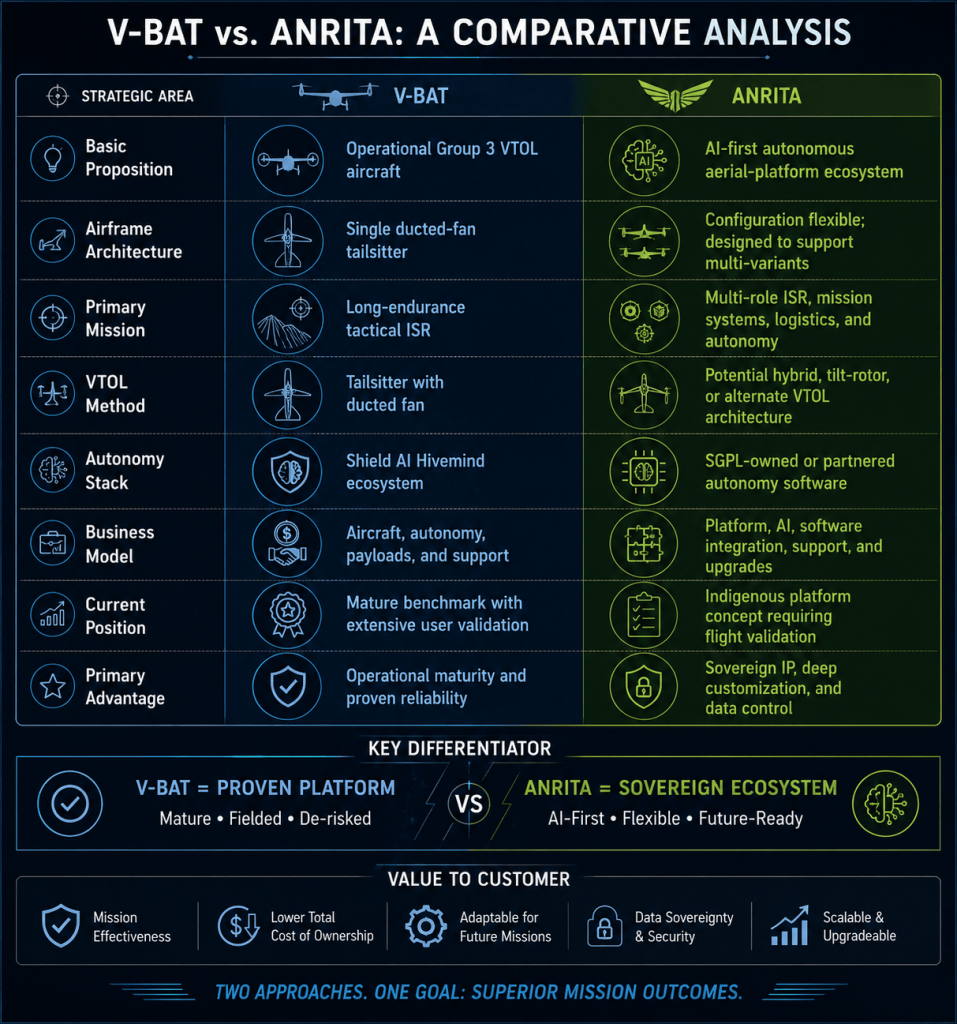
ANRITA must not be viewed merely as an Indian copy of the V-BAT. Instead, ANRITA carves its path by emphasizing sovereign technology ownership, flexible airframe configurations, lower lifecycle costs, fleet intelligence, and seamless integration with native Indian sensors and communication architectures.
The Competitive Challenge for ANRITA
Because the V-BAT has already established a strong presence in international markets and holds deep operational credibility, ANRITA faces a high bar for market entry. To succeed, ANRITA must answer critical operational questions:
- Can its endurance and payload capacity match or exceed the V-BAT benchmark?
- Can it demonstrate safe, reliable operations and autonomous transitions at extreme high-altitude Himalayan locations?
- Will its software prove resilient and fully sovereign in GPS-denied environments?
- Can India effectively scale manufacturing and lifecycle support while undercutting unit costs?
Strengths and Risks
- Strengths: Indian ownership of core IP, AI-first architecture, modular payload flexibility, sovereign data control, and powerful multi-product reuse across defense and disaster response.
- Risks: Unfrozen final airframe configurations, demanding flight-control transition hurdles, long defense procurement cycles, and intense competition from established global benchmarks and domestic large primes.
Conclusion
The V-BAT drone represents the gold standard of mature, single-engine ducted-fan tactical VTOL design, successfully merging the vertical flexibility of a helicopter with the range and efficiency of a fixed-wing aircraft, all backed by cutting-edge AI autonomy.
Conversely, ANRITA represents India’s ambitious blueprint to capture the same tactical space through a sovereign, AI-first ecosystem. While the V-BAT serves as the operational benchmark that ANRITA must measure up to, ANRITA’s true differentiation lies in its broader architectural vision: a reusable, customizable, and locally owned platform designed to secure India’s borders and redefine the future of autonomous aerial warfare.


Leave a Reply