
Author Note:
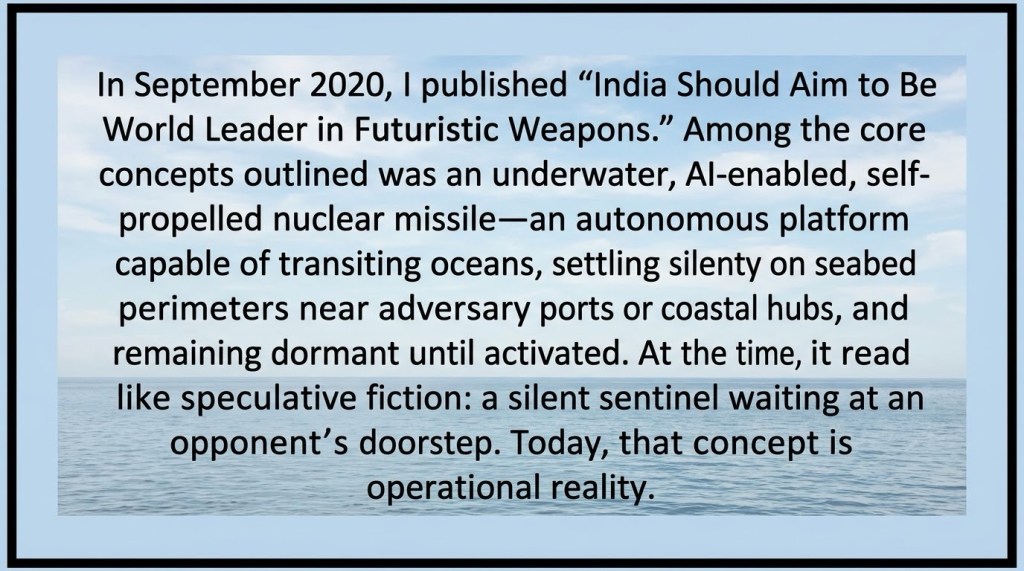
Russia’s Poseidon (Status-6 / Kanyon)—deployed alongside purpose-built carriers like the Khabarovsk—validates the underlying strategic prediction: autonomous, nuclear-powered, long-endurance undersea systems are redefining strategic deterrence. While Poseidon operates as a launched intercontinental-range strategic delivery system rather than a stationary seabed mine, the paradigm shift is complete. The future of warfare belongs to systems that bypass traditional missile-defense architectures by operating beneath traditional detection thresholds.
This trajectory dictates the character of conflict over the next five years. The modern battlefield is expanding into domains where physical detection is severely degraded, communications links are fragile, and localized autonomy supersedes remote control. Low-cost uncrewed systems, AI-enabled swarms, robust electronic warfare (EW), cyber operations, satellite disruption, and AI-assisted command frameworks are converging into a unified model of conflict: a resilient network of mass-produced, attritable, intelligent nodes operating seamlessly across land, air, sea, space, and the electromagnetic spectrum.
The Changing Character of Future Conflict
Future military conflict will be fundamentally hybrid, attritional, and multi-domain. It will fuse massed missile salvos, drone swarms, cyber intrusions, orbital denial, electronic warfare, information operations, and conventional joint maneuver. As seen in Ukraine, low-cost loitering munitions and FPV platforms impose disproportionate attrition on legacy conventional forces, while electronic warfare has proven itself as the foundational layer of modern air defense.
The most disruptive transformation is the collapse of traditional cost-exchange ratios. A drone costing a few hundred dollars forces a defender to expend interceptor missiles valued in hundreds of thousands or millions of dollars. This economic asymmetry does not render exquisite platforms obsolete; rather, it forces a doctrinal evolution where high-value assets—such as crewed aircraft, capital ships, orbital assets, and command nodes—must survive within an environment saturated with cheap decoys, autonomous jammers, and precision munitions.
The Layered Force Architecture
To survive and dominate this operating environment, modern militaries require a fully integrated, multi-tiered force structure:
- Tactical Edge: Low-cost reconnaissance and FPV drones for local situational awareness.
- Precision Strike: Loitering munitions for dynamic, time-sensitive target engagement.
- Persistent ISR: Medium-Altitude Long-Endurance (MALE) and High-Altitude Long-Endurance (HALE) platforms for strategic intelligence.
- Command Nodes: Crewed platforms functioning as manned-unmanned teaming (MUM-T) hubs.
- Autonomous Enablers: Uncrewed ground, surface, and undersea systems (UGVs, USVs, AUVs) for logistics, mine warfare, and sea denial.
- Cognitive Acceleration: AI-enabled command systems designed to fuse multi-sensor data and compress decision cycles.
- Electromagnetic Dominance: Integrated EW and cyber suites to blind, deceive, and disrupt adversary networks.
The ultimate arbiter of victory will be the sensor-to-shooter loop: the ability to find, fix, track, target, engage, and reassess faster than the adversary—while maintaining operational tempo under severe GPS, communications, and orbital denial.
Strategic Imperatives: What Will Be Different?
Mass and Attritability Match Quality
The era of relying exclusively on small fleets of exquisite, high-cost platforms is drawing to a close. Modern armed forces require a hybrid force mix: high-end systems for range and command persistence, paired with tens of thousands of attritable systems for saturation, reconnaissance, and strike. China’s defense-industrial ecosystem excels here, leveraging civil-military fusion for the rapid, mass-scale production of microchips, optical sensors, batteries, and propulsion systems.
For India, the primary bottleneck is not technical innovation—our startups, DRDO laboratories, and private sector firms demonstrate exceptional capability. The core challenge lies in translating laboratory innovation into wartime-scale production, rigorous standardization, and rapid inventory replenishment.
Electronic Warfare as the Baseline Environment
GPS denial, spoofing, frequency hopping, radar deception, and cyber intrusion are no longer edge-case contingencies; they are the baseline operating environment. A military force that cannot navigate, communicate, and coordinate fires under heavy electronic attack is strategically obsolete.
Consequently, future uncrewed systems must be engineered from inception for degraded environments, incorporating:
- Inertial Navigation Systems (INS) and visual odometry.
- Terrain-Relative Navigation (TRN) and anti-jam GNSS.
- Secure frequency-hopping mesh communications.
- Autonomous terminal guidance algorithms capable of completing missions post-loss of link.
AI and Cognitive Decision Compression
Artificial intelligence will not replace strategic military judgment, but it will fundamentally compress tactical tempo. AI algorithms will fuse radar, electro-optical/infrared (EO/IR), acoustic, signals intelligence (SIGINT), and orbital feeds; classify objects; predict movement patterns; and recommend engagement vectors across thousands of simultaneous contacts.
Industrial Depth as a Deterrent
A protracted multi-year conflict is won as much in manufacturing plants, semiconductor foundries, battery production lines, and software depots as it is on the tactical front line. The belligerent capable of producing, updating, and replacing attritable munitions and drones faster holds the strategic initiative.
Technology Horizon: Shock vs. Disappointment
High-Impact Capabilities (Likely Shocks)
- AI-Coordinated Swarms: Scalable, collaborative autonomous swarms capable of executing distributed task-sharing, dynamic re-routing, and anti-jam resilience to overwhelm point defenses.
- Compact Directed-Energy Weapons (DEW): High-power microwave (HMW) and 30kW+ laser systems transitioning to operational counter-drone roles, offering deep magazines and ultra-low cost-per-engagement against swarms.
- Undersea Autonomy: Proliferated AUV networks, smart seabed sensors, and autonomous mining designed to secure critical chokepoints and enforce sea denial.
- Proliferated Space & Cyber Resilience: Low-Earth Orbit (LEO) satellite constellations, rapid-launch replenishment, and hardened tactical networks.
Overhyped Capabilities (Likely Disappointments)
- Hypersonics as Magic Bullets: While maneuverable and fast, hypersonics remain astronomically expensive, limited in inventory, difficult to retarget dynamically, and vulnerable to integrated multi-tier missile defences.
- Fully Autonomous “Terminator” Drones: Unconstrained humanoid or autonomous combat robots face insurmountable technological, legal, and operational hurdles regarding reliability, fratricide, and escalation control.
- Exotic Macro-DEW: Large-scale railguns and space-based lasers continue to suffer from insurmountable power-generation, thermal-cooling, and atmospheric attenuation constraints.
- Standalone 6th-Generation Fighters: Crewed platforms will excel primarily as high-end sensor-fusion and MUM-T command nodes rather than lone air-superiority combatants.
India vs. China: The Strategic Balance
China maintains a distinct advantage in structural enablers: industrial scale, drone manufacturing capacity, deep electronic warfare integration, shipbuilding depth, and doctrinal embedding of intelligentized warfare.
India, however, possesses formidable asymmetric advantages: world-class missile engineering (BrahMos, Agni, Astra, Akash, Pinaka), a rapidly maturing private space sector, elite software engineering talent, and favorable geography in the Indian Ocean Region (IOR) enabling an aggressive sea-denial strategy.
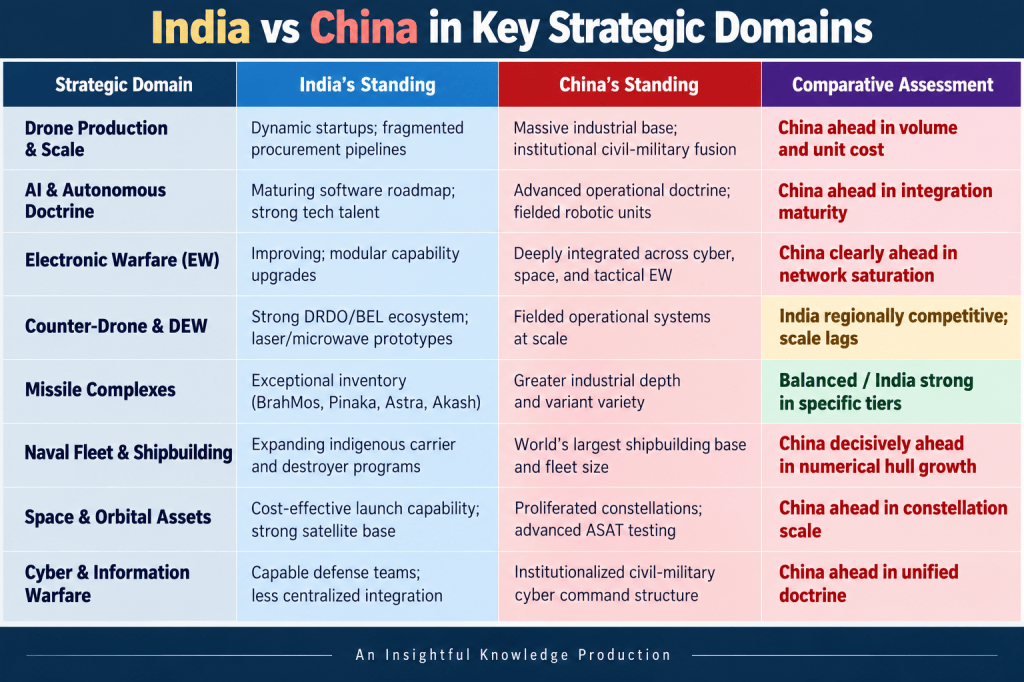
Strategic Prescription: India should avoid symmetric parity races. Instead, it must forge an asymmetric defense posture anchored in impenetrable counter-drone networks, Indian Ocean sea denial, resilient communications, low-cost precision strike, and undersea autonomy.
India’s Unmanned Ecosystem: Capability vs. Integration
India has made significant strides in expanding its uncrewed inventory through acquisitions and indigenous R&D:
- Strategic ISR: Israeli-origin Heron Mk-I/Mk-II, Searcher Mk-II, and U.S.-origin MQ-9B SeaGuardian / SkyGuardian platforms.
- Indigenous Platforms: TAPAS-BH-201 and Adani-built Drishti-10.
- Loitering Munitions: Harop, Harpy, SkyStriker, and indigenous Nagastra-1 / Nagastra-1R platforms (with ~480 units fielded by late 2024 and expanding contracts).
- Swarm Prototyping: Army 75-drone demonstration (2021) and NewSpace Research 100-drone swarm system (2023).
The Integration Deficit: Can Indian Drones Operate Together?
Partly, but not seamlessly.
While the Indian Army’s Project Sanjay (Battlefield Surveillance System) successfully aggregates ground and aerial sensor feeds into a Common Surveillance Picture over secure Army networks, it functions primarily as a sensor-fusion and situational-awareness framework rather than a universal uncrewed command architecture.
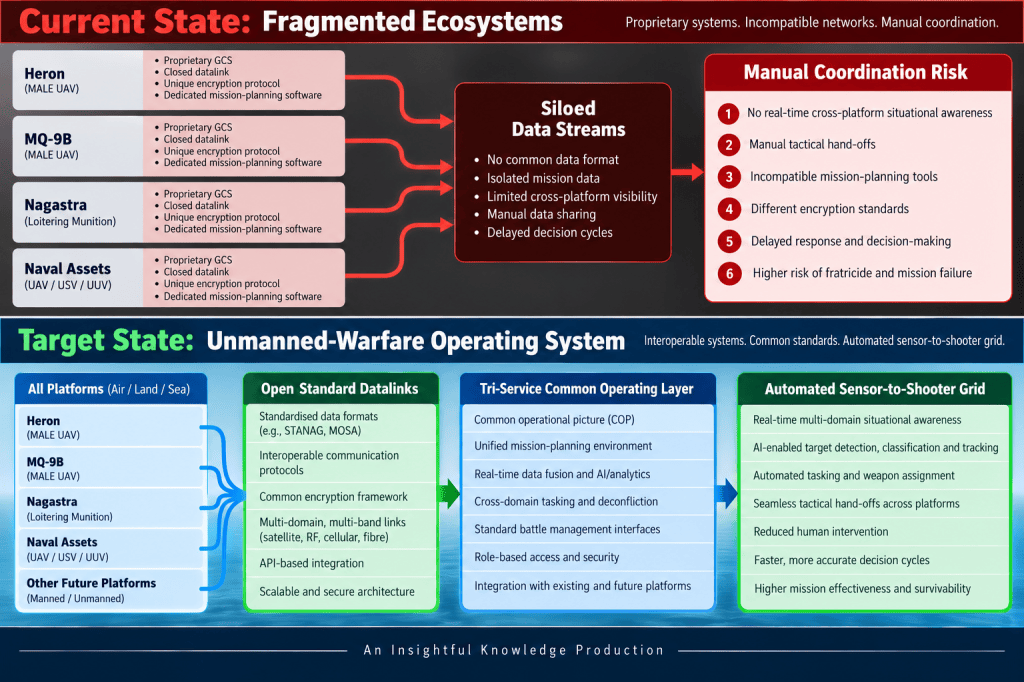
Currently, disparate platforms rely on proprietary ground-control stations, closed datalinks, distinct encryption protocols, and incompatible mission-planning software. Without mandated interoperability standards, tactical hand-offs between a Heron, an MQ-9B, a Nagastra loitering munition, and naval assets remain manually encumbered.
Critical Operational Bottlenecks
- The Software Layer: India lacks a unified Unmanned Systems Common Operating Environment—standardized target formats, open API ground-control interfaces, and cross-service cryptographic key management.
- Collaborative Swarming: While swarm demonstrations are successful, operational fleets lack standardized swarm autonomy stacks capable of dynamic task reallocation across mixed-vendor assets.
- GNSS-Denied Survivability: Tactical loitering munitions like Nagastra rely heavily on GPS guidance, creating acute vulnerabilities to electronic jamming unless hardened with onboard visual odometry, TRN, and autonomous terminal guidance.
- Network Bandwidth Constraints: Streaming raw full-motion video from dozens of drones overwhelms tactical datalinks; Edge AI is urgently required to process imagery locally and transmit concise, encrypted metadata packets.
What India Must Do Next: An Actionable Roadmap
To secure its northern and maritime frontiers against peer competitors, India must transition from platform-centric procurement to an integrated uncrewed ecosystem.
- Mandate Open Interoperability Standards: Legislate open-architecture requirements for all future military drone procurements, enforcing common datalinks, open APIs, and standardized ground-control interfaces.
- Establish a Tri-Service Unmanned Systems Command Layer: Fuse drone tracks, air-defense telemetry, artillery sensors, naval assets, and satellite feeds into a unified, cross-domain combat grid.
- Decouple ISR from Strike Nodes: Institutionalize a doctrinal separation where persistent ISR platforms continuously track targets, while attritable loitering munitions are dynamically retasked via the common operating picture.
- Enforce GNSS-Denied Testing as a Baseline Certification: Mandate that no tactical uncrewed platform be inducted without verified operational performance under heavy electronic jamming and simulated GPS/comms blackout.
- Standardize Swarm Autonomy Stacks: Develop and deploy an indigenous, hardware-agnostic autonomy software stack enabling mixed fleets of FPVs, decoys, and loitering munitions to swarm autonomously.
- Deploy Edge AI for Target Classification: Equip all tactical payloads with onboard AI chips to perform object recognition locally, conserving bandwidth by transmitting only target telemetry rather than raw video feeds.
- Scale Attritable Industrial Production: Shift procurement focus from dozens of high-end platforms to tens of thousands of low-cost, mass-producible attritable drones, interceptors, and jammers.
- Accelerate Undersea & Maritime Autonomy: Fast-track AUVs, smart seabed acoustic arrays, and uncrewed surface vessels (USVs) to establish permanent sea denial across the Indian Ocean.
- Harden Space and Cyber Infrastructure: Proliferate resilient LEO satellite constellations, establish rapid-launch orbital replacement capabilities, and deploy cyber-hardened ground control nodes.
The Bottom Line
The coming decade will not be won by the military that possesses the most expensive weapons, but by the one that can combine mass, intelligence, autonomy, survivability, and industrial power into a single, relentless fighting system. China enters this contest with formidable advantages in manufacturing scale and intelligentized warfare. India, however, possesses its own strategic assets: exceptional human capital, proven missile-engineering capabilities, a growing technological base, and decisive geographic leverage across the Indian Ocean.
India’s defining challenge is no longer merely to build better weapons. It is to make every weapon, sensor, platform, and command network fight as part of one integrated force. Attritable drones, high-end ISR platforms, loitering munitions, air-defence systems, naval assets, electronic warfare, and AI-enabled command networks must evolve from disconnected capabilities into a unified, tri-service combat ecosystem—resilient under attack, adaptive under pressure, and capable of operating when communications are degraded or denied.
The strategic choice before India is stark: integrate at scale, industrialise at speed, and prepare for the character of warfare that is coming—or risk entering the next conflict with sophisticated weapons trapped inside fragmented systems. In the decade of wars, technological excellence alone will not guarantee victory. The decisive advantage will belong to the nation that can see first, decide faster, adapt continuously, and deliver combat power at scale. India must become that nation—not tomorrow, when the next war begins, but today, before the next decade defines its place in history.


Leave a Reply