Throughout history, sovereign power has relied as much on trickery as on raw military might. A classic example is the Battle of Plassey in 1757, when Robert Clive and the British East India Company secretly secured the betrayal of Nawab Siraj-ud-Daulah by Mir Jafar. The Nawab was defeated without a real fight, handing the British decisive political control in Bengal.
From the legendary wooden horse of Troy to colonial-era conspiracies, rising empires have always masked aggressive expansion behind a facade of cooperation while exploiting internal divisions. Today, this ancient art of deception has been scaled up to a global level.
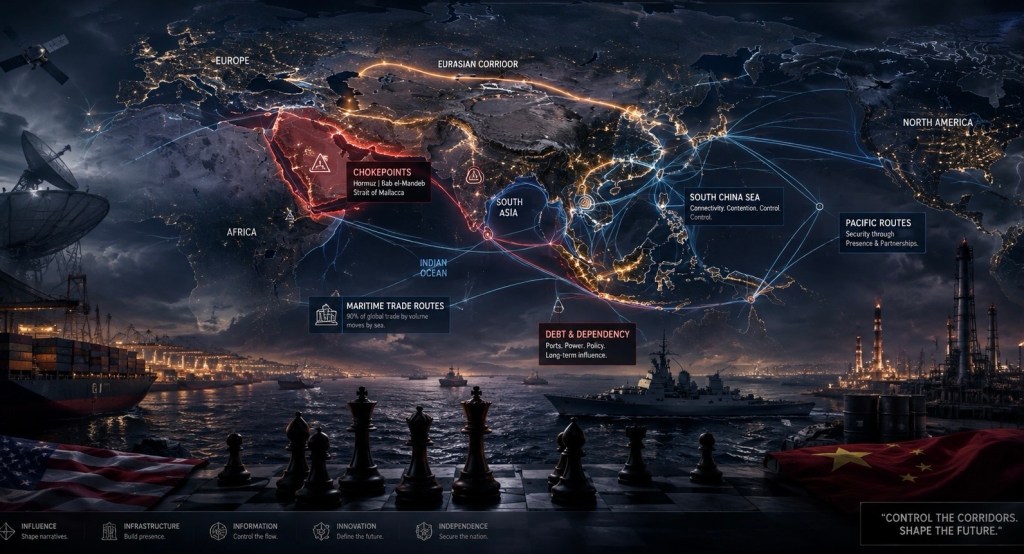
While Western powers focused on counterterrorism and domestic politics, Beijing quietly executed a multi-decade plan to dismantle American hegemony. Through diplomatic charm, economic webs, proxy conflicts, and strategic encirclement, China has applied these exact tactics against both the United States and India to reshape the world order.
Phase One: Laying the Foundations (The Pre-COVID Era)
Long before global supply chains fractured, Beijing was carefully building the scaffolding for future supremacy. Before COVID-19, Xi Jinping presented China as a reformist yet increasingly leading power. Rather than calling for a violent overthrow of the international system, Beijing argued that global rules should be reshaped to give developing countries more influence while reducing US dominance.
The Charm Offensive
In September 2015, Xi called for a “community of shared future for mankind” featuring win-win cooperation. Framed around state sovereignty and common security, this messaging presented China as an inclusive champion of multilateralism rather than a bloc-builder, successfully reassuring nations across Asia, Africa, and Latin America.
From Rule-Taker to Rule-Shaper
Abandoning past advice to keep a low profile, Beijing declared it could no longer remain a bystander. By 2017, the goal was explicit: China aimed to become a global leader in national strength and international influence by mid-century. This ambition was backed by alternative economic structures:
- The Belt and Road Initiative: Tying developing nations into web-like debt and infrastructure dependence.
- Alternative Institutions: Establishing the Asian Infrastructure Investment Bank, expanding the Shanghai Cooperation Organisation, and strengthening BRICS.
- Defending Globalization: As the United States turned toward protectionism, Xi positioned China as the primary defender of open trade and economic integration.
Early Middle East Outreach
This pre-COVID strategy included building deep ties in the Middle East. Beijing shifted from a passive energy importer to an active political player, conducting landmark presidential visits to the United Arab Emirates and securing long-term energy and infrastructure alignment with Saudi leaders.
Rhetoric Versus Reality
A massive gap separated public words from actual deeds. While China preached non-interference and shared growth, it militarized artificial islands in the South China Sea, punished trading partners with economic coercion, tightened control over Taiwan, and dismantled Hong Kong’s autonomy. The goal was never a liberal international order, but a Chinese-led system that preserved global trade for Beijing’s benefit while hollowing out US strategic primacy.
Phase Two: Exploding American Reliability and Exploiting the Middle East
Recognizing a historic shift defined by “great changes unseen in a century,” Beijing prepared its people for major shocks, warning against unforeseen “black swan” and “grey rhino” risks. Those warnings were validated by a cascade of disruptions: COVID-19, the Galwan Valley border clash with India, and rising tensions in the Middle East culminating in the 7 October 2023 Hamas attack on Israel.
The Trap Set for Washington
Beijing calculated that the brutality of the 7 October assault would force a massive Israeli military retaliation, dragging the United States deep into a West Asian quagmire. This would compel Washington to pull crucial naval strike groups, air defense systems, and intelligence resources away from the Western Pacific, effectively vacating its posture in the South China Sea.
The playbook worked perfectly. Israel struck back with full force, and the United States rushed into the trap, tethering its superpower capabilities to an endless regional crisis.
Crucially, Beijing had tried this exact trap earlier against India during the June 2020 Galwan Valley clash, hoping to provoke a disproportionate military response that would lock New Delhi into a permanent two-front distraction. Through calculated tactical restraint and strategic maturity, India avoided the trap.
Propaganda and Diplomatic Dividends
While publicly preaching neutrality, China maintained covert diplomatic, financial, and material lifelines to Iran and regional proxies. State-backed information networks simultaneously spread propaganda claiming the 7 October attack was an Israeli “false flag” operation designed to justify expansion.
The crisis severely damaged American moral credibility. While Washington offered unconditional backing to Israel, China called for a ceasefire and Palestinian statehood without condemning Hamas, winning immense popularity across the Global South. Building on its mediation of the Saudi-Iran rapprochement, Beijing framed the crisis as proof of US failure, culminating in high-level summits in Riyadh that cemented China’s role in regional security and infrastructure.
Phase Three: Transactional Multipolarity and the Mecca Pact
Years of US policy inconsistencies and transactional diplomacy eroded trust in American security guarantees, prompting regional allies to hedge their bets.
The Mecca Joint Defence Agreement
The ultimate expression of this hedging was the signing of the Mecca Joint Defence Agreement between Saudi Arabia, Türkiye, and Pakistan. Fusing Saudi financial power, Turkish drone technology, and Pakistan’s military infrastructure into an autonomous security network, the pact bypasses American command structures entirely. Though not yet an integrated “Islamic NATO,” it signals to Washington that its former partners are preparing for a post-American regional order where US protection is just one option among several.
China’s Indirect Gain and Washington’s Silence
While China is not a signatory to the Mecca pact, any blow to American prestige is an inherent win for Beijing. By encouraging independent regional security architectures outside of Washington’s control, China achieves its goal of eroding US unipolarity without spending its own resources.
Tellingly, the United States has not issued a formal public response to the pact. Analysts view this silence not as approval, but as anxious caution—recognizing that opposing the pact confirms American unreliability, while endorsing it legitimizes a security network built specifically to bypass US primacy.
Phase Four: Forcing US Adaptation and Imperial Overstretch
The consequences of this strategy forced a reckoning in Washington. With military assets continuously reallocated to the Middle East and the Red Sea, the US deterrence posture in the Western Pacific suffered severe strain.
Beijing exploited this window. With Washington distracted by West Asian wars, China accelerated its coercion in the South China Sea and tightened pressure around Taiwan, exposing the fatal flaw of the US “two-theater” defense strategy: America could no longer maintain simultaneous global dominance without severe overstretch.
Eventually, this pressure loop forced U.S. leadership to seek an accommodation, bringing Washington to the negotiating table in Beijing to manage a controlled decline of unipolar dominance.
Disruption of Key Economic Corridors: IMEC, INSTC, and the Chabahar Pivot
The cascading Middle East crisis has severely damaged international trade routes, heavily impacting India’s major connectivity projects: the India–Middle East–Europe Economic Corridor (IMEC), the International North-South Transport Corridor (INSTC), and the strategic Chabahar Port.
1. The Stalling of IMEC
Envisioned as a multimodal network connecting Mumbai to Europe through the UAE, Saudi Arabia, Jordan, and Israel, IMEC was frozen by the outbreak of regional war. Because the corridor relies entirely on regional stability and open transit through the Levant, the post-7 October conflict halted its core infrastructure integration, exposing how proxy warfare can paralyze trans-continental trade.
2. Pressures on the INSTC and Chabahar Port
Similarly, the crisis severely disrupted the 7,200-kilometer INSTC linking India to Russia and Eurasia, alongside India’s operational foothold at Iran’s Chabahar Port—the crown jewel of New Delhi’s strategy to bypass Pakistan and reach Afghanistan and Central Asia. While Red Sea and maritime bottlenecks made traditional shipping via the Suez Canal dangerous, routing trade through West Asian corridors became heavily entangled in sanctions, regional war threats, and intense geopolitical friction.
How This Immensely Benefits China
The paralysis and stagnation of IMEC, the INSTC, and Chabahar serve a massive strategic windfall to Beijing for several clear reasons:
- Elimination of Counter-Balancing Trade Routes: IMEC and Chabahar were explicitly conceptualized to offer democratic, India-led commercial alternatives to China’s Belt and Road Initiative (BRI). Their stalling preserves Beijing’s near-monopoly over Eurasian and trans-continental connectivity networks.
- Consolidation of the China-Pakistan Economic Corridor (CPEC): With India’s western land-access routes choked or bogged down by regional instability and secondary sanction risks, Pakistan’s Gwadar Port (situated just miles from Chabahar) faces diminished immediate competition, cementing the dominance of the China-Pakistan axis across regional trade.
- Forcing New Delhi Back into Defensive Isolation: By neutralizing India’s outward economic corridors, China successfully traps Indian strategic bandwidth within its immediate subcontinental borders, preventing New Delhi from projecting robust economic and political influence into Central Asia and West Asia.
The Internal Subversion Threat: Foreign Remittances, FCRA, and Subversive Networks
Beyond external encirclement and trade route strangulation, a crucial vector of the modern multi-front assault on India involves the weaponization of domestic civil society spaces through foreign funding.
Between 2019–2022, nearly 13,520 entities received staggering foreign remittances totaling approximately ₹55,741 crore under the Foreign Contribution (Regulation) Act (FCRA). This massive influx triggered intense pushback and strategic panic from Western governments, think tanks, and international philanthropic foundations when New Delhi aggressively tightened compliance rules.
Washington and European capitals heavily criticized India’s regulatory clampdown, officially framing it as a shrinking of “democratic space.” In reality, Western donor networks and foreign governments have historically used non-governmental organizations (NGOs), human rights groups, and policy advocacy entities to project soft power and steer domestic public discourse. Tighter restrictions—such as banning sub-granting, capping administrative costs, and enforcing strict transactional tracking—severely limited external actors’ ability to covertly influence internal Indian policy spaces.
Indian security and intelligence findings have long highlighted that a portion of these multi-billion-dollar foreign inflows went far beyond legitimate humanitarian work, finding its way into covert political mobilization, anti-infrastructure campaigns, and orchestrated civil unrest.
Intelligence reports indicate that foreign remittances have routinely underwritten localized disruptions, including violent resistance against major industrial projects, nuclear power plants, and economic reforms.
Coordinated information operations and financial pipelines have similarly been leveraged to stoke deep societal polarization during major civil disturbances.
By forcing all compliance through designated banking channels and criminalizing the misuse of charitable fronts for political agitation, India’s regulatory overhaul was engineered to choke off unverified money streams designed to shake the nation’s internal foundations.
Strategic Implications for India
For India, continued pressure from the US and the rise of a China-centric, multipolar order demands careful navigation.
In the Medium Term
- Two-Front Pressures: The growing security nexus between China, Pakistan, and West Asian actors creates a formidable anti-India diplomatic and military bloc.
- Maritime Exposure: Volatility in the Arabian Sea and western Indian Ocean threatens India’s energy and trade lifelines.
- Diplomatic Tightrope: New Delhi must protect its vital economic partnerships with Saudi Arabia and the UAE while preventing them from being leveraged by adversarial neighbors.
In the Long Term
- Indigenous Defense: India must rapidly scale domestic production of advanced jets, engines, and surveillance technology to eliminate reliance on shifting foreign powers.
- Maritime Leadership: Leveraging its geography, India must become the primary net security provider across the Indian Ocean through coalitions with France, Japan, Australia, and local partners.
- Strategic Autonomy: While cooperating selectively with the United States to balance China, India must maintain absolute freedom of action and avoid binding alliances.
Conclusion
Ultimately, Beijing’s long game—moving quietly from the South China Sea to the heart of the Middle East—proves that the twenty-first century is being shaped by systemic endurance, economic statecraft, and structural deception rather than open declarations of supremacy.
Beyond these visible geopolitical maneuvers, a darker dimension remains hidden: perhaps the American “deep state” is in full control, and the apparent poor leadership of the US is entirely by design. Only time will tell if this erosion of unipolarity is accidental or intentional.
Regardless, India remains a prime target. Both China and external Western networks will continue to exploit internal fault lines to constrain India’s rise. Coordinated destabilization efforts—such as weaponized farmers’ protests, engineered CAA propaganda, or artificial student unrest—will be deployed as asymmetric tools to fracture India from within. Navigating this reality requires matching strategic clarity with unmatched domestic power, absolute internal resilience, and uncompromising vigilance.


Leave a Reply