
The geopolitical landscape of the Indo-Pacific is undergoing a profound structural transformation. As intensifying great-power competition between the United States and China threatens to polarize the region into rigid, zero-sum alliances, middle powers are increasingly taking agency to shape their own strategic destinies.
Among the most significant emergent architectures is the pragmatic triangular partnership unfolding between India, Japan, and Vietnam.
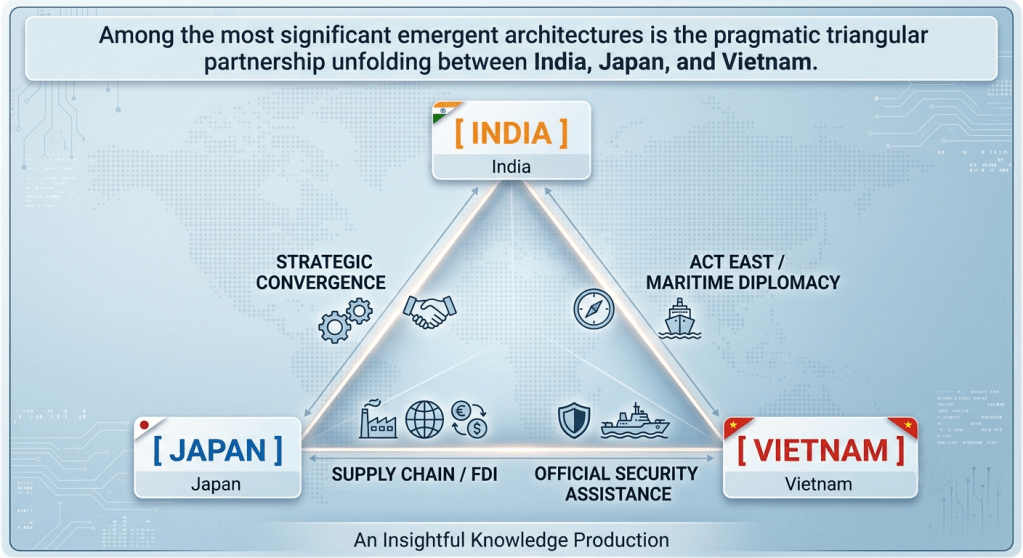
Rather than seeking to construct a formal, exclusive military bloc, New Delhi, Tokyo, and Hanoi have quietly woven a web of minilateral cooperation. This partnership strengthens regional resilience, enhances economic security, and elevates the costs of coercion—all while scrupulously respecting each nation’s deeply cherished strategic autonomy.
Through routine high-level exchanges, complementary economic integration, and differentiated defense engagement, this trio offers a compelling model for contemporary international relations: cooperation without alignment, and security through diversification.
The Core Geopolitical Philosophy: Autonomy Over Alignment
At the heart of the India-Japan-Vietnam triangle lies a shared recognition that rigid alliance politics are ill-suited to the complexities of the 21st-century Indo-Pacific. Each country brings a distinct historical legacy and a specific set of constitutional or doctrinal foreign policy constraints to the table:
- Vietnam strictly adheres to its “Four No’s” defense policy: no military alliances, no affiliating with one country to counteract another, no foreign military bases on Vietnamese territory, and no using force or threatening to use force in international relations.
- India maintains a long-standing commitment to strategic autonomy, preferring a multipolar world order where it acts as a “leading power” rather than a junior partner in a Western-led bloc.
- Japan, operating under its post-war pacifist constitution, has traditionally channeled its external security role through its alliance with the United States and its diplomatic vision of a Free and Open Indo-Pacific (FOIP).
Rather than viewing these differing frameworks as limitations, the three nations treat them as highly complementary assets. The triangle operates on the principle that regional stability is best served not by creating a counter-alliance to contain any single power, but by building up the intrinsic strength, resilience, and sovereignty of individual states.
By keeping cooperation flexible and functional, the trio minimizes the risk of provoking major-power conflict while systematically building the capacity to resist external economic or military pressure.
The Economic Engine: Capital, Capacity, and Supply Chain Resilience
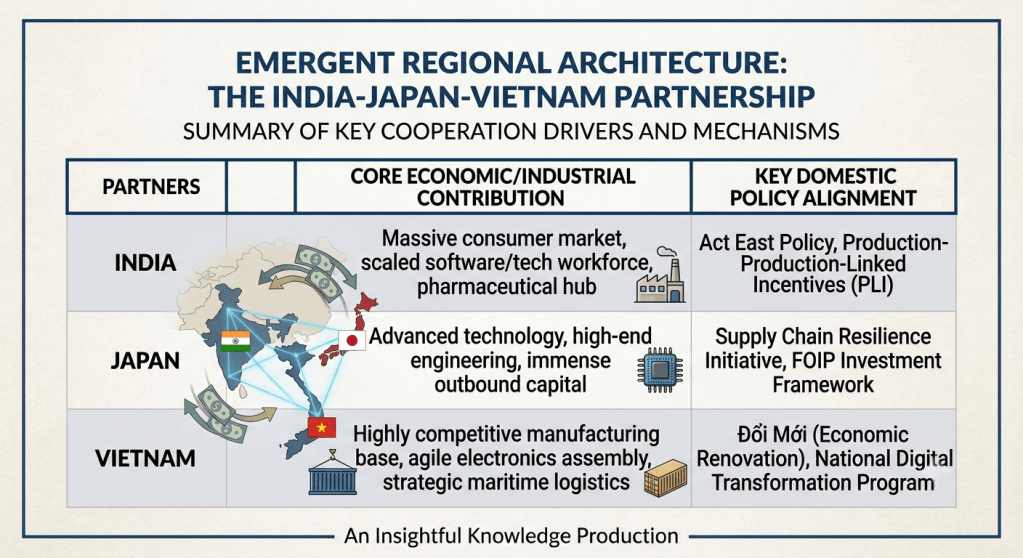
Geopolitics may provide the strategic rationale for the partnership, but economic engagement serves as its primary engine. The vulnerability of hyper-concentrated global supply chains—laid bare by recent pandemic disruptions and weaponized economic interdependence—has driven a shared imperative for diversification.
The economic synergy of the trio creates a potent, self-reinforcing production loop perfectly aligned with global “China Plus One” corporate strategies:

Japan has been a pioneer in reducing overreliance on single production markets. Through state-backed incentives for supply chain diversification, Japanese corporations have significantly expanded their footprint in Southeast Asia, with Vietnam emerging as a primary destination.
Japan’s average annual Foreign Direct Investment (FDI) in Vietnam ranges between US$6.5 billion and US$7 billion, pushing its cumulative FDI near US$78.6 billion. This capital injection is targeted at high-value sectors, including:
- Advanced electronics and semiconductor packaging
- Digital infrastructure and 5G/6G telecommunications
- Renewable energy grids and smart city technologies
- Critical mineral processing
Simultaneously, India is aggressively pursuing its own manufacturing renaissance through the Make in India initiative and targeted Production-Linked Incentive (PLI) schemes. By linking with Japanese capital and Vietnam’s highly efficient, export-oriented industrial zones, India can integrate its vast domestic market and deep pool of skilled software engineers into a broader, cross-regional production network.
The convergence of India’s Act East Policy with Japan’s investment clout and Vietnam’s competitive labor market provides global multinational corporations with a credible, high-tech, and politically stable manufacturing alternative.
Differentiated Defense Engagement and Maritime Security
In the security realm, the India-Japan-Vietnam triangle operates via a layered, non-provocative architecture. Cooperation is meticulously calibrated to enhance maritime domain awareness (MDA) and defensive capacity without triggering regional security dilemmas.
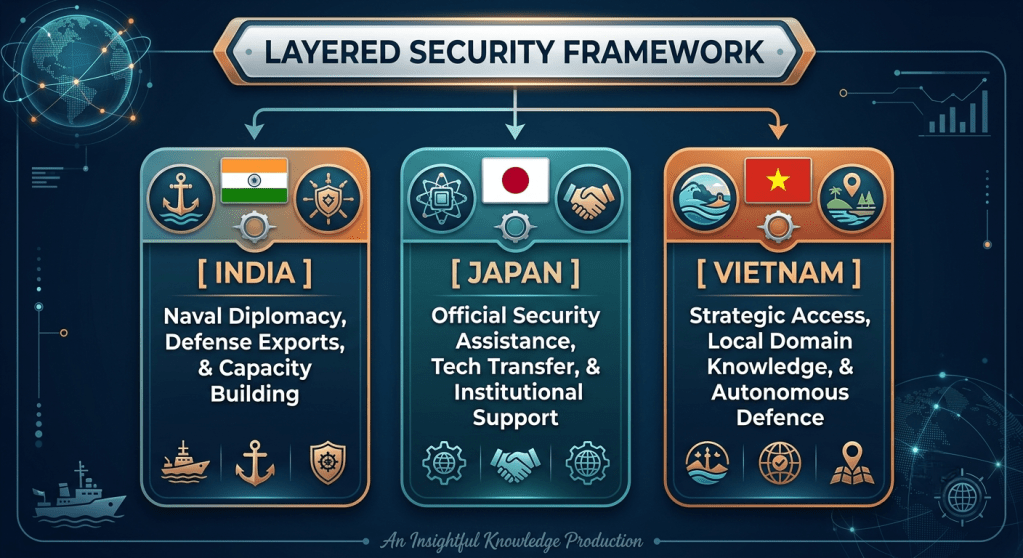
India’s contributions are heavily focused on naval diplomacy and capacity building. As a net security provider in the Indian Ocean, New Delhi has steadily extended its strategic reach into the Western Pacific.
The Indian Navy routinely conducts joint maritime exercises with Vietnam, performs goodwill port calls at strategic locations like Cam Ranh Bay, and offers advanced training programs for Vietnamese sailors in submarine operations and Su-30 fighter jet maintenance. India could also extend the Airbus C-295 MRO facility to Vietnam.
Furthermore, India has emerged as a key defense exporter to Hanoi, offering soft-loan defense lines of credit to fund the procurement of high-speed patrol boats and transferring naval assets, such as the active-duty missile corvette INS Kirpan, to the Vietnam People’s Navy.
Japan complements India’s operational diplomacy by providing long-term institutional support and cutting-edge hardware. Through its newly established Official Security Assistance (OSA) framework, Tokyo is legally empowered to provide defense equipment and infrastructure aid to the armed forces of like-minded developing nations.
For Vietnam, this has materialized in the provision of advanced multi-role maritime patrol vessels for the Vietnamese Coast Guard, radar surveillance systems, and cybersecurity capacity-building initiatives. Japan’s role focuses on making Vietnam’s maritime borders “transparent,” ensuring that attempts at revisionism or coercion can be detected and publicized in real time.
Vietnam provides the vital geopolitical anchor for this maritime cooperative framework. Holding a pivotal geographic position along the critical sea lanes of communication (SLOCs) in the South China Sea, Hanoi offers its partners unparalleled regional insight and localized maritime expertise.
By engaging simultaneously with New Delhi and Tokyo, Vietnam avoids over-dependence on any single external patron, effectively using the triangle to insulate its sovereign maritime claims under the United Nations Convention on the Law of the Sea (UNCLOS).
Institutional Trust and Multilateral Synchronization
The long-term viability of this triangular relationship is guaranteed by a deep repository of historical trust and institutional synchronization. Unlike transactional partnerships that shift with political winds, the ties between these three states are rooted in decades of steady, reliable diplomatic alignment.
Japan’s relationship with Vietnam has matured over more than half a century, transitioning from early post-war economic re-engagement following Vietnam’s Đổi Mới reforms in 1986 to a “Comprehensive Strategic Partnership for Peace and Prosperity in Asia and the World.” Japan has consistently respected Hanoi’s political system and independent foreign policy, earning immense goodwill among the Vietnamese leadership and public alike.
Indian and Southeast Asian trade links, including with early Vietnam, were active by the late centuries BCE, carrying goods, ideas, and cultural influences across maritime routes. These contacts later helped spread Buddhism and other Indian cultural elements into Vietnam, laying the foundation for a long civilizational relationship.
Similarly, India and Vietnam share history of mutual support during anti-colonial struggles and the Cold War. This historical rapport gives New Delhi unique political access and depth in Hanoi.
Economic Security as National Security: The Tech and Minerals Frontier
In the modern strategic landscape, the boundary between national security and economic policy has entirely dissolved. The India-Japan-Vietnam triangle has swiftly adapted to this reality by expanding its remit into emerging technologies, critical mineral supply chains, and green energy infrastructure.

The global scramble to secure microchip pipelines has made semiconductor cooperation a priority for the trio. Japan possesses world-leading semiconductor manufacturing equipment and chemical inputs; India offers a massive chip-design talent pool and state-subsidized fabrication initiatives; Vietnam has rapidly scaled its domestic packaging, testing, and assembly capacities. By interconnecting these distinct segments, the three countries are building a reliable, high-tech semiconductor ecosystem that reduces vulnerabilities to supply shocks.
A similar logic governs cooperation in critical minerals and renewable energy. Vietnam holds some of the world’s largest unexploited reserves of rare earth elements (3.5 million tonnes), which are indispensable for electronics, defense systems, and electric vehicle motors.
Japanese capital and processing expertise, combined with Indian industrial demand, present an opportunity to develop alternative rare earth supply chains outside monopolistic markets. Furthermore, joint ventures in solar power arrays, offshore wind infrastructure, and green hydrogen technology are actively transforming the energy landscape of Southeast Asia, turning green transitions into a shared engine for economic resilience.
The Blueprint for Contemporary Middle-Power Geopolitics
The evolution of the India-Japan-Vietnam triangle over five decades offers a masterful template for how middle powers can proactively shape the regional order. It disproves the fatalistic notion that smaller or medium-sized states must inevitably choose a side in a bipolar world.
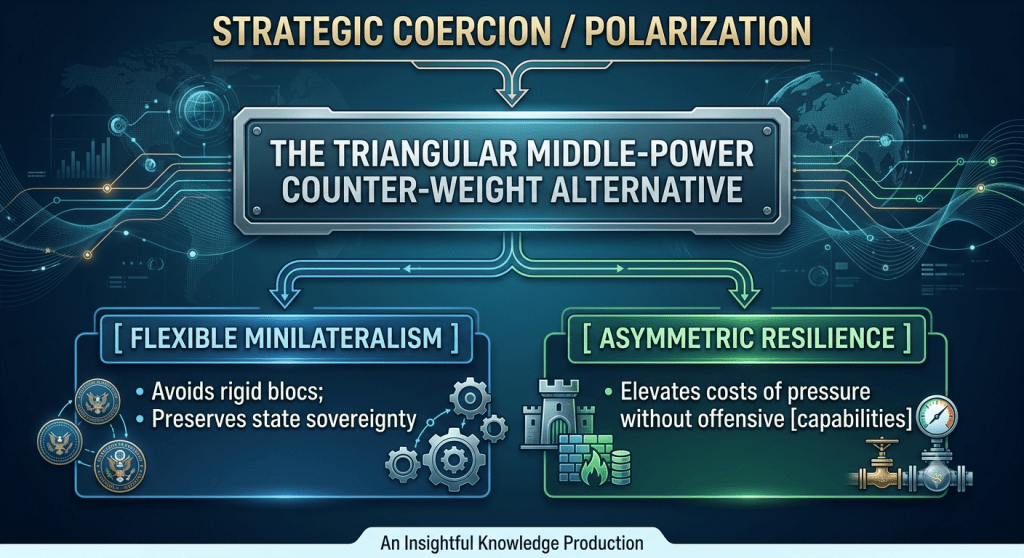
For Vietnam, the triangle serves as a vital strategic shield, reinforcing its national resilience and defense posture without compromising its strict non-alignment. For India, the partnership provides a concrete economic and security anchor in Southeast Asia, turning its “Act East” oratory into tangible, cross-regional influence. For Japan, it advances its vision of a stabilized, diversified, and legally grounded Indo-Pacific maritime commons while respecting the unique political constraints of its partners.
Ultimately, India’s commitment to the India-Japan-Vietnam triangle represents a sophisticated exercise in modern statecraft: the cultivation of practical, high-impact capabilities with trusted partners over the hollow posturing of provocative pacts. By seamlessly blending supply-chain de-risking, high-end technological integration, and robust maritime domain awareness, this minilateral architecture reinforces New Delhi’s strategic autonomy rather than compromising it. Moreover, it serves as a powerful diplomatic force multiplier. When synchronized with India’s wider regional outreach to anchors like Indonesia, Australia, and New Zealand, the triangle weaves a resilient, overlapping web of partnerships across Southeast Asia and Australasia. This decentralized approach systematically expands Indian influence without the rigid constraints of formal alignment.
In an era defined by intensifying systemic friction, this network provides India with the tangible leverage required to safeguard vital trade routes, anchor global investment, and champion a rules-based order. By translating shared principles of sovereignty and international law into concrete security and economic resilience, India is not merely adapting to the Indo-Pacific’s shifting dynamics—it is actively shaping a stable, multipolar future tailored to its long-term national interests.


Leave a Reply