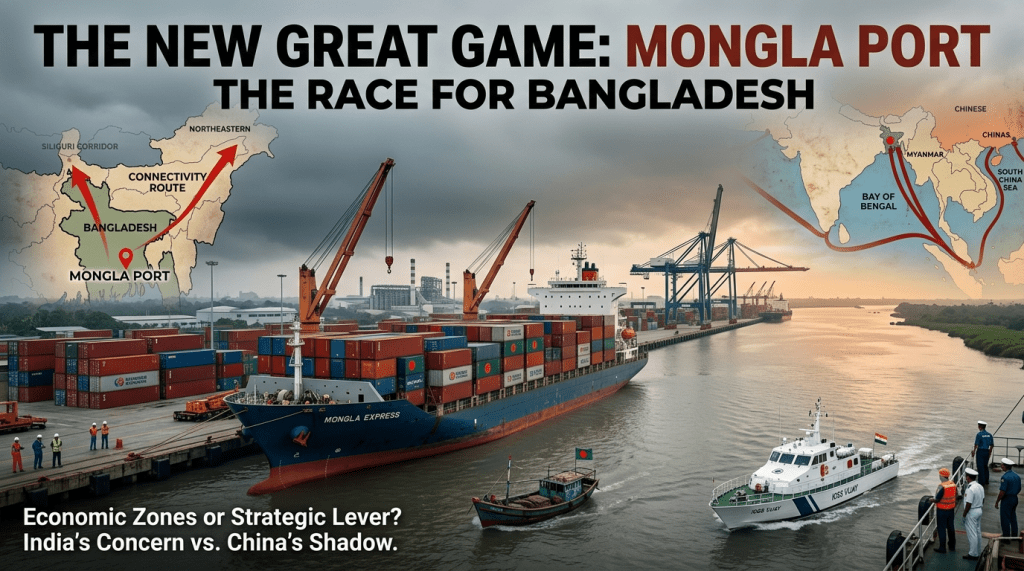
Bangladesh’s recent decision to hand over the development of an economic zone near Mongla Port to a Chinese state-owned firm is more than an infrastructure story. It is a reminder that in the Indian subcontinent, ports, rail lines, power plants, and industrial zones are never just commercial assets. They are also instruments of influence, leverage, and long-term strategic positioning. For India, the Mongla deal is especially sensitive because the site was originally intended for an Indian-backed venture. That shift is not merely symbolic. It reflects a broader transformation in Bangladesh’s external alignment and a growing contest for influence in India’s eastern neighborhood.
At one level, Bangladesh is simply behaving like any rational state with scarce capital and large development needs. It is looking for the fastest, cheapest, and most politically useful way to build infrastructure. At another level, however, the pattern is unmistakable: Dhaka is using great-power competition to maximize its gains, while the major powers are using Bangladesh to deepen their own strategic footprint. That is why the Mongla case matters far beyond Bagerhat district. It sits at the intersection of economics, security, diplomacy, and the balance of power in the Bay of Bengal.

Bangladesh’s geography explains why it is suddenly so central. The country lies on the frontier between South Asia and Southeast Asia, with a long coastline on the Bay of Bengal and a land border that places it directly beside India’s vulnerable eastern flank. It is also the key geographical bridge between mainland India and the northeastern states. Any serious plan for Indian connectivity to the Northeast, regional trade, or even border stability must pass through Bangladesh in some form. That makes Bangladesh valuable not only to India, but also to China, the United States, Japan, and other outside powers.
The Infrastructure Game and Regional Anxieties
Mongla itself is strategically important because it is Bangladesh’s second-largest seaport. Ports are never just about cargo throughput; they are nodes in a larger logistics and intelligence network. A modern port zone can support warehousing, transport corridors, communications systems, customs data flows, and maritime coordination. In the best case, it boosts trade. In the worst case, it can create dual-use capabilities that serve foreign influence well beyond the commercial sphere.
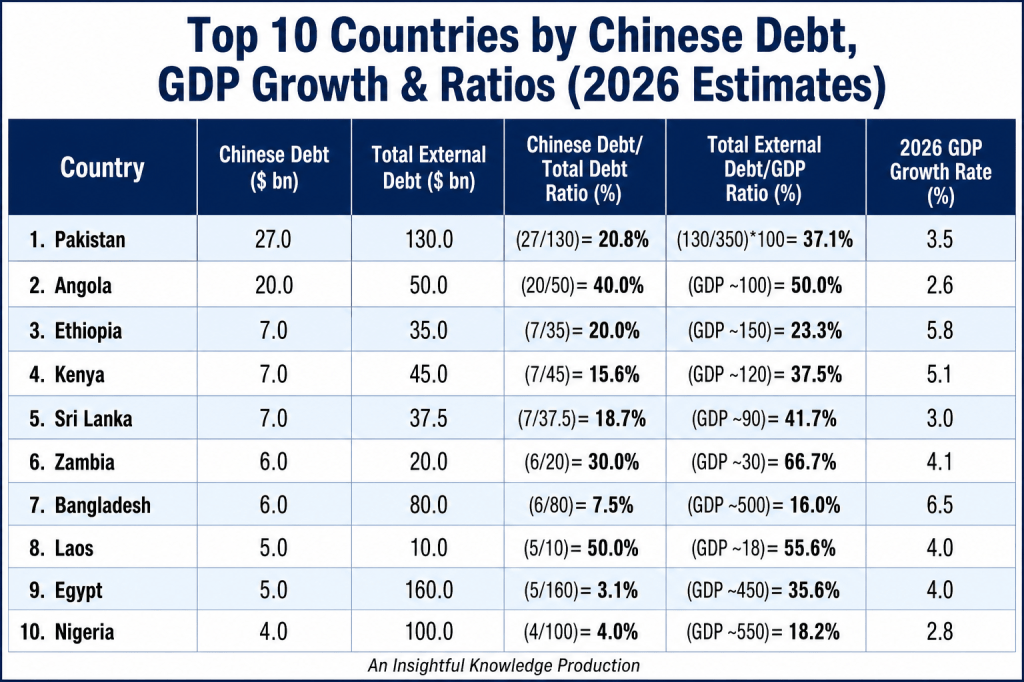
That is the source of India’s concern. The fear is not that every Chinese-built port or economic zone will instantly become a military facility. The more serious worry is subtler. Chinese state-owned firms, especially when paired with financing, construction, and long-term operational access, can create an ecosystem of dependence. Over time, that ecosystem can provide access, visibility, and leverage in a strategic area close to India’s eastern security environment. Mongla sits near enough to matter, especially when viewed in tandem with the broader Chinese footprint in the Bay of Bengal and India’s northeastern neighborhood.
India’s anxiety is further heightened by the fact that the Mongla project was once linked to an Indian-backed plan. Interestingly, while the project was approved in 2018, the appointment of a consultant dragged on until 2022 due to stringent criteria imposed by Bangladesh—a timeline that dismantles the notion that Sheikh Hasina hurried through all Indian proposals. Ultimately, the venture earmarked for an Indian firm was reassigned to a Chinese competitor. This shift matters because it signals more than just a lost contract for India; it represents a loss of momentum. In strategic competition, disrupted timelines are rarely neutral. They create a vacuum, and someone else inevitably fills it. In this instance, China stepped directly into a space that India failed to occupy decisively.
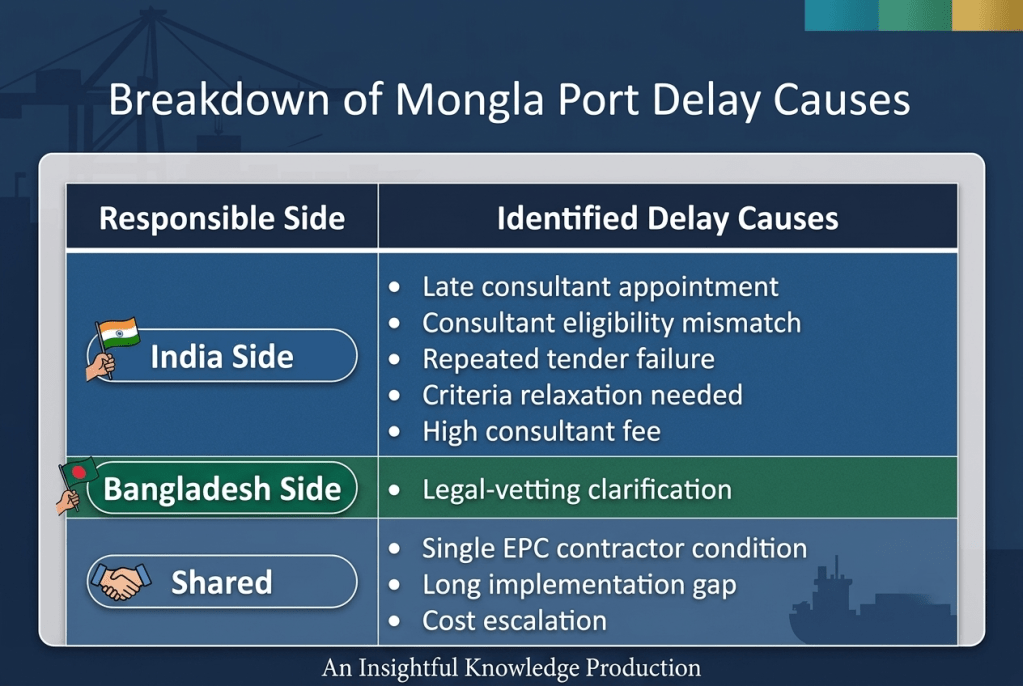
This is not the only Indian-backed project in Bangladesh to stall or be dropped. Reports highlight other delayed or delisted Indian economic zone plans—particularly in Mirsarai—alongside a range of transport and connectivity initiatives that have progressed far slower than anticipated. Rail lines, port access infrastructure, and broader logistics schemes frequently suffer from bureaucratic delays, financing bottlenecks, and weak implementation. These setbacks matter because infrastructure is more than just plans on paper; in the real world, delivery builds trust, whereas delay destroys it.
Competing Interests in the Bay of Bengal
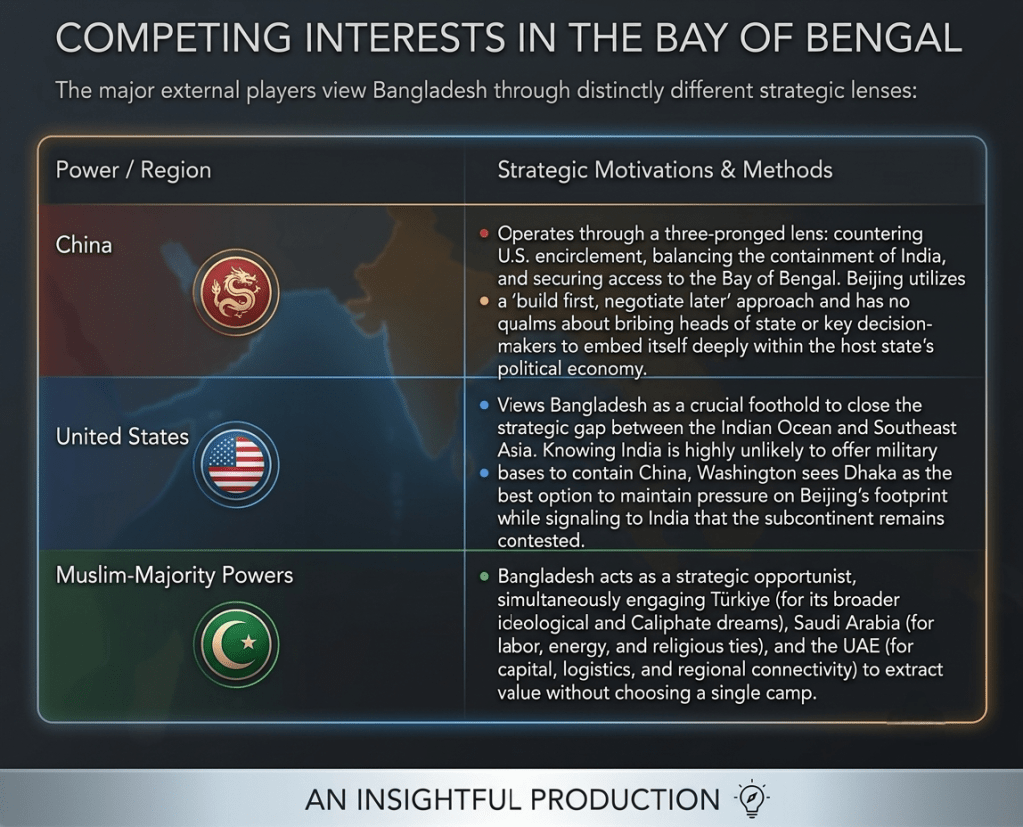
Bangladesh is not just another market or development partner. It is a strategic hinge that can prevent any single power from dominating the region. By deepening its presence there, the U.S. can maintain pressure on China’s expanding footprint while also signaling to India that the subcontinent will remain contested, not comfortably settled.
India should be careful, however, not to overstate the military dimensions in a way that becomes counterproductive. Not every Chinese-built bridge, zone, or port is a covert base. But it would be equally naïve to assume that such projects are politically neutral. In the modern era, infrastructure is power. Ports affect access. Economic zones affect dependence. Connectivity projects affect choices. If a country can shape the flow of goods, credit, data, and logistics in its neighborhood, it also shapes the strategic environment.
The Balancing Act and Future Implications
Bangladesh is exploiting this competition skillfully. It is not passive. It is using rival interest from India, China, the U.S., Japan, and the Muslim world to bargain harder for better terms. But there is a darker side to this strategy. Great-power competition can deliver gains in the short term, but it can also create overdependence in the long term. Chinese loans and Chinese-built infrastructure are often criticized for producing debt distress, reduced policy freedom, and strategic vulnerability. The core concern is real: when a weaker economy borrows too heavily, especially for large projects tied to one external power, it can lose bargaining leverage. Debt does not always lead to asset seizure, but it can still constrain sovereignty through repayment pressure and political dependence.
That is why Bangladesh has to be careful. It may be able to extract good deals today, but if its external portfolio becomes too heavily weighted toward one power, it risks narrowing its own strategic autonomy tomorrow. The smartest version of Bangladesh’s current strategy is diversification, not dependence. That means keeping China engaged, but also preserving space for India, Japan, the United States, and the Middle Eastern powers.
The regional context makes this even more important. Myanmar’s instability has turned India’s eastern neighborhood into an even more volatile space. Civil conflict, border spillovers, refugee pressures, and disrupted transit routes all increase the importance of Bangladesh as a stable buffer and connector. For India, Myanmar’s chaos makes Bangladesh more valuable than ever as an alternative route to the Northeast and as a partner in managing regional security. For China, instability in Myanmar only increases the attraction of Bangladesh as a second line of access to the Bay of Bengal. The result is a sharper geopolitical contest around a country that can no longer be treated as peripheral.
The U.S.-China rivalry also magnifies Bangladesh’s importance. As Washington seeks to preserve a favorable balance in the Indo-Pacific and Beijing seeks to expand its economic and strategic reach, countries like Bangladesh become arenas of competition. India is not simply watching from the sidelines. It must navigate between maintaining its own strategic autonomy and preventing an adverse shift in its immediate neighborhood. That is not easy. But it is necessary. Elevating the Indian High Commissioner to Bangladesh, Dinesh Trivedi, to the rank of a Union Cabinet Minister, India has made its intentions clear.
A Prescription for Indian Diplomacy
To effectively counter these shifts, India must match its strategic anxieties with practical, decisive action:
- Become a Superior Project-Delivery State: Prove that Indian-backed projects do not stall for years by providing faster approvals, more reliable financing, better coordination, and fewer missed deadlines.
- Broaden Institutional Engagement: Build a wider spectrum of relationships and institutional links in Dhaka that survive elections, leadership changes, and short-term political turbulence.
- Foster Minilateral Alternatives: Work closely with the UAE, Saudi Arabia, Japan, and the United States to offer Bangladesh viable alternatives to Chinese capital. Dhaka must remain aware of its Chinese dependence, and Türkiye is not a viable long-term solution.
- Enhance Maritime Domain Awareness: Strengthen surveillance and coastal coordination in the Bay of Bengal. India should watch carefully and prepare quietly; vigilance is necessary, but alarmism is counterproductive.
- Treat Bangladesh as an Active Player: Make them realize that while Bangladesh will not be an Indian pawn, its diplomatic missteps could inadvertently turn it into a Chinese or Turkish pawn. Goodwill alone is no longer enough—in a competitive region, only consistent delivery sustains influence.
Mongla is therefore not just a port story. It is a test of whether India can match strategic concern with practical action. While India is currently unable to resolve the issues surrounding Mongla, an even larger concern is emerging on the horizon—China undertaking the multi-billion-dollar Teesta River Comprehensive Management and Restoration Project just 60 km from the northeast border. Therefore, if India is proactive, it will remain the natural partner for Bangladesh. If it cannot, others will keep moving into the space it leaves behind.


Leave a Reply