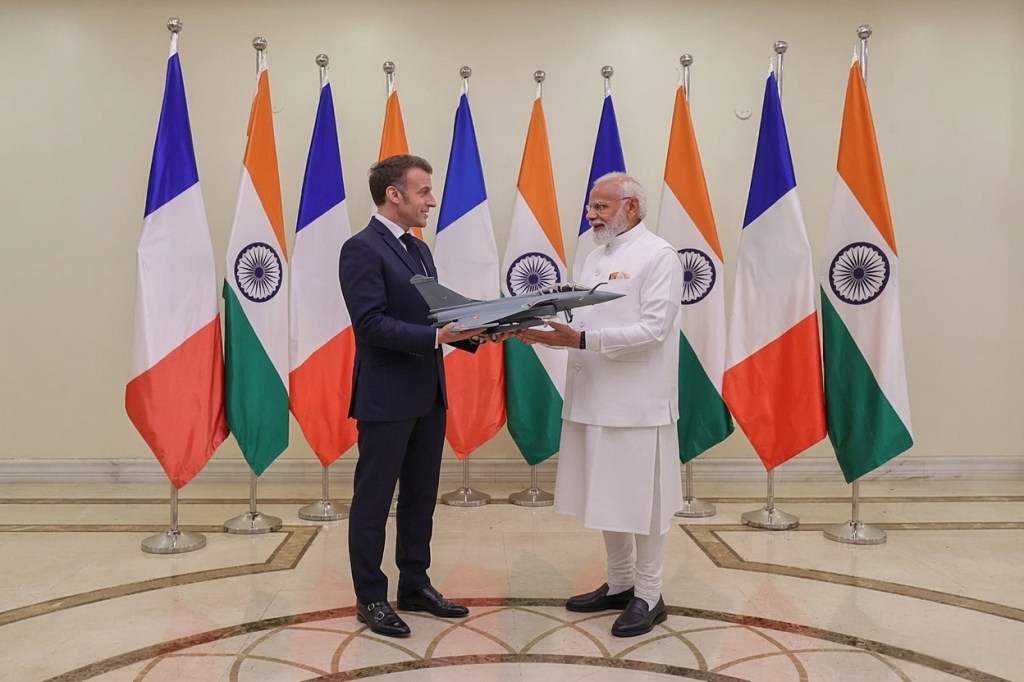
In one of the largest defense procurements in modern military history, New Delhi has formally set wheels in motion to acquire ‘114 Rafale multi-role fighter aircraft (MRFA)’ for the Indian Air Force (IAF). Valued at approximately $34 billion (₹3.25 trillion), this mega-deal represents a tectonic shift in South Asian geopolitics.
The defense ministry has officially issued its Letter of Request (LoR) to Paris, triggering a government-to-government negotiation process. Moving far beyond a standard buyer-seller agreement, this procurement marks a transformative leap for India’s “Make in India” initiative and fundamentally recalibrates the balance of airpower against China and Pakistan.
Bolstering the IAF: Plugging the Squadron Crisis
The Indian Air Force faces a structural numbers crisis. Authorized to operate 42 combat squadrons to effectively counter a two-front war scenario, the IAF’s active strength has plummeted to roughly 29-30 squadrons due to the progressive retirement of aging Soviet-era MiG-21s and MiG-27s.
The addition of 114 modern Rafales—consisting of 88 single-seat and 26 twin-seat variants—directly resolves this capability gap.
Performance and Combat Heritage
Is it a good aircraft? Military analysts universally rank the Rafale as arguably the most versatile, battle-tested 4.5-generation fighter in production. The twin-engine, delta-wing aircraft features an Omnirole design, meaning it can execute distinct missions—air defense, deep precision strike, nuclear deterrence, and anti-ship warfare—during a single sortie.
The platform has established a formidable operational reputation in Indian service. Following the Pahalgam terror attack, the Rafale served as the operational anchor for Operation Sindoor, executing highly precise strikes against hostile positions using advanced SCALP deep-strike cruise missiles and HAMMER precision-guided munitions.
Strategic Recalibration: China and Pakistan
1. The Threat Matrix: Counters to China’s Mass
The principal strategic driver behind this procurement is China’s massive aviation expansion along the Line of Actual Control (LAC). While China fields high volumes of Chengdu J-20 stealth fighters and Shenyang J-16s, the Rafale acts as a severe asymmetric equalizer.
Weapon Advantage: The Rafale’s integration of the Meteor Beyond-Visual-Range Air-to-Air Missile (BVRAAM) fundamentally alters aerial engagement dynamics. With a ramjet-powered no-escape zone exceeding 100-150 km, the Meteor outranges standard Chinese air-to-air missiles, allowing the IAF to lock onto and threaten hostile aircraft well before entering their engagement envelope.
Sensor Fusion: Driven by the RBE2 Active Electronically Scanned Array (AESA) radar and the SPECTRA internal electronic warfare suite, the Rafale can operate dynamically in highly contested, dense anti-access/area-denial (A2/AD) environments, hunting targets while suppressing enemy ground-based air defences.
2. The Impact on Pakistan
Pakistan’s defense establishment has viewed the expanding Indian Rafale fleet with immense urgency. Unable to match India’s defence spending power, Islamabad has increasingly turned to Beijing, aggressively negotiating to acquire more ‘Chengdu J-10CE’ fighters and plotting paths for the 5th-generation J-35. However, the Rafale’s vastly superior payload capacity, advanced electronic countermeasure suites, and combat-proven track record preserve a decisive technical edge for the IAF across the western border.
Evaluating the Deal: Costs, Equivalents, and “Make in India”
Is it a good deal? The staggering price tag of up to $34 billion understandably draws scrutiny. However, looking closely at how the procurement is structured reveals its long-term economic and operational value:
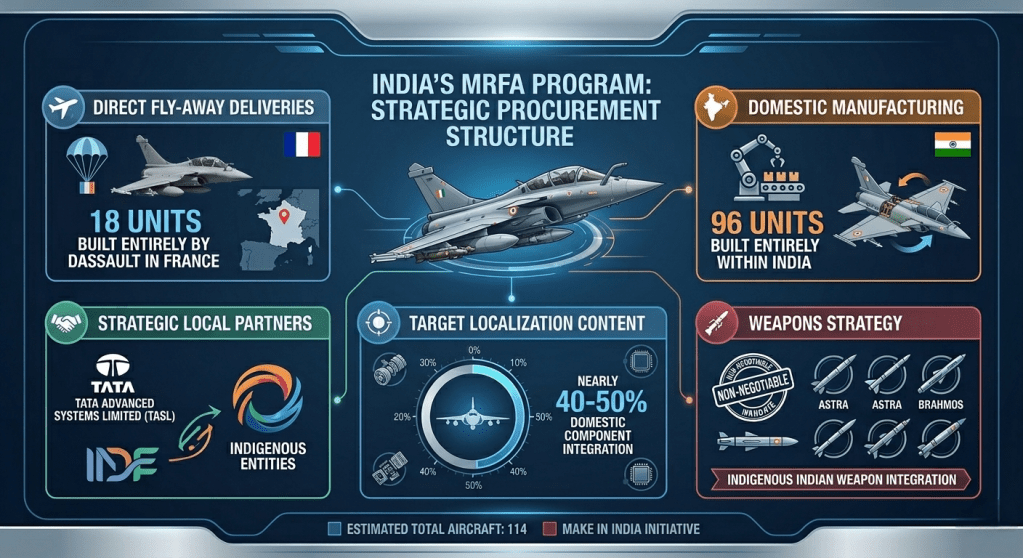
This deal effectively transitions India from a foreign client to a major advanced manufacturing hub. Massive domestic infrastructure steps are already underway. The joint enterprise ‘Dassault Aviation Maintenance, Repair and Overhaul India (DAMROI)’ is operational near Noida to handle lifecycle support, while Tata and Dassault are setting up facilities in Hyderabad to construct major sub-assemblies like the Rafale fuselage.
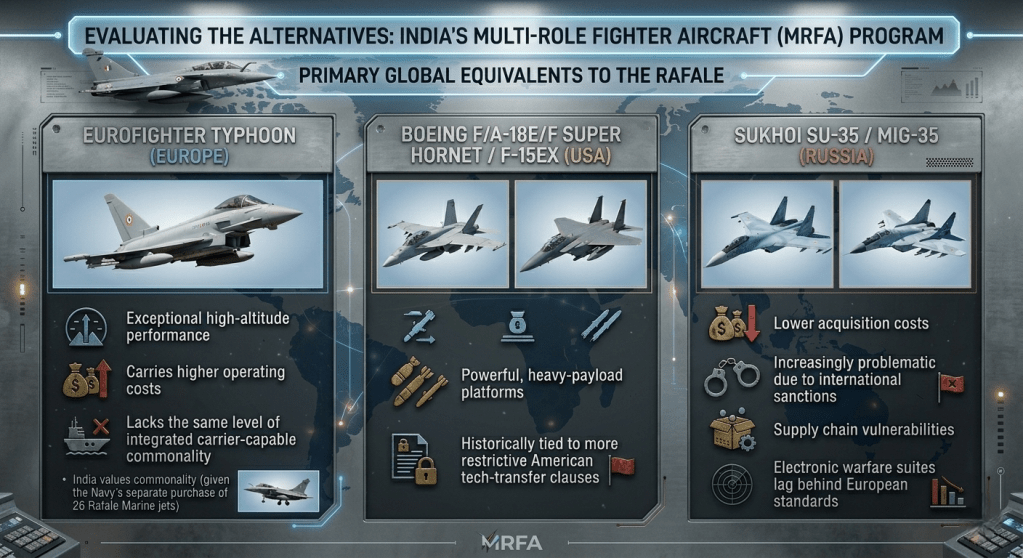
Peer Competitors
The MRFA program originally evaluated several international aircraft. The primary global equivalents to the Rafale include:
The Strategic Pivot: Indigenous Weapon Integration & Sovereignty
The overarching value of the 114-Rafale MRFA program hinges on a critical, non-negotiable stipulation New Delhi has embedded within the formal Letter of Request (LoR) sent to Paris: the complete structural integration of India’s homegrown weapon systems onto the French platform.
In past defense procurements, buying a foreign fighter jet meant locking the military into a closed, proprietary ecosystem. An air force was forced to buy expensive foreign missiles for the lifetime of that aircraft because the original manufacturer held the keys to the mission computer. For the 114-Rafale deal, India is breaking that cycle, turning a formidable weapon system into an open architecture platform for domestic arms.
The Weapon Stack: Upgrading the Punch
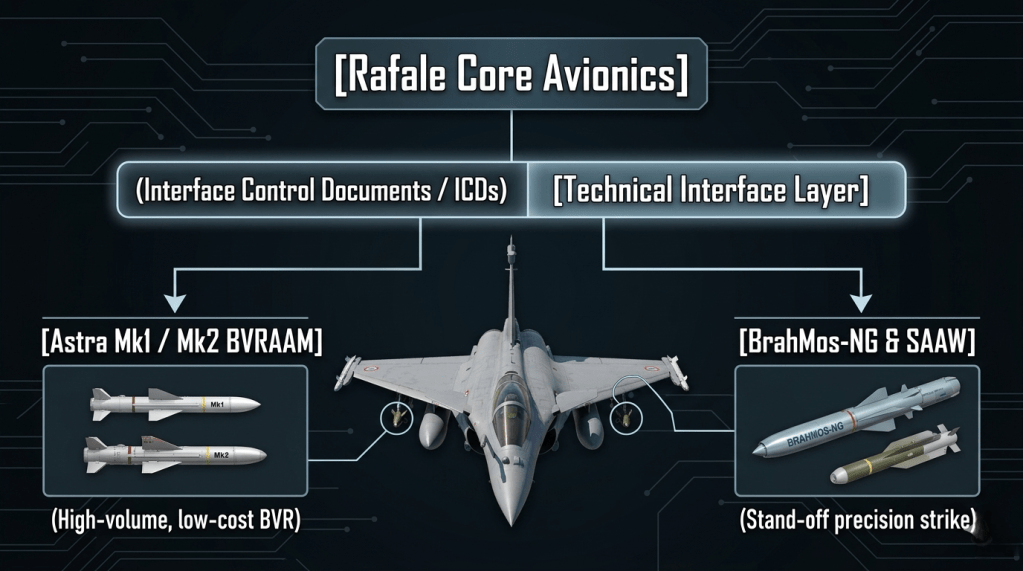
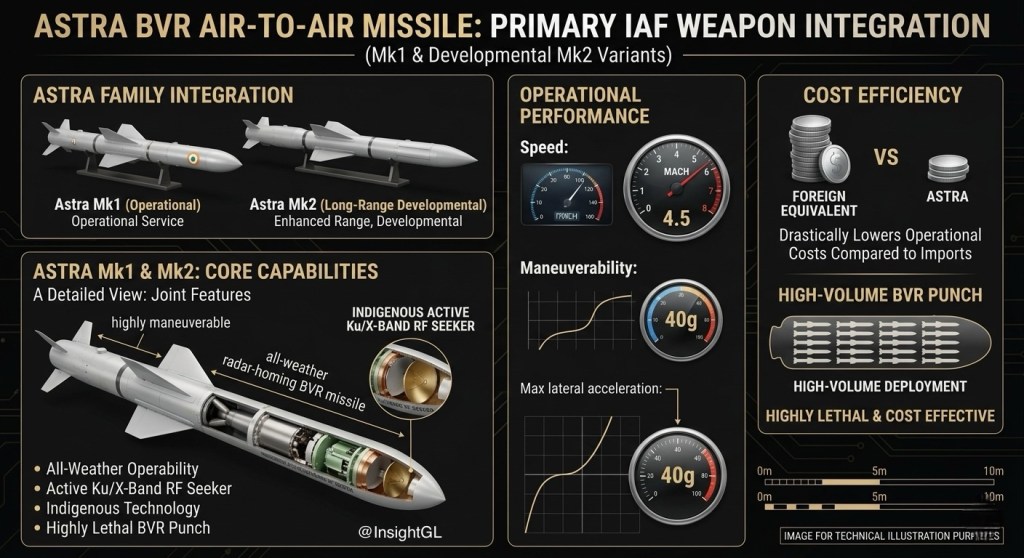
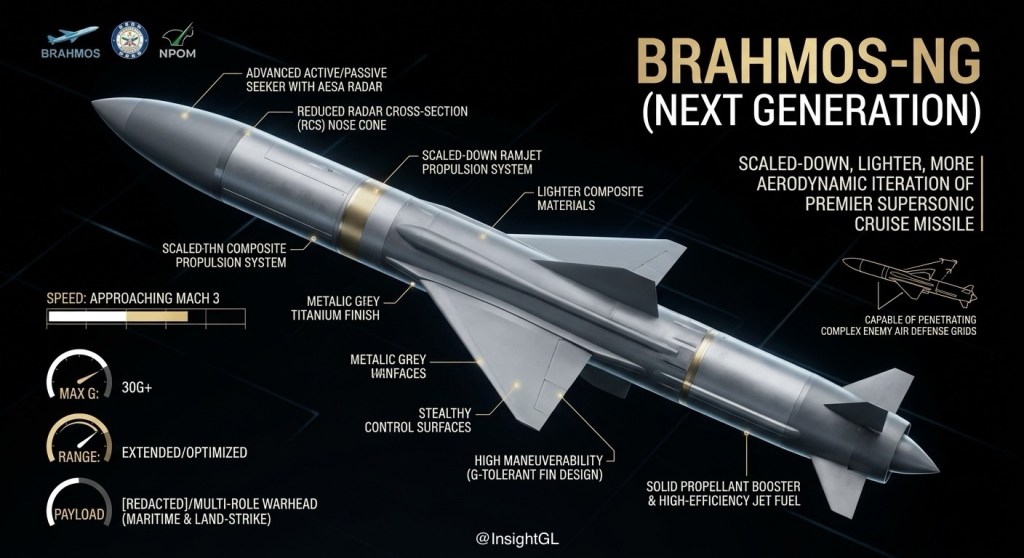
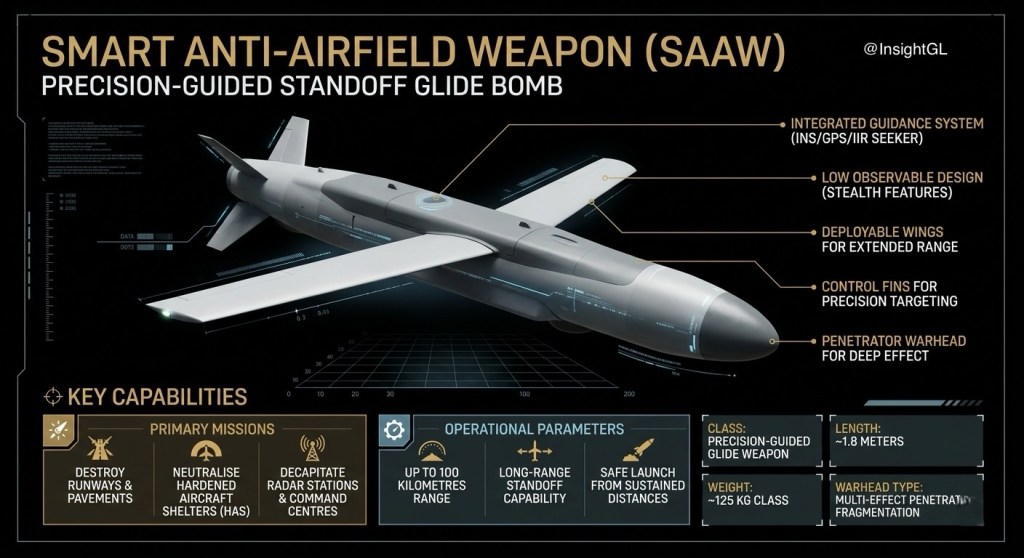
While the European Meteor and SCALP missiles provide unparalleled premium performance, they cost millions of dollars per shot. For high-intensity, sustained combat operations against a two-front threat, the IAF needs a deep, cost-effective magazine of highly capable domestic munitions:
Sovereignty via Technical Access: The ICD Solution
A common hurdle in integrating domestic weapons on Western fighters is the vendor’s refusal to share source codes. Dassault Aviation, safeguarding its intellectual property, does not surrender the internal software code of the Rafale.
To bypass this without compromising operational sovereignty, India’s defense negotiators have conditioned the deal on the delivery of Interface Control Documents (ICDs) and specific technical interface arrangements.
How it works: Instead of letting Indian engineers rewrite the Rafale’s master software code, an ICD provides a clear, documented “communication bridge” or digital map. It tells the Indian weapons team exactly how the Rafale’s mission computer expects data to look. This allows the DRDO to write companion software that translates the language of an Indian Astra missile or a BrahMos-NG into data packets the French radar and mission system can immediately understand, track, and fire.
Economic and Export Long-Game
This integration policy creates two massive distinct advantages for India’s defense industry:
1. Strategic Autonomy in Conflict: In a prolonged war scenario, foreign stockpiles can dry up quickly, and supplier nations can enforce sudden export blocks or delivery delays. By clearing domestic missiles for the Rafale, the IAF ensures that its primary strike fleet can be fully replenished directly from Indian factories during an emergency.
2. Opening Global Export Paths: Once Dassault and India successfully certify the Astra and other indigenous weapons on the Rafale airframe, it fundamentally shifts India’s export potential. New Delhi can pitch its highly competitive, cost-effective missile suites to other global Rafale operators (such as Egypt, the UAE, Qatar, Greece, and Indonesia), transforming India into an international tier-1 subsystem supplier.
The Stealth Question: 4.5 Gen vs. 5th Gen Reality
A prominent debate surrounding this deal is whether investing billions into a 4.5-generation fighter makes sense in an era increasingly dominated by 5th-generation stealth aircraft like the American F-35 or Chinese J-20.
While stealth geometry and radar-absorbent coatings offer tremendous first-day-of-war survival benefits, they come with debilitating real-world trade-offs:
Extreme Maintenance Logistics: Stealth aircraft require temperature-controlled hangars and specialized labor to maintain radar-absorbent skins. A single scratch or skin tear can compromise the entire radar cross-section (RCS). This severely limits their operational sortie generation rates in rugged or forward-deployed environments.
Payload Limitations: To maintain a stealth profile, 5th-generation jets must carry all fuel and weapons internally. This limits their strike capacity. Once a stealth jet mounts external fuel tanks or heavy missiles on its wings, its stealth profile vanishes, effectively turning it into a highly expensive 4.5-generation fighter.
The 4.5-Gen Advantage
A highly advanced 4.5-generation platform like the Rafale presents a highly pragmatic counterstrategy:
The “Missile Truck” Philosophy: The Rafale boasts an astonishing max takeoff weight of 24.5 tonnes, allowing it to carry up to 9.5 tonnes of external payloads. It can carry heavy, long-range cruise missiles, anti-ship ordnance, and massive fuel drops simultaneously—something an F-35 cannot do internally.
Furthermore, using its highly sensitive passive sensors (Optronique Secteur Frontal) and electronic jamming suites, the Rafale can detect and counter threats without relying solely on geometric stealth, operating at a fraction of the hourly maintenance cost and maintaining an incredibly high daily sortie rate.
Future Horizons: The F4/F5 Upgrades and AMCA
This 114-jet purchase is not a static acquisition; it links directly into France’s long-term modernization roadmap.
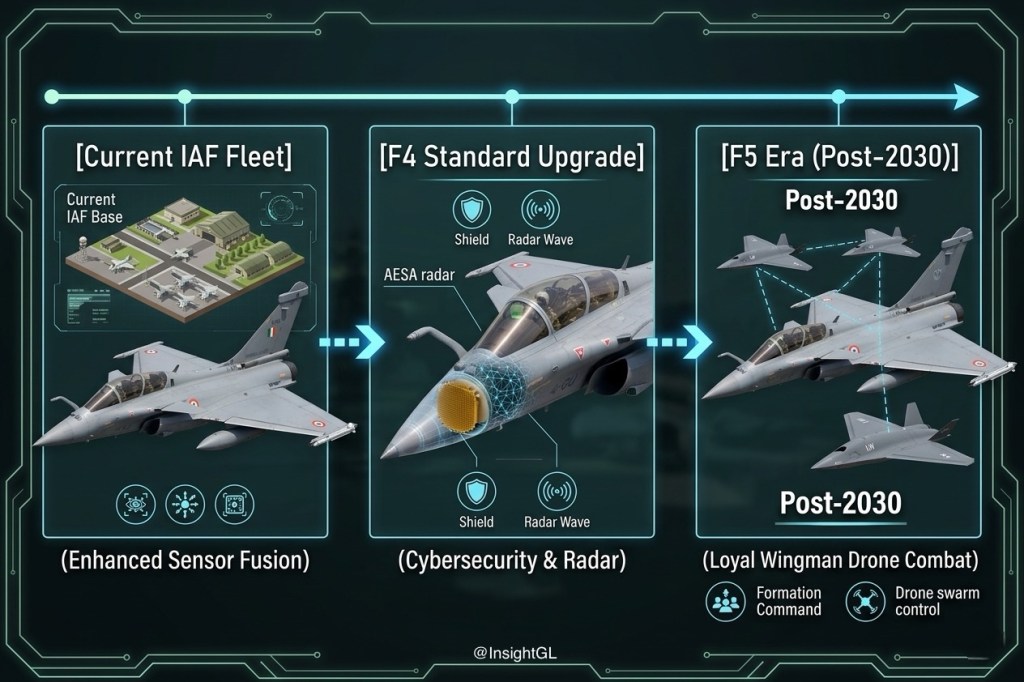
The aircraft will transition smoothly into the upcoming F4 and F5 evolutionary standards:
F4 Standard: Centers on vastly improved network-centric warfare capabilities, upgraded RBE2 radar algorithms, enhanced helmet-mounted displays, and hardened cybersecurity defences against modern electronic attacks.
F5 Standard (Post-2030): Expected to completely transform the platform, turning the Rafale into a command hub capable of controlling surrounding Loyal Wingman collaborative combat drones, alongside deploying next-generation nuclear and hyper-velocity cruise missiles.
In the End
As I write, Indian Air Force (IAF) Chief Air Chief Marshal A.P. Singh has reached France. He must be actively laying the groundwork for the non-negotiable clause of full integration capability for indigenous weaponry. India understands that demanding proprietary software source code of the Rafale is futile, therefore the IAF must focus on obtaining Interface Control Documents (ICDs).
These vital technical frameworks act as the digital and physical blueprints necessary to safely mate, code, and certify domestic Indian weaponry onto the French platform without exposing Dassault’s protected core software. The Air Chief’s direct consultations with Dassault Aviation and missile manufacturer MBDA are explicitly designed to advance these exact architectural modalities, ensuring India secures complete operational autonomy over its future fleet.
Overall, the ICD and the long-term upgrade cycle give the IAF a reliable, highly advanced bridge for the next 15 to 20 years, protecting Indian airspace while the country refines its domestic 5th-generation stealth fighter program—the Advanced Medium Combat Aircraft (AMCA). By combining elite foreign technology transfer with domestic manufacturing, the Rafale deal ensures the IAF maintains strict operational dominance across the Indo-Pacific for decades to come.


Leave a Reply