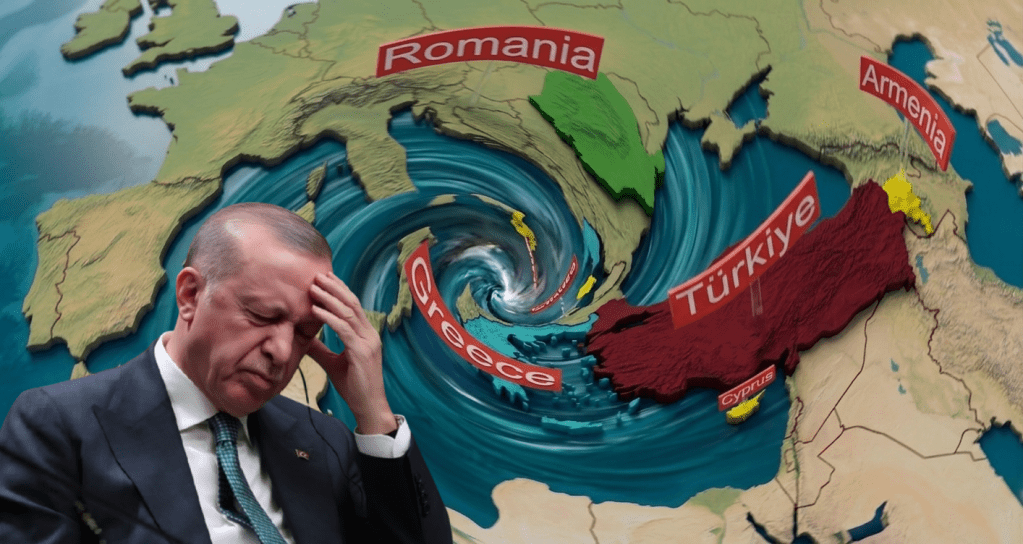
The President of Cyprus, Nikos Christodoulides, visited New Delhi from May 20–23, 2026. This visit made Türkiye incredibly nervous, and for good reason. During the trip, India and Cyprus officially became Strategic Partners. Even more importantly, Cyprus showed interest in buying Indian military hardware, including BrahMos supersonic cruise missiles and advanced kamikaze drones. Türkiye knows exactly who those weapons would be used against.
There is a clear story behind India’s move. Türkiye has adopted an aggressive foreign policy, closely aligning itself with Pakistan and interfering in South Asian affairs. This has pushed India to build strong defense ties with countries in the Mediterranean to act as a direct counterweight. Instead of arguing publicly, New Delhi is choosing quiet, long-term planning. By getting closer to Türkiye’s neighbors, India is creating a strategic balance that forces Türkiye to rethink the costs of its foreign policy.
Türkiye’s actions go beyond supporting Pakistan. Ankara is trying to expand its military footprint right in India’s backyard by selling air defense systems to Bangladesh and trying to get naval access in the Bay of Bengal. India sees this as a direct threat to its regional security. Combined with Türkiye’s frequent international criticism of India’s internal policies, New Delhi felt it had no choice but to change its approach. India has moved away from passive diplomacy and is now actively pushing back.
The Encirclement
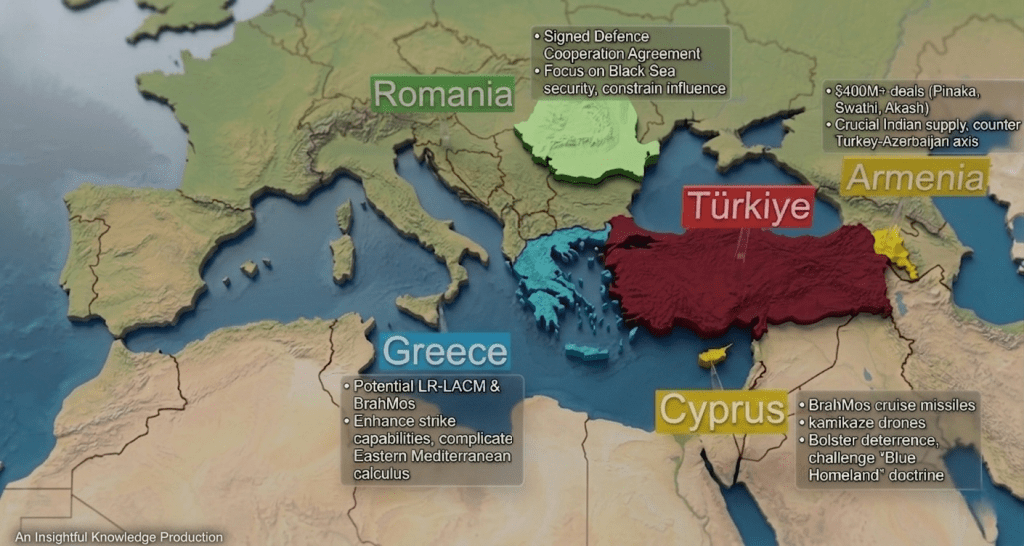
This counterstrategy takes the shape of an encirclement framework. India is deliberately anchoring its influence with nations that directly border Türkiye or have historical tensions with it. These key partners include Cyprus, Greece, Armenia, and Romania. In the Mediterranean region, India has elevated its relationships with both Athens and Nicosia to the level of strategic partnerships. This means they are committed to long-term military and economic cooperation. Details:
Erdoğan’s Ottoman Empire Dreams
Türkiye’s persistent focus on Indian internal matters, particularly the region of Jammu and Kashmir, remains driven by a mix of domestic politics and global ambitions. President Recep Tayyip Erdoğan frequently raises the Kashmir issue during his speeches at the United Nations. By doing this, he tries to frame himself as a global leader and champion for Muslim causes worldwide. This narrative is highly effective for him at home, as it helps rally nationalist and religious support among Turkish voters.
Furthermore, Türkiye views Pakistan as its primary strategic anchor in the Indian subcontinent. Supporting Pakistan’s political narrative on Kashmir is essentially the price Türkiye pays to support this vital alliance. This behavior also reflects Türkiye’s broader desire to project power far beyond its own borders. It is a way for Ankara to signal to the world that Turkish influence is no longer confined to the Middle East. India has consistently and firmly pushed back against these moves. The Indian government has repeatedly labeled Türkiye’s rhetoric as completely unacceptable interference in its sovereign internal affairs.
India-Israel Connection
In navigating this complex geopolitical game, Israel acts as a vital and highly effective element in India’s Mediterranean strategy. While India and Israel maintain deep bilateral ties on their own, their security interests naturally overlap when it comes to countering Turkish influence. The best part of this relationship is that it allows India to counter Türkiye without requiring a direct, loud confrontation. Israel supplies India with highly critical military technology, including advanced radar systems and electronic warfare equipment. This high-tech cooperation helps India develop its own defense systems and reduces its dependence on volatile or unfriendly supply chains.
Furthermore, Israel already maintains deep security and energy partnerships with Greece and Cyprus. By plugging into this existing trilateral network, India gains seamless access to a highly coordinated Mediterranean security architecture. This connection also facilitates vital intelligence sharing between India and Israel on regional radicalization networks and cross-border security threats, keeping both nations safer.
India’s Mediterranean Ambition?
It is important to understand that India’s entry into the Mediterranean is not about territorial ambition, military dominance, or trying to act like an old colonial power. Instead, it is a calculated insurance policy designed to protect India’s economic safety and strategic autonomy. Over the last decade, massive natural gas fields have been discovered in the Eastern Mediterranean, shared by Israel, Cyprus, and Greece. Building strong partnerships in this region aids India’s long-term energy diversification, making it less dependent on traditional Middle Eastern oil.
At the same time, securing alternative trade corridors is a top priority for New Delhi. India wants to ensure that its goods can flow smoothly to European markets even if traditional maritime choke points, like the Suez Canal or the Red Sea, face conflict, or disruption. This presence also helps balance China’s massive Belt and Road Initiative and its growing naval footprint in European waters. For India, the Mediterranean is an arena of pure strategic realism. The logic is simple: if Türkiye and China can build partnerships and naval bases in India’s backyard, New Delhi has every right to do the exact same thing in theirs.
Türkiye’s “You Reap What You Sow” Moment Has Arrived
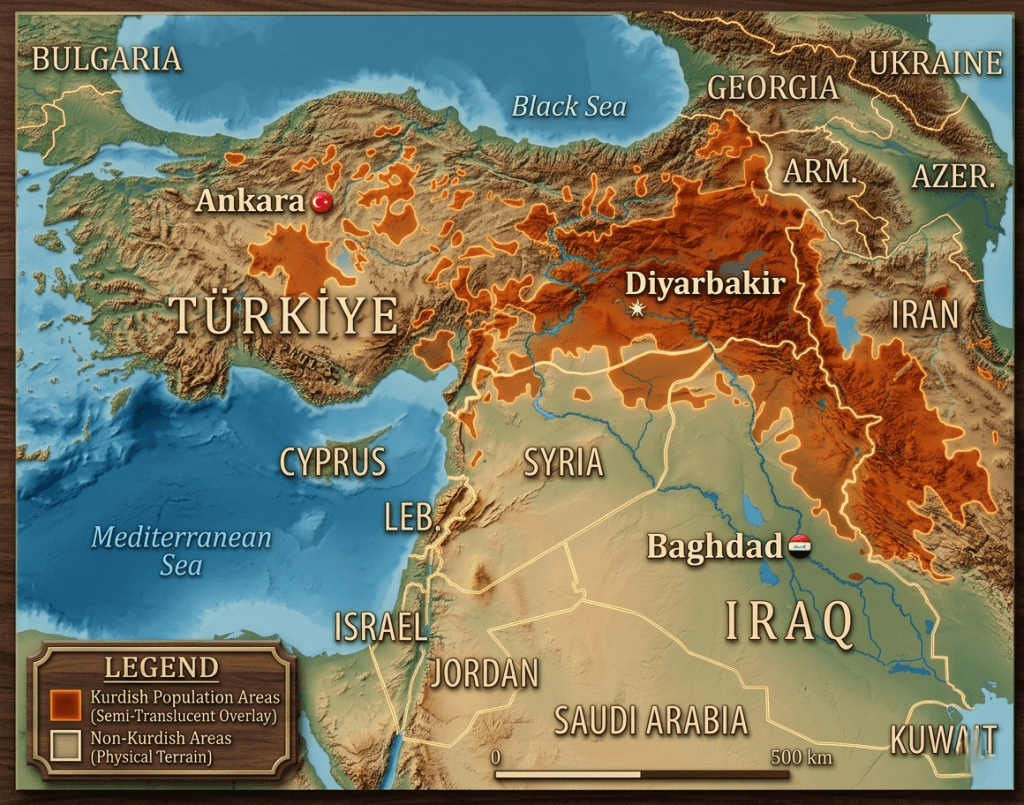
Türkiye faces a deep and unresolved Kurdish conflict that represents one of its most persistent internal security challenges. The Kurdish question involves 10-15 million Kurds (15-20% of Türkiye’s population) concentrated in southeastern Anatolia who seek greater cultural recognition, political autonomy, and economic development. The Kurdistan Workers’ Party (PKK) insurgency has claimed over 40,000 lives over four decades. Despite PKK leader Abdullah Öcalan calling for disarmament in early 2025 and the group announcing its dissolution in May 2025, Türkiye continues military operations and airstrikes against Kurdish insurgents in Iraq and Syria, with President Erdoğan demanding Kurdish forces in Syria lay down arms immediately. The conflict is still unresolved with peace negotiations not producing a bilateral ceasefire, creating a continuous threat to Türkiye’s territorial integrity while fueling systematic discrimination and repression against Kurdish civilians.
Türkiye’s economic and social stability faces multiple compounding pressures from its massive refugee burden and fragile economic structure. The country hosts over 3.6 million Syrian refugees, creating significant strain on public finances, housing markets, and labor dynamics—Syrian refugee inflows led to a 1.8 percentage point decline in native employment, particularly in the informal sector, while pushing up rental prices in low-cost neighborhoods. The economy shows mixed signals with high inflation at 58.51%, moderate growth of 3.18%, substantial external debt of $444.6 billion (33.60% of GDP), and a 4.72% fiscal deficit. Türkiye’s defense industry, while developing domestic capabilities, is still export-dependent with $3.6 billion in defense exports in the first half of 2025 to 180 countries, making it vulnerable to market disruptions. The combination of economic vulnerability, refugee backlash fueling domestic populism, and an unresolved Kurdish conflict creates multiple fault lines that threaten Türkiye’s long-term stability and provide strategic opportunities for rival powers like India to exploit Türkiye’s geographic exposure and economic weaknesses.
While India and Türkiye continue to maintain formal diplomatic lines and hold regular consultations to manage their bilateral trade, the underlying security dynamic has changed for good. The moral debt Türkiye owes India remains unaddressed: during ‘Operation Madad’ in February 2023, India was the first responder to Türkiye’s devastating earthquake, rapidly deploying its National Disaster Response Force team, and providing critical relief supplies to save lives. Yet Türkiye never reciprocated this humanitarian gesture. Instead, Ankara’s anti-India activities intensified—Erdoğan’s repeated inflammatory remarks on Kashmir, hosting Kashmiri dissidents, supporting Pakistan’s propaganda, and imposing a moratorium on arms exports to India due to Pakistan ties. This betrayal deepened during Operation Sindoor, when Türkiye actively supported Pakistan against India’s counter-terror strikes, condemning New Delhi’s actions and joining Azerbaijan in calling for boycotts against India while Türkiye and Azerbaijan’s coordinated diplomatic offensive sought to isolate India on the international stage.
This ingratitude confirms that Türkiye will not reset its Pakistan alignment voluntarily. Therefore, India should no longer hesitate to openly exploit Türkiye’s fault lines using overt and covert means. India must leverage Türkiye’s geographic exposure through defense partnerships with Greece, Cyprus, Armenia, and Romania; capitalize on economic vulnerabilities through trade restrictions and alternative partnerships; expose the Kurdish conflict diplomatically; and coordinate with Israel to counter Turkish influence across the Mediterranean. India has already demonstrated its capability to project strategic influence beyond the Indian subcontinent. The time has come to convert Türkiye’s strategic isolation into tangible geopolitical gains. New Delhi is no longer just defending its borders at home in the Indian subcontinent. Today, a more confident India is actively shaping the balance of power across the European, Mediterranean, and Middle Eastern frontiers, proving that it can project its strategic influence wherever its national interests are challenged. Türkiye’s “you reap what you sow” moment has arrived, and India must seize it decisively.


Leave a Reply