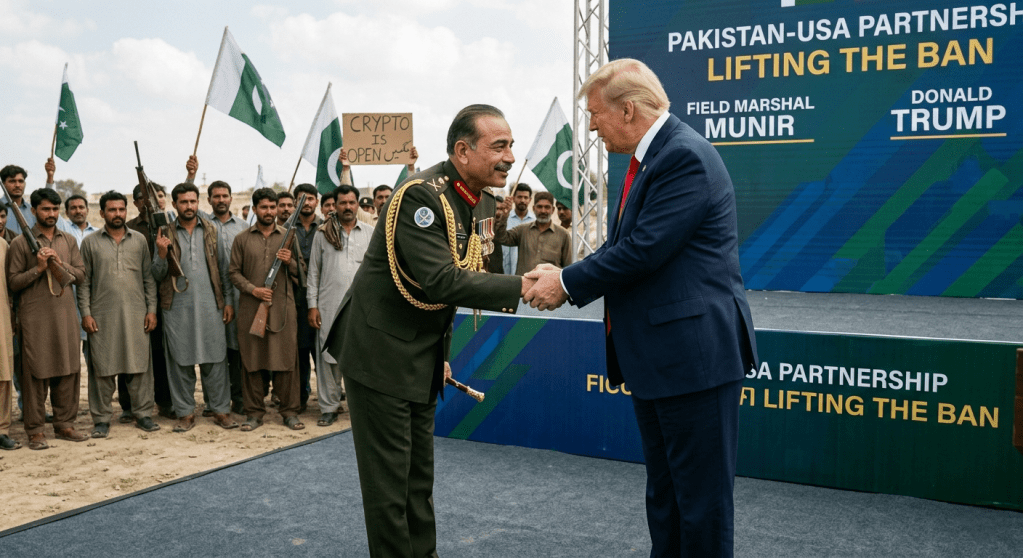
In April 2026, Pakistan quietly dismantled an eight-year-old barrier that had effectively severed cryptocurrency firms from the nation’s formal banking sector. By rescinding its 2018 restrictive order, the State Bank of Pakistan (SBP) authorized regulated financial institutions to facilitate accounts for licensed Virtual Asset Service Providers (VASPs). This policy shift, however, is far more than a technical banking adjustment; it represents a profound geopolitical and financial realignment. This reversal brings the crypto-related ventures of the Trump family into the heart of Pakistan’s economy and positions Army Chief Field Marshal Asim Munir as the indispensable intermediary between Islamabad and Washington.
Originally, Pakistan’s ban was a defensive measure against perceived threats of money laundering, terror financing, and economic volatility, fueled by pressure from the Financial Action Task Force (FATF). The inherent pseudonymity of digital assets presented a clear risk, as decentralized channels allowed for “layering” funds through mixing services and bypassing traditional sanctions. While the ban was officially framed around compliance and sovereignty, the true challenge remained a balancing act: mitigating the risk of misuse while attempting to harness a transparent, regulated crypto system that could potentially offer superior monitoring capabilities compared to traditional “hawala” networks.
From Ban to Partnership with Trump-Linked Crypto Capital
The policy change comes from both domestic economic needs and external pressure. Inside Pakistan, the country has long struggled with a fragile banking system, capital flight, and a huge underground remittance and digital assets scene. Over the last ten years, millions of Pakistanis have turned to crypto—especially stablecoins and offshore exchanges—not just for trading but also for sending money across borders, avoiding rupee swings, and bypassing slow, costly bank services. Even after the 2018 ban, the market did not disappear; it just went underground and offshore.
The 2018 ban started to seem less realistic when the Trump family’s crypto venture, World Liberty Financial, got involved. In early 2026, Pakistan’s Finance Ministry signed an agreement with an affiliate of World Liberty, a project run by Donald Trump’s sons and close associates, to explore using its USD1 stablecoin for cross-border digital payments and remittances. This was one of the first public partnerships at the country level for World Liberty, putting Pakistan at the center of US-aligned digital dollar infrastructure as Washington pushes dollar-based stablecoins as a global payments layer.
The link between the Trump family’s money and Pakistan’s policy change is clear in timing and story. Weeks after signing the deal, Pakistan moved to create a national crypto framework, including the Virtual Assets Act, 2026, and the Pakistan Virtual Assets Regulatory Authority (PVARA). Right after, the SBP repealed the 2018 circular, letting banks serve licensed VASPs while keeping the banking system crypto-friendly. The sequence—deal with a Trump-linked crypto firm, new laws, then opening up banking—suggests that US-aligned digital finance capital wasn’t just a beneficiary but a key driver and negotiator.
Munir: CIA Asset, Opportunist, or Both?
At the same time, Pakistan’s military and security agencies have played a bigger role in shaping the country’s foreign financial ties. Field Marshal Asim Munir, the Army Chief and ex-head of the Inter-Services Intelligence (ISI), has longstanding links with US intelligence agencies. Publicly, he is seen as Islamabad’s main contact in Washington’s broader efforts to reset ties with Pakistan, especially involving US‑Iran talks and managing tensions with India.
However, inside policy circles, Munir is often seen as a sort of American asset—a top Pakistani military leader with ties, training, and intelligence-sharing links that make him a reliable channel for US strategic and commercial interests. Some of the most sensitive negotiations—especially involving US-linked crypto-finance—have happened while Munir has been in-charge of the military and security hierarchy.
Critics argue Munir’s role is not just diplomatic: they see him as helping keep US-friendly policies in place, even under civilian governments that do not always agree. In the new crypto and banking scene, this means the military and security agencies, through Munir, are basically co-architects of the digital-financial setup, making sure any opening to US-linked crypto capital comes with strong security oversight and political shielding.
Why the US-Linked Crypto Shift Matters
Aligning Pakistan’s crypto-friendly banking changes with Trump-family-linked money and Munir’s security-driven approach is not just about lobbying or business deals; it is a strategic move to tie Pakistan’s digital financial infrastructure more tightly to the US-led financial world. Stablecoins linked to the US dollar—like World Liberty’s USD1—are basically dollar shadow instruments, giving Washington and US-aligned commercial interests more visibility and control over cross-border money flows, even in countries wary of traditional banking.
For Pakistan, the gamble is that this could hypothetically bring several benefits:
– Access to US-linked capital and tech, especially in the volatile global crypto and fintech sectors, which are increasingly dominated by US firms.
– Better international credibility, as joining US-backed stablecoin systems can help Pakistan avoid being seen as risky or chaotic in crypto terms.
– A stronger bargaining chip in US-Pakistan relations, where Washington can point to digital finance and remittance cooperation as signs of a modern Pakistan, even if security and governance still face challenges.
At the same time, there are worries about losing sovereignty and conflicting interests. US-based crypto projects, especially those tied to the current president’s family, are already under political scrutiny in Washington for blurring the lines between foreign policy, security, and business. When these ventures are part of bilateral agreements with Pakistan, there is a risk that economic and digital policies will be shaped more by American corporate interests than Pakistan’s development needs.
India’s Security Concerns
When Pakistan lifts its crypto restrictions, it mainly impacts Indian security by opening more channels for illegal financing, sanction-busting, and cross-border terrorist funds, which also shifts regional crypto politics in favor of actors opposed to India.
Even with a “sandboxed” regulatory setup, Pakistan still creates a legal-looking crypto corridor that could be exploited by its military and jihadi groups to move funds more anonymously. Crypto’s pseudonymity and borderless nature make it easier to send donations from worldwide sympathizers to Pakistan-based groups, layer the funds through mixing services, and convert them into local currency or move them through hawala-style methods, which Indian agencies find harder to track than regular wire transfers.
A formal crypto system gives Pakistan an extra tool to bypass sanctions by moving some capital onto blockchain when normal banking channels are blocked or watched. If parts of Pakistan’s crypto infrastructure come under military or intelligence influence, hostile groups could use regulated but militia-linked exchanges as middlemen, complicating India’s effort to track and enforce sanctions.
While Pakistan is building a more structured, US-aligned crypto system, India still lacks a clear, comprehensive crypto law, relying mostly on high taxes and strict rules that are scattered and hard to follow. This gap might:
– Encourage illegal or grey-market money to flow through Pakistan’s crypto-friendly routes before targeting India.
– Make it harder for India to effectively monitor cross-border crypto activity, especially if Pakistan positions itself as a US-favored crypto hub and gains political cover for its digital financial setup.
For India’s security agencies, the main concern is more room for covert crypto-based financing of irregular warfare—like supporting local proxies, funding sleeper cells, and moving money from international backers without leaving obvious paper trails. To fight this, India will need stricter crypto monitoring at borders (including KYC for VASPs and peer-to-peer platforms), better coordination with global financial intelligence units, and faster domestic crypto rules to close gaps like those in Pakistan’s “permissioned” crypto systems.
Munir The Trusted Servant
By lifting the eight‑year crypto‑banking ban, Field Marshal Asim Munir is effectively helping Donald Trump’s financial and political interests more than Pakistan’s own security and economic sovereignty. By one stroke, Munir makes Trump happy by handing his crypto empire a strategically located, internationally legitimised gateway into South Asia, while simultaneously hardening the system so that FATF‑style monitoring of terror funding and money laundering becomes far more difficult: the new framework allows Pakistan to claim it has a “compliant” crypto regime, but the blending of traditional banking, blockchain‑based channels, and military‑linked intermediaries creates opaque layers through which illicit flows can be routed under the guise of licensed, regulated activity.
Munir, as the apex military‑security figure and a de‑facto American asset, ensures that this alignment is insulated from domestic political pushback and framed as a national‑development project, even as it deepens Pakistan’s financial‑digital dependence on Trump‑linked capital and American‑led financial‑intelligence architecture. In practice, this arrangement strengthens Trump’s global crypto‑finance network and enhances his leverage over Pakistan’s financial‑policy space, while exposing Pakistani users and institutions to greater US‑driven surveillance, compliance pressure, and long‑term structural vulnerability—all without commensurate gains in domestic financial stability or grassroots welfare.
Munir, a former head of the ISI with long-standing ties to the CIA and US intelligence, has often been seen and described by the media as an American asset who can ensure certain policies remain consistent, no matter who is in charge in the civilian government. His current position as army chief and key mediator in US-Iran-Pakistan talks shows he is a trusted servant of Washington, a behind-the-scenes negotiator and runner boy, who would sacrifice Pakistani interests to stay in power forever.


 Insightful Geopolitics
Leave a reply to B Raja Cancel reply