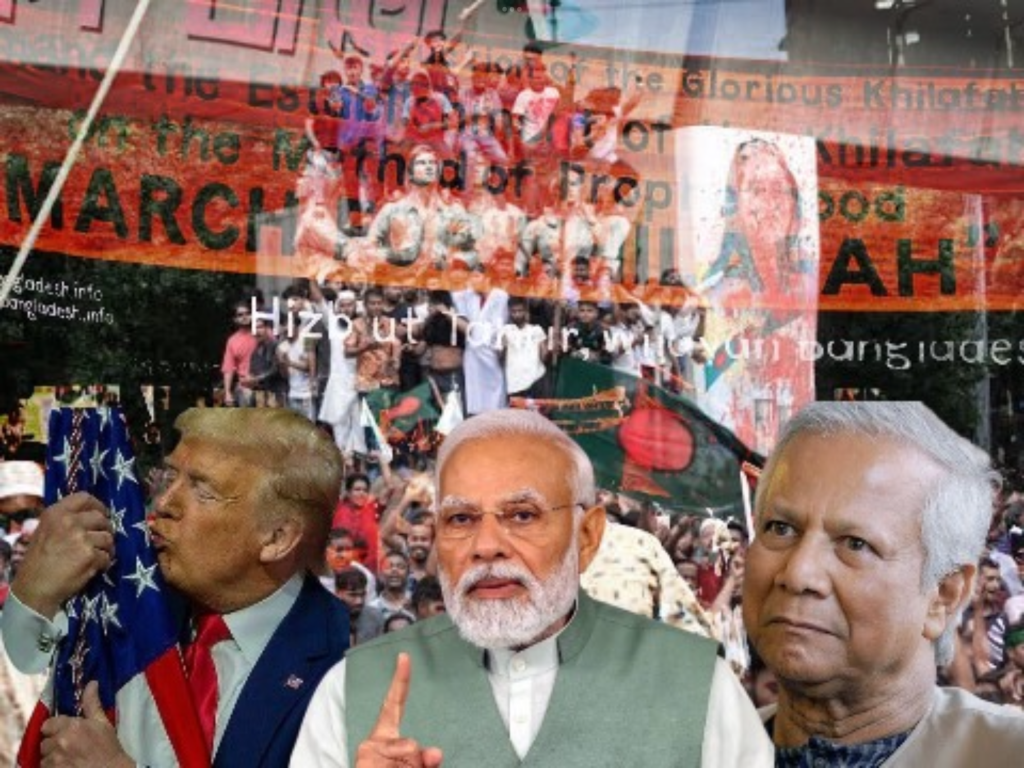
Since the fall of Sheikh Hasina’s government in early August 2024, there has been a rise in activities by the banned group Hizb ut-Tahrir in Bangladesh (HTB). Exploiting a dysfunctional administrative and law enforcement system, HTB has begun conducting political-religious activities openly and demanded its name be removed from the list of designated terrorist groups. The Islamist group took advantage of the fragile state of the new Bangladeshi interim government to hold public seminars, appeal for the removal of its proscribed status, and engage in recruitment. These HTB activities mainly use online and in-person “gray zone tactics” (neither clearly legal nor illegal) that exploit the interim government’s weak and indecisive stance.
Origins and Ban in Bangladesh
Hizb ut-Tahrir (“The Party of Liberation;” HT) is a pan-Islamist political organization founded in Jerusalem in 1953. It presents itself as a vanguard seeking to establish a unified Islamic caliphate. Although HT claims to be “revolutionary but nonviolent,” its doctrine is openly subversive, and Hizb ut-Tahrir is banned in numerous countries—including nearly the entire Muslim world and Bangladesh in 2009—due to incitement to violence and radicalization.
The organization’s Bangladeshi chapter, HTB, started in the 2000s through initiatives by several teachers from Dhaka University and Rajshahi University. The group aimed to establish an official HT presence in Bangladesh, the third most populous Muslim country, and to promote HT’s global goal of establishing a caliphate locally. Bangladesh was also designated as a wilaya (“state, province”) of the prospective caliphate. Later, HTB expanded its activities to include elite universities like Bangladesh University of Engineering and Technology (BUET) and North South University (NSU).
HTB mainly targets, radicalizes, and brainwashes high-achieving students by tapping into the dissatisfaction among Muslim youth with Western-style secular and democratic values in Bangladesh. The group appeals to educated but conservative audiences by advocating for a caliphate similar to the Ottoman Empire. It was banned in October 2009 after Sheikh Hasina’s rise to power. HTB’s leader, Mohiuddin Ahmed, was placed under strict surveillance and arrested in April 2010. Since then, the group has gone underground, occasionally making headlines as a threat to national security.
In 2012, the Bangladesh Army announced in a press conference that it had thwarted an attempted coup planned by mid-level officers and had forcibly retired any army personnel linked to HTB. HTB’s infiltration of the military was not unusual—the group had previously tried to incite officers of the Bangladesh Air Force to overthrow the government after the Pilkhana Massacre (related to the 2009 crackdown on a mutiny by the Bangladesh Rifles), which contributed to its ban. Before the 2024 elections, HTB also held online seminars targeting military officers. Interestingly, some leadership and members of HTB find Islamic-nationalist rhetoric more appealing than the pan-Islamist vision of a caliphate, which has limited support in the country. This faction repeatedly attempts to incite military officers to join their cause, claiming they can end Western and Indian conspiracies against Bangladesh.
Post-Ban (2009–2024) Activities
From 2012 until August 2024, HTB’s methods mainly involved indoctrination, infiltration, and recruitment. This included social media campaigns and targeted efforts to influence state institutions, including Bangladesh’s security forces. HTB primarily targeted educated youth and established professionals like academics, doctors, engineers, bureaucrats (active and retired), police, and military personnel. Broadly, HTB does not advocate violence or terror to achieve its aims. It claims to seek the “overthrow of governments through nonviolent means” in its operating countries. However, its ideology can serve as a pipeline to jihadism—often seen when al-Qaeda and ISIS affiliates recruit HTB members, suggesting they view HTB as a potential recruitment pool.
As of 2022, HTB reportedly had between 10,000 and 15,000 members, including 10 secret study groups where members discussed issues related to the Middle East, South Asia, and the West. These groups used various texts to highlight instances of torture, persecution, and abuse of Muslims worldwide. Recruitment likely increased after Sheikh Hasina’s fall in August 2024, with HTB posters supporting a new caliphate appearing across Dhaka at night.
In 2023, the Bangladesh Police’s Counter-Terrorism and Transnational Crime (CTTC) unit arrested Touhidur Rahman Sifat, a Dhaka University graduate and freelancer. Sifat was the main speaker in HTB’s online sermons and behind the late-night posters. In early 2024, the group also sent mail to BUET students, encouraging them to join against “westerners.” Their access to student mailing lists showed how deeply they had infiltrated Bangladesh’s top engineering university.
HTB’s Activities Under Md. Yunus
Just two days after Sheikh Hasina’s regime was ousted on August 5, 2024, by a student-led uprising, HTB held a protest in front of the national parliament, called Jatiya Shangshad. Hundreds of HTB activists waved white flags with the Islamic Shahada (“bearing witness”), handed out propaganda leaflets, and carried banners demanding a caliphate. They also occupied the area around the Raju Memorial Sculpture at Dhaka University, which symbolizes the fight against terrorism, on the same day. That month, posters appeared at Gulshan Police Station, which commemorates two police officers killed in the 2016 Holey Artisan Bakery attack by ISIS.
In September 2024, HTB cautiously revamped its activities just weeks after an interim government led by Dr. Muhammad Yunus took power. Exploiting weak governance and fractured law enforcement, the group organized a seminar at Dhaka Reports Unity, a key journalism organization, focusing on the Pilkhana Massacre. This event was organized under a group called Bangladesh Policy Discourse (BPD). The seminar focused on Indian influence in Bangladesh and the need for a caliphate, avoiding any real discussion of the massacre. Though hosted by BPD, the seminar was promoted on HTB’s website, showing the organization’s involvement.
A week later, HTB called for lifting its ban during a press conference, claiming to have petitioned the Home Ministry. Imtiaz Selim, HTB’s media coordinator, said in an interview that group members took part in the 2024 uprising to help remove Hasina. These actions show a clear effort to regain legal status and operate openly.
In October 2024, the interim government adopted a tougher stance. Imtiaz Selim was arrested and remanded, yet posters advocating a caliphate and calling for the ban’s reversal kept appearing. The most notable event was the “March for Khilafot” (caliphate) on March 7, after Friday prayers, when over 3,000 supporters gathered at Baitul Mokkaram mosque in Dhaka to mark 101 years since the Ottoman Empire’s end. They chanted “Freedom has one path, Khilafot, Khilafot.” Security forces knew about the event at least a week earlier and detained three coordinators during a raid the night before. Despite this, the crowd began to march, and security forces pushed them back. Dozens, including journalists and police officers, were injured, and more than 30 HTB supporters, including spokesperson Saiful Islam, were arrested. The event caused nationwide outrage because it was openly announced, and the government failed to stop the violence.
In March, the security forces conducted raids and arrested two students of Cumilla University with links to HTB. In the same month, the police also arrested seven people from Dhaka’s elite suburb of Dhanmondi who sought to hold an “anti-genocide” rally for Gaza after Friday prayers that showcased HTB banners and placards. In July, the government also issued directives to the Madrasha Education Directorate and Vocational and Technical Education Boards to curb HTB activities and enforce government-sanctioned religious narratives. The government further prepared a list of cases against the organization related to militancy, extremism, and terrorism, and the CTTC head promised constant online surveillance of extremist groups to prevent future incidents.
Violent extremism and terrorism are genuine threats in Bangladesh and India is going to be the most affected party. The whole issue has regrettably been politicized by Islamists to enhance their appeal. This distorted narrative has been bolstered by certain high-ranking officials within the law enforcement sector, including the Police Commissioner of Dhaka, who publicly refuted the existence of terrorists in Bangladesh. Although leading security experts in Dhaka have widely condemned him for these remarks, the commissioner’s statement has merely strengthened the politicization of alleged ‘Jongi Natok’ (alleged military killings during the Hasina government) events by Bangladeshi Islamists.
Furthermore, the nation’s police have lost track of 712 trained HTB members and 174 convicted terrorists who escaped following prison breaks during the July uprising. Meanwhile, HTB has broadened its membership to include female cells, reaching high school and college students, as well as high-ranking government officials and other select segments of Bangladeshi society. All of these developments present significant internal security challenges.
India: Act Now or Suffer
HTB has created a WhatsApp group named “Prabaashi Muslim Network” to bring together its members in the UK who are of Bangladeshi, Indian, and Pakistani descent. This network acts as a strategic platform aimed at consolidating support within the diaspora community and furthering HTB’s goal of establishing a pro-Islamic government in Bangladesh. The revival of HTB in Bangladesh is not merely a national concern for Bangladesh but represents a security threat to India in particular. The group’s extremist agenda, coupled with its entrenched connections to terrorist organizations, presents an immediate risk to India and beyond.
If not addressed, HTB’s growth could result in the formation of a radical Islamist state, destabilizing the region and creating a sanctuary for jihadist networks. For the Modi government and the global community, addressing this threat should be a top priority. India possesses various strategic tools to compel the Yunus regime to take decisive measures against HTB.
Even the US which is allegedly behind the latest uprising and ousting of Sheikh Hasina has a lot to lose if HTB flourishes. The US can put economic sanctions, targeted visa restrictions, and the freezing of assets belonging to key regime figures who support HTB. The IMF and World Bank could also be coerced into limiting financial assistance to Bangladesh until it implements concrete actions against jihadist factions.
However, Washington is blinded by the notion of the ‘Ring of Crisis Zones Around India,’ which explains the Trump administration’s inaction. As a result, India must chart its own course in Bangladesh. A decade ago, Kiren Rijiju, the Union Minister of State for Home, informed the Rajya Sabha that over two crore (20 million) illegal Bangladeshi immigrants live in India. This number has likely risen further due to the economic challenges and social turmoil in Bangladesh. If even one percent of these undocumented individuals become radicalized, India could face a highly unstable situation.
While West Bengal, Assam, and Tripura are the most apparent targets, illegal immigrants from Bangladesh have also increased their presence in southern cities such as Hyderabad and Bengaluru. This scenario could not have developed without the complicity of local politicians, who are blinded by the politics of vote banks and show a complete disregard for national security. If India remains complacent this time, as it did in 2024, the fragile situation in the politically sensitive Northeast India is poised for turbulent times.


 Insightful Geopolitics
Leave a reply to rajiv saxena Cancel reply