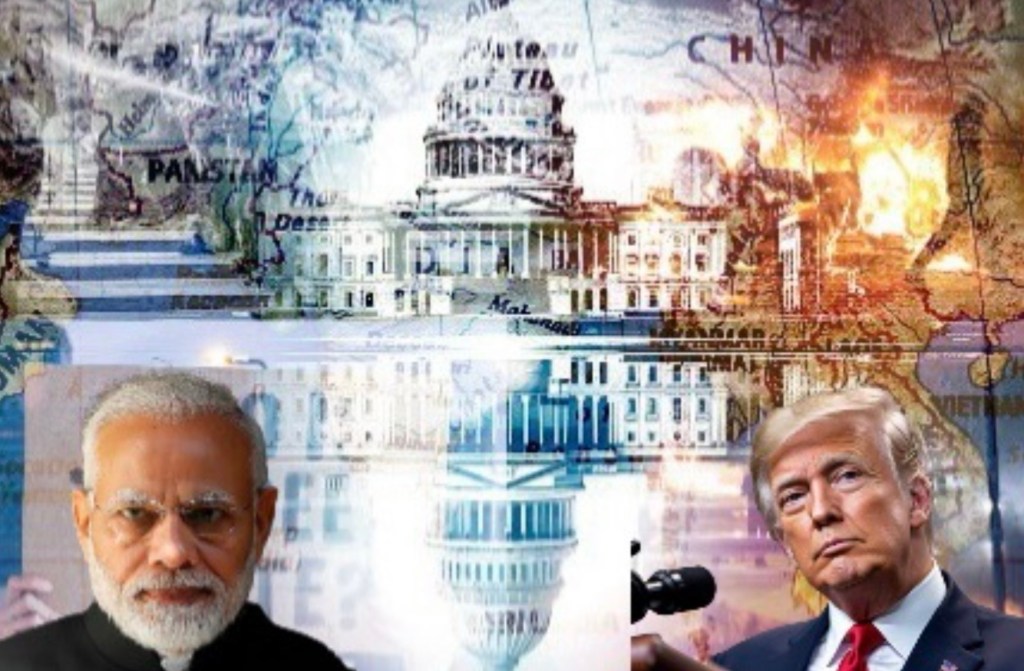
The past eight months have been incredibly challenging for India, with the last three months proving especially catastrophic. In January 2025, ordinary Indian citizens celebrated the election of US President Trump as if it were a victory for their favorite leader. However, to those with a keen eye for the geographical events, the situation appeared ominous right from the start.
In April 2025, the US released a list of tariffs, followed by the Pahalgam massacre and a brief war between India and Pakistan in May 2025. Initially, it seemed that India was managing the situation well. However, Trump first imposed a 25% tariff on India, which was later increased to 50%. Up to that point, India had been confident in its ability to handle relations with the US.
So, what went wrong? Did Indian leaders and diplomats misinterpret the various indicators from the US over the past decade, particularly in the last year?
The Past Decade
From 2013 onwards, the West began recognizing a significant shift in geopolitical relations with India. European nations and Australia lifted the ban on Narendra Modi, the Chief Minister of Gujarat. In February 2014, Nancy Powell, the U.S. ambassador to India, visited Gandhinagar to meet with Modi and engaged in an hour-long discussion. Later, in May 2014, Modi became the Prime Minister of the world’s largest democracy, and the U.S. lifted a nine-year visa ban on him in the same month.
The Wall Street Journal noted in 2014 that Narendra Modi was the only person ever denied a U.S. visa based on a little-known law concerning religious freedom. He had been denied a visa in 2005 under the International Religious Freedom Act of 1998. The removal of ban reflected two things. Firstly, the U.S. designs in India had not worked out, and secondly, a growing necessity for the United States to partner with India in confronting various regional challenges and common threats. The decision to lift the ban underscored that too much was at stake to be squandered due to ignorance and arrogance.
While this public embrace of Modi showcased a strong camaraderie, there were significant undercurrents that were not visible to the public. Consequently, when Modi returned to power with an even larger majority in 2019, tensions began to rise. By December 2019, India witnessed widespread protests against the Citizenship Amendment Act (CAA). Following that, in August 2020, farmers began protesting proposed farm reforms.
Organizing extended protests and winning elections both require support and huge funding. It is well-known that illicit money transactions often play a crucial role in this. One of the most trusted methods for these transactions is Hawala. The Middle East, particularly Dubai, is a key player in Hawala activities. Many of these transaction routes often pass through Kerala and occasionally involve Nepal. A decade ago, it was estimated that the Indian government was losing over ₹10 lakh crore annually due to Hawala activities.
Another way to receive funds from abroad is through Non-Governmental Organizations (NGOs). As of July 2023, there were 16,301 NGOs with valid licenses under the Foreign Contribution Regulation Act (FCRA). The Indian government was aware of these organizations and had canceled the FCRA licenses of more than 6,600 NGOs in the past five years. In total, 20,693 NGO licenses have been revoked over the last decade. The cancellations were for reasons including involvement in activities contrary to the FCRA, misuse of funds, using funds for purposes outside their declared mandate, and violations of other laws.
These actions by the Indian government have faced significant criticism from various Western governments and organizations funded by them, such as Human Rights Watch, Amnesty International, Article-14, and the Oxford Human Rights Hub. Initially, the BJP government did not respond to this criticism, but eventually, they did address it.
In February 2025, former Union Minister and senior BJP leader Ravi Shankar Prasad commented on foreign funding in Indian elections, stating, “It is a matter of shame what the Congress has done. Rahul Gandhi has made a joke of Indian democracy abroad and sought help from foreign democracies. This means he sought support to help him win, especially as the Congress continues to lose elections.”
He also referenced comments made by U.S. President Trump, who expressed concern over USAID, stating, “I have decided to cancel the funding of USAID. Why do we need to spend $21 million for voter turnout in India? I guess they were trying to get somebody else elected.”
Additionally, Prasad played an incriminating audio clip of Mr. Rahul Gandhi in which Gandhi was heard saying, “The opposition is fighting the battle, and it is not just an Indian battle,” implying that the Indian opposition has been receiving help from abroad.
The Bharatiya Janata Party (BJP) has also alleged that George Soros, the Hungarian-American financier and billionaire, is funding the Forum of Democratic Leaders in the Asia-Pacific (FDL-AP), which includes Sonia Gandhi as co-president.
Additionally, the French media outlet Mediapart claims that Soros’s Open Society Foundations and the U.S. State Department supported the Organized Crime and Corruption Reporting Project (OCCRP). Mediapart noted that the OCCRP has conducted investigations into the alleged use of Pegasus spyware by the Modi government, inquiries into the Adani Group’s activities, and reports on the decline of religious freedom in India. The publication suggested that both Soros and the Biden administration are effectively responsible for this coverage.
Consequently, during a news conference, a BJP spokesperson stated, “The deep state has a clear objective to destabilize India by targeting Prime Minister Modi. The U.S. State Department has always been behind this agenda, and the OCCRP has served as a media tool to carry it out.” Openly naming the State Department as one of the conspirators aiming to destabilize India was surprising. This indicates that the Indian government was aware of an impending challenge.
Meanwhile, in 2023, a new U.S.-based forensic financial research firm, Hindenburg, emerged with serious allegations against the Adani Group. Hindenburg claimed the group had engaged in a “brazen stock manipulation and accounting fraud scheme” over several decades. In the short term this, report led to a loss of $108 billion for the Adani conglomerate. Adani is considered close to Modi and has been accused of funding the BJP’s rise.
In 2024, Hindenburg accused Madhabi Puri Buch, the chief of the Securities and Exchange Board of India (SEBI), of having connections with offshore funds used by the Adani Group. However, Hindenburg unexpectedly shut down in January 2025, raising questions about the firm’s purpose and why it ceased operations just eight years after its inception.
Is Rahul Gandhi the Choice of the West
The Leader of the Opposition (LoP) in Parliament, Mr. Rahul Gandhi is no doubt the most prominent opposition leader, despite the fact that he has not held any ministerial position till to-date. Yet he made 247 trips to foreign countries between 2015 and 2019. During these visits, he was seen with anti-India figures in the West and made inflammatory statements about India, specifically targeting the current BJP government. Historically, no Indian politician—whether in power or the opposition—has made so many trips abroad. This situation raises questions about the true agenda behind these visits.
During his overseas visits, Mr. Rahul Gandhi met with people who had an anti-India agenda. These included US lawmaker Ilhan Omar, British Labour Party leader Jeremy Corbyn, European Parliament members Alviina Alametsa and Pierre Larrouturou, and Italian leftist politician Fabio Massimo Castaldo. Castaldo is known to have connections with Pervaiz Iqbal Losar, who is believed to be a Europe-based asset of the Pakistani spy agency ISI. These meetings have raised numerous questions that the Indian National Congress has yet to address.
In 2022, at the ‘Ideas for India’ conference held in the United Kingdom, Mr. Rahul Gandhi expressed a desire for foreign intervention. During his controversial address, he indicated this sentiment twice. The first instance was when he referenced the Russia-Ukraine conflict, and the second was when he criticized Indian diplomats for their reluctance to take orders from Europeans. In the same conference, he even compared Ladakh to Ukraine, suggesting that it, too, requires intervention from the United States.
Here are some of the recent foreign visits of Mr. Rahul Gandhi:

The Habit of Regime Change
Over the last 80 years, Washington has overthrown multiple regimes (some experts believe that the number is 70). For a superpower, toppling foreign governments is relatively straightforward; however, achieving the desired outcomes is much more complex. This makes regime change both alluring and perilous, as history has shown.
Some of the examples are:

As of today few US officials believe that the US has abandoned electoral interference in the twenty-first century. Others take a more cautious approach. Former CIA Deputy Director John McLaughlin remarked that this is “not something that intelligence does with anything like the sense of flexibility and freedom that it might have had in the early Cold War.” Avril Haines, who held the same position a decade later, stated that “it is not acceptable to tamper with votes in an election,” however, he declined to comment on whether the CIA still seeks to influence voters’ opinions. Former Director of National Intelligence James Clapper noted, “It’s all a question of degree.”
Former CIA Director Leon Panetta stated that the agency does not alter votes or spread disinformation but does influence foreign media outlets to “change attitudes within the country.” He explained that the CIA would sometimes “acquire media within a country or within a region” to deliver messages or attempt to “influence those that may own elements of the media to cooperate in delivering that message.” It is unclear what specific activities Panetta had in mind; they could refer to traditional CIA propaganda efforts intersecting with electoral politics. However, they bear similarity to what the US blamed some of the Russian social media operations in 2016.
The differing accounts from US officials likely stem from varying definitions of electoral interference. This type of interference can take many forms, including vote-changing, disinformation, doxxing, propaganda, and financial support. Therefore, it is clear that the current or past US administrations have not banned the practice of covert electoral interference, but it is an option that is not executed with great frequency. This is different from the Cold War, but it also does not mean that the US has categorically ruled it out.
The US government also remains divided on how to approach the issue. Some officials believe the US should definitively end the practice, while others disagree. Panetta argues that the US should keep the option open to assist foreign political actors with money, propaganda, and other means.
The 2024 Shocker to Modi and BJP
The 2024 Indian general elections dealt a significant blow to Modi. The BJP, which had anticipated a larger victory, was reduced to 240 seats, falling 32 seats short of a full majority. A weakened Modi aligned well with the interests of the deep state. An organization based in Europe, Disinfo Lab, published an 85-page analysis titled “The Invisible Hand,” which examined foreign influence in the 2024 Indian general elections. The report identified two organizations and one individual accused of promoting a specific narrative: the US-based Henry Luce Foundation (HLF), George Soros’ Open Society Foundation (OSF), and French Indologist and political scientist Christophe Jaffrelot. According to the report, this propaganda intensified during the six months leading up to the 44-day-long elections.
The Modi government should not have been surprised by the results of the 2024 general elections, especially following its defeat in the Karnataka elections. The writing was on the wall, and the key players and their actions were well known. Issues such as buying Russian oil, not attending Trump’s political rallies, not nominating Trump for the Nobel Prize, or failing to credit Trump with the ceasefire between India and Pakistan are merely distractions. The US wants India to align completely with its interests. The tariff situation is just another tool aimed at weakening Modi.
The recent missteps by the U.S. have limited India’s options and have emboldened China. The recent visit of Chinese Foreign Minister Wang Yi to India, along with Prime Minister Modi’s trip to China at the end of August, reflects this trend. Hu Xijin, a Chinese media professional, provided a somewhat accurate summary of the situation following the 2024 elections. He noted, “The Indian Prime Minister claimed victory for a third term, but it feels more like a loss. As Modi becomes weaker, Washington may reassess his long-term significance. This election marks a turning point for Modi, transitioning him from a position of strength to one of weakness.” However, Xijin failed to analyze the forces behind Modi’s setbacks in the 2024 elections.
The 2026 Kerala election is expected to be inconsequential for the BJP. Therefore, if the party is wise, it should focus on preparing for the upcoming elections in Bihar and Assam, while also strategizing for the 2029 general elections before it is too late. Additionally, the BJP should get ready for new and emerging challenges. Although the United States has reduced its direct interventions, it is evident that its interest in influencing and funding activities has shifted to a different approach. The U.S. acknowledges that achieving its desired outcomes is much easier in a democracy like India. Modi’s visit to China would serve as a catalyst for these impending threats.


 Insightful Geopolitics
Leave a reply to TEJASH Cancel reply