Guest article by Brig RK Singh (Retd)
Introduction
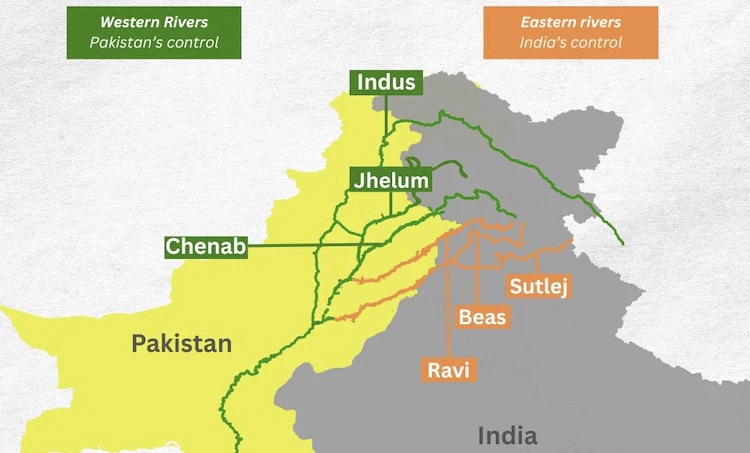
The Indus Water Treaty (with annexures) is a landmark document signed between India and Pakistan on 19 September 1960 at Karachi between Prime Minister Jawaharlal Nehru and President Ayub Khan. The protocol to the above treaty was inked on 27 November 1960. In order to mitigate financial risks and cover subsequent development works arising out of the treaty the International Bank for Reconstruction and Development (IBRD) was also a signatory, as a facilitator. They had a role during the transition period (10 years) where Pakistan had to develop infrastructures like dams, barrages, canals, link canals, etc to utilize the water of Western Rivers ( Indus, Jhelum, and Chenab). During the 10-year transition period, Pakistan was also allowed to savour the unrestricted use of Eastern Rivers (Ravi, Beas, and Sutlej). It is only recently that much of the water of the Eastern Rivers has been restricted from entering Pakistan. Since its independence Pakistan has used the water of all six rivers in a resplendent manner. India lacked the required infrastructure to utlise all the water from even the Eastern Rivers. The successive governments at the Center and States could have done more to utilize the precious water for use within Indian soil.
Salient features of IWT
The Pahalgam terror attack has stirred India to revisit the IWT of 1960. India feels fleeced by the underutilization of the precious water resource of Western Rivers. Jal Hi Jeeven Hai was lost sight of by Nehru and his advisors to conclude a lopsided deal favouring Pakistan. Crux salientia of IWT have been listed below for the countrymen to absorb the drought of ideas by the Indian side while crafting the treaty.
- The Western and Eastern Rivers have been defined including their tributaries. Even the tributary waters cannot be utilized by the upper riparian India.
- Introduction of a transition period to help Pakistan develop infrastructure to utlise Western River water.
- Financial provisions of Pound Sterling 62060000 to Pakistan by India to effectively utilize the Western River water.
- Pakistan has received an unrestricted flow of water from both Western and Eastern Rivers since its independence. India could not create enough infrastructure to use water rightfully as per the IWT. India instead paid for infrastructure development in Pakistan which was well utilized by them. India at the same time could not completely harness the water of even the Eastern Rivers. The water from Ravi, Beas, and Sutlej again flows unrestricted in the rainy season to Pakistan.
- Severe mental lethargy of the Indian polity in not creating the required infrastructure well in time in Ladakh, Jammu and Kashmir, Punjab, Himachal Pradesh, Haryana, and Rajasthan has allowed unrestricted wastage of water to Pakistan.
- Short-sightedness and the collective wisdom of the then Indian political and bureaucracy class are highly questionable. The population and land ratios at least could have been compared before arriving at such a skewed treaty. Nehru worked on equity and divided the three rivers without keeping in mind the national interest and a futuristic vision.
- The treaty clauses manifest loads of disadvantages for India while there are scores of advantages to Pakistan.
- Provisions exist to modify the treaty between the governments.
Pattern of Internationalisation of Issues
The International Bank for Reconstruction and Development (IBRD) was the third signatory to the treaty. Habitually the diplomatic understanding of Nehru had a propensity to internationalize any issue. In a bilateral water treaty, there was no reason to get IBRD since they paid nothing to develop the infrastructure within Pakistan. Contrarily the Western Rivers passed through J and K to include Ladakh and in 1948 Nehru went to the UN to call for a ceasefire Since then POJK has been administered by Pakistan hence it was axiomatic that IWT in 1960 shouldn’t have been signed but clamour for taking back POJK should have been the real agenda. IWT had no legitimacy due to POJK. It was a treaty for perpetual hurt to India and especially the people of J and K and Ladakh. It should have been deferred rather it was hurried by Nehru to pose as a diplomatic champion betraying the Indians. Similarly, Nehru even tried to ignore the sentiments of willing citizens of Goa, Daman, and Diu to join India on independence but persuaded engagement with the Portuguese government for egotistic reasons. Sardar Patel took charge and assimilation became an easy process.
Pakistan’s Dilemma
The suspension of IWT by India just before the commencement of Op Sindoor has been a very bold decision. Pakistan has been mauled badly during Op Sindoor and India has asked Pakistan to scrap terror and hand over the perpetrators. Suspension of IWT coupled with the success of Op Sindoor has checkmated Pakistan and it does not know how to wriggle out of a Catch 22 situation. Pakistan is a terror state and does not have the know-how to disassociate from terror policies and terrorists. India has clearly stated that Pakistan should vacate the POJK and stop terror within India. Pakistan in response has started denial tactics with its people and alleges India for illegal suspension of IWT. Pakistan understands that a few years down the line real water crisis will grip them but does not have the courage to peacefully reject the terror factory against India. Munir has echoed support for terror again after a month of Op Sindoor.
Resilient India
Suspension of IWT is a well-thought-out decision to provide an escape route to Pakistan to come out of the terror quicksand. In a way suspension of IWT is a bridge to Pakistan to imbibe the implications of India’s New Normal doctrine which amplifies No to terror and talks, terror and trade, nuclear blackmail and any further terrorist attacks will be paid back with punitive actions. India will decide when, where, and the intensity. India’s New Normal doctrine is an inspiring scope for India and a deterrent for Pakistan for new misadventures. India needs to provide the required gatishakti to develop infrastructure to harness legitimate water share from the Western Rivers of an upper riparian state.
Futuristic Road Map
India has to learn to say no to talks on the water treaty unless Pakistan suspends the terror factory. Pakistan has started sensing the heat of water scarcity and threatens to fight it out but realizes that mightier India will not cede till terror activity is closed forever. Pakistan has disrespected the quintessence of the treaty and defied the spirit of goodwill, friendship, and a cooperative spirit while profusely utilising the water of Western Rivers.
India has to develop a canal network to take the water to farther areas in Rajasthan and Gujarat. Enhance the water holding capacity of existing canals in Ladakh, J & K, and Punjab post haste by broadening the existing canals, linking lakes, construction of reservoirs enhancing the capacity of existing hydropower projects e.g Pahalgam, Bandipura, Dachhigam, Ranbir Canal, Udhampur, and Poonoh. Provision for all these and many more ways to utilise the western river waters exists as per the IWT 1960.
As per Article III Para 2 of IWT India has complete rights on Western Rivers for agricultural, domestic, industrial, generation of hydropower, and non-consumptive usages which remained latent so far. There is a need to consume the water to its potential.
Convey to the International community of no space to compromise on terror plots by Pakistan and yet enjoy the benefits of IWT. Pakistan can be an affiliate of the USA and China but they are using Pakistan for their strategic gains. The people of Pakistan are the prey but the Pakistan Military and polity won’t heed. Pakistan is on a terrible and pathetic course of action. Since the IWT is held in abeyance as of now Pakistan has to take the initiative to shun terror to bilaterally resolve and coexist in peace.
Conclusion
It is expected from Pakistan that the Protocols of the IWT 1960 treaty are followed in good faith and friendship. Water and terror cannot coexist.
Friendship means that in all walks of life, selective friendship has no space in a bilateral relationship.
India has the right of usage of the waters of Western Rivers and capacities will be developed in due course to harness the same.


 Insightful Geopolitics
Leave a reply to S0bha Rose Cancel reply