Beijing’s Standing Claim on Arunachal Pradesh
China’s posture on Arunachal Pradesh is neither new nor ambiguous. Beijing asserts that the entire state is Chinese territory and dismisses India’s administration, elections and infrastructure there as illegitimate. Even when bilateral mechanisms such as Corps Commander-level talks are active, Chinese spokespersons pair routine assurances that the border is “generally stable” with explicit reiterations that China does not recognize the “so-called Arunachal Pradesh illegally set up by India.”
India’s position is straightforward: Arunachal Pradesh is an integral part of India, and the McMahon Line, agreed between British India and Tibet during the 1914 Simla negotiations, constitutes India’s legitimate eastern boundary. China participated in the negotiations but rejected the final convention and continues to dispute the line.
Beijing’s claim is closely linked to its control over Tibet. China argues that historical connections between Lhasa and Tawang make Arunachal Pradesh an extension of southern Tibet. India’s recognition of Chinese sovereignty over Tibet, without securing Chinese acceptance of the boundary, did not resolve this dispute.
The result is a strategic asymmetry: India accepts Beijing’s position on Tibet, while Beijing continues to challenge India’s territorial position in the eastern Himalayas.
Deep Civilizational Roots: Tibet, Kailash and Mansarovar
Tibet is not merely a twentieth-century buffer. Long before modern nation-states, its geography was woven into the sacred and cultural fabric of the Indian subcontinent.
The Puranas, Ramayana and Mahabharata refer to and venerate Kailash Parvat and Mansarovar Lake. Kailash is regarded as the abode of Lord Shiva, while Mansarovar is associated with sacred traditions surrounding Brahma. The Indus, Sutlej, Brahmaputra and Karnali systems originate across the wider Tibetan plateau, including the Kailash-Mansarovar region, binding the ecological and spiritual geography of the subcontinent to Tibet.
Tibet’s cultural and spiritual orientation also looked south. Its script developed from Indian script traditions, and Tibetan Buddhism was profoundly shaped by Indian masters from Nalanda and Vikramashila, including Padmasambhava, Shantarakshita and Atisha. For centuries, Indian pilgrims crossed Himalayan passes to visit Kailash and Mansarovar under arrangements with Tibetan authorities.
The annexation of Tibet did not merely alter a political buffer. It transformed India’s relationship with a region connected to its civilizational heritage and placed access to that geography under the control of a strategic rival.
When Tibet Was the Power: Turning Beijing’s Logic Around
Beijing’s historical argument for Tibet rests on the assertion that Chinese dynasties once exercised influence over Tibet and therefore Tibet belongs to China. History, however, does not support a one-way interpretation.
From the seventh to ninth centuries, the Tibetan Empire was a major Asian power. In 763, Tibetan forces captured Chang’an, the Tang capital. The Sino-Tibetan treaty of 821–822, commemorated by a bilingual pillar in Lhasa, described relations between the two sides in language reflecting their status as political equals.
Marriage alliances also reflected the diplomatic relationships of the era. Princess Wencheng of the Tang court married the Tibetan emperor Songtsen Gampo, Princess Jincheng was sent to Tibet in 710, and Songtsen Gampo also married the Nepali princess Bhrikuti. Such alliances were instruments of diplomacy between neighbouring powers, not proof that one political entity permanently belonged to another.
The same historical logic can be applied in reverse. If past military control, tribute or political influence establishes permanent sovereignty, then Tibetan military victories over Chinese territories or Chinese concessions to Tibet could be used to construct counterclaims.
India need not endorse such claims. The point is that historical control cannot, by itself, determine modern sovereignty. A principle that proves everything ultimately proves nothing.
How India Gave Away the Tibet Card
Between the fall of the Qing dynasty in 1912 and the PLA’s entry in 1950, Tibet exercised substantial de facto autonomy and many attributes of independent statehood. It maintained its own government, currency, armed forces, administrative system and external relations, although its international status remained contested and China continued to claim sovereignty.
Tibet negotiated the 1914 Simla Convention with British India and China. Although the Chinese plenipotentiary initially led the draft convention on 27 April 1914, the Chinese government repudiated his action, refused to accept the agreement, and withdrew from the convention process. Britain and Tibet subsequently proceeded with a separate declaration on 3 July 1914, which included the boundary arrangement known as the McMahon Line.
The British position was itself shaped by imperial priorities. Britain was interested in Tibet principally as a buffer protecting India from rival powers, particularly Russia and later Chinese expansion. It did not wish to assume the cost of defending Tibet, establish an expensive northern frontier, or become entangled in a major confrontation with China.
British policy was therefore inconsistent. To suit its purpose, the Britain maintained diplomatic ambiguity rather than preserving Tibet’s buffer. Thus, by the time Britain transferred power to India, it had left behind a complicated frontier arrangement rather than a fully resolved political settlement. Some say it was by design.
When Mao’s forces entered Tibet in 1950 and Tibetan representatives were coerced into signing the Seventeen Point Agreement in 1951, Nehru prioritised Asian solidarity and avoided confrontation. India’s strategic position was extremely constrained.
In 1954, New Delhi signed the Panchsheel Agreement, formally placing India’s trade, pilgrimage and other relations with Tibet within a framework conducted through the People’s Republic of China. The accompanying arrangements also ended or transferred several inherited Indian privileges and facilities in Tibet. For the first time, the agreement’s formal title referred to the “Tibet Region of China.”
The strategic failure lay not necessarily in recognizing the reality of 1954, but in assuming the concession would generate goodwill sufficient to settle India’s wider territorial disputes. Beijing took the recognition but did not settle the border.
Later governments reinforced the concession. In 2003, India explicitly recognized the Tibet Autonomous Region as part of the PRC without a formal Chinese commitment to settle the boundary. China subsequently made practical adjustments concerning Sikkim, but these developments were not a comprehensive settlement of India’s territorial concerns and should not be presented as a direct exchange for India’s Tibet recognition.
The Illusion of Buying Peace
For decades, realists in New Delhi justified recognition on pragmatic grounds: virtually no major country recognizes Tibetan independence, reversal could provoke retaliation along the LAC, and the official position preserves channels for trade and border management.
Measured against outcomes, however, the policy has not delivered a durable resolution.
- 1962 War: Eight years after Panchsheel, China invaded India, seized Aksai Chin and temporarily overran parts of Arunachal Pradesh.
- Persistent coercion: From Nathu La in 1967 and Sumdorong Chu in 1986 to Doklam in 2017 and Galwan in 2020, recognition did not prevent serious military confrontations.
- Escalating claims: Beijing has hardened its stance on Arunachal Pradesh, issued standardized Chinese names for locations inside the state, used stapled visas for some Indian citizens from the region and built dual-use border villages.
- Water vulnerability: China’s control of the Tibetan plateau gives it an upstream position over major river systems flowing into India. Dam construction, hydrological data and water-management decisions create a long-term strategic and environmental vulnerability.
Government Data Reveal the Scale
Government of India data reproduced in the academic study show the scale of reported border transgressions. Between 2006 and 2019, the government reported an average of approximately 334 transgressions annually. The highest figure in the series was 663 in 2019. These figures are reported transgressions, not necessarily military clashes or armed confrontations; the category includes border incidents of varying nature and severity.
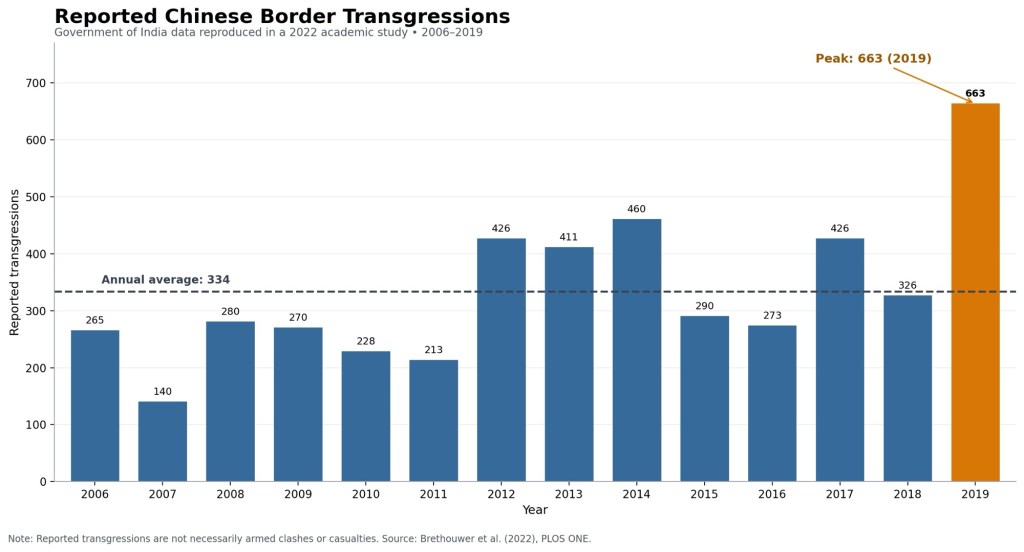
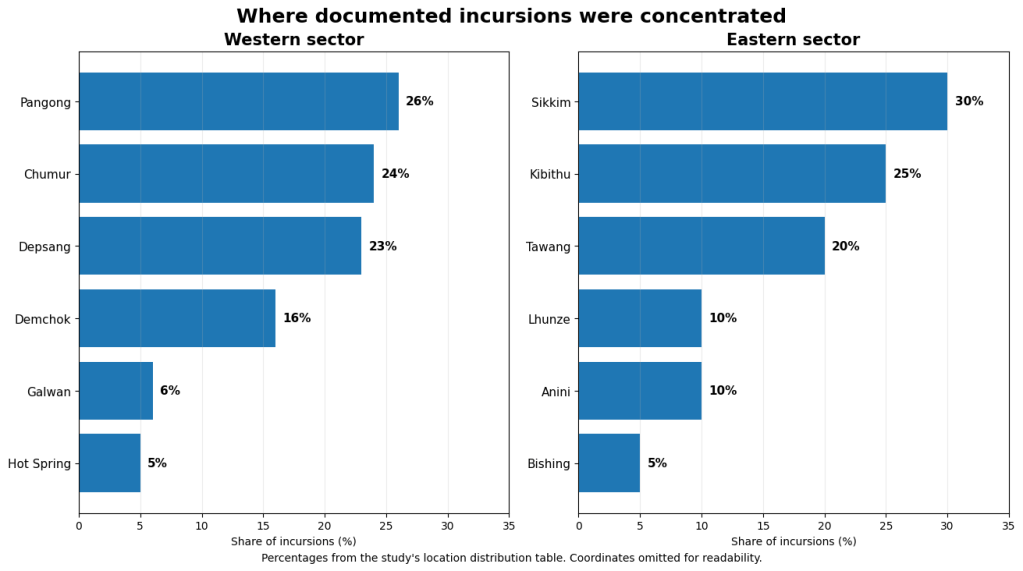
Figure. Government of India reported transgressions, 2006–2019. Source data reproduced in Brethouwer et al. (2022).
The annual figures are shown above. The pattern demonstrates that border activity continued on a substantial scale despite decades of diplomatic engagement, agreements and confidence-building mechanisms. The chart should not be interpreted as a count of battles or casualties, but as an indicator of persistent border friction and the scale of reported Chinese transgressions.
History Is Not a Title Deed: The Nepal Example
Historical arguments about sovereignty must be applied consistently.
Nepal and the Qing Empire fought during the Sino-Nepalese conflict of 1788–1792. Nepal initially achieved military gains in Tibet. During the subsequent Qing campaign, Chinese forces advanced into Nepal, but Nepalese resistance and the eventual settlement ended the conflict.
Nepal subsequently entered a formal relationship with the Qing Empire that included periodic diplomatic missions. Yet China did not annex Nepal or establish sovereignty over its territory.
The lesson is straightforward: military victories, defeats, tribute arrangements, diplomatic influence and historical relationships do not automatically create permanent territorial ownership.
If China argues that historical influence establishes sovereignty over Tibet, the same principle cannot be selectively applied to every region where Chinese dynasties exercised influence—or to every territory over which Tibet once exerted power.
Modern sovereignty must be evaluated through a broader framework of history, political status, international law, treaties, the wishes of populations and the circumstances under which control was established.
Why India Must Re-examine Tibet
The wider world experiences the consequences of Chinese rule in Tibet differently from India. For Washington, London, Brussels and Tokyo, Tibet is principally a question of human rights, international norms and strategic competition. For India, it is also an immediate question of geography, national security, water security and the military balance along its northern frontier.
India has historical, strategic and moral grounds to re-examine the assumptions underlying its recognition. The circumstances of the PLA’s entry in 1950, the contested status of the Seventeen Point Agreement, and Tibet’s substantial de facto independence beforehand justify a serious international debate about Tibet’s status.
India need not prejudge that debate to recognize that its present position has failed to secure the territorial assurances it sought.
If China refuses to recognize Arunachal Pradesh, Ladakh or India’s territorial position in Jammu and Kashmir, there is no strategic logic in treating India’s recognition of Chinese sovereignty over Tibet as an untouchable diplomatic doctrine.
A change in India’s position need not begin with formal recognition of Tibetan independence. Greater engagement with Tibetan institutions, easing unnecessary restrictions on Tibetan political activity, raising Tibet’s historical status in international forums and reassessing the legal and diplomatic assumptions behind India’s position could themselves alter the strategic calculus.
Assertive Diplomacy Backed by Military Preparation
Reversing seven decades of diplomatic orthodoxy cannot be an impulsive gesture. A sharp challenge to China’s position on Tibet could freeze relations and invite military, economic, cyber and diplomatic pressure.
India must therefore pair assertive diplomacy with credible deterrence.
Infrastructure and logistics: All-weather roads, tunnels, forward airfields, rail links, bridges, logistics hubs and resilient supply chains across Ladakh, Uttarakhand, Sikkim and Arunachal Pradesh.
Joint military preparedness: Integrated intelligence, surveillance, air defence, long-range precision capabilities, drones, improved joint planning and appropriately configured mountain forces capable of deterring aggression and responding effectively to escalation.
Maritime leverage: Strengthen India’s ability to monitor and influence critical Indian Ocean sea lanes, protect its own maritime interests and create strategic options in a wider conflict.
Economic resilience: Reduce excessive dependence on Chinese pharmaceuticals, electronics, industrial inputs and critical supply chains so Beijing cannot weaponise trade.
India must build the capabilities required to deter coercion before making major diplomatic changes. Diplomacy without credible power risks becoming an invitation to pressure.
The International Cost of Reversing Recognition
Reversing recognition would carry heavy costs. Beijing would treat it as a direct challenge to its sovereignty and could retaliate through pressure along the LAC, economic restrictions, cyber operations, diplomatic campaigns and intensified support for Pakistan.
Many major powers, despite concerns about human rights and Tibetan autonomy, are unlikely to back a formal Indian declaration of Tibetan independence. India could therefore receive sympathy for its broader security concerns while remaining isolated on the question of Tibet’s formal status.
China is also deeply embedded in global supply chains and India’s industrial ecosystem. A sudden reversal could disrupt trade, investment and access to critical components precisely when India must modernize its forces and accelerate domestic industry.
India must distinguish among re-examining its Tibet policy, increasing support for Tibetan autonomy and self-determination, and formally recognizing Tibetan independence. Each carries different consequences.
Any revision must be deliberate, coordinated with partners where possible, and undertaken only after India strengthens its military preparedness, economic resilience, infrastructure and partnerships. The objective should be to increase India’s leverage and options—not to provoke a crisis for which it is unprepared.
The Taiwan Contingency
A major crisis in the Indo-Pacific could alter China’s strategic priorities and the regional military balance. India must examine how a conflict involving Taiwan could open a window for India to sustain military pressure along the Himalayan frontier. In fact, that could be India’s best chance to regain Aksai Chin.
Military estimates must be interpreted carefully. A 2018 Carnegie Endowment analysis estimated approximately 90,000–120,000 ground-force personnel in China’s Western Theatre Command, alongside approximately 40,000 in the Tibet Military District and 70,000 in the Xinjiang Military District. These are estimates of force structures, not troops immediately available for a Himalayan offensive.
A separate RUSI analysis published in 2020 estimated approximately 230,000 personnel in the PLA’s Western Theatre Command, compared with approximately 225,000 Indian Army troops potentially mobilisable from India’s Northern, Central and Eastern Commands. These figures do not represent directly comparable forces immediately available for combat; actual military balances would depend on deployment, logistics, air power, terrain and operational objectives.
A Taiwan conflict could place extraordinary demands on Chinese military, naval, air, logistical, economic and diplomatic resources. But India must not assume that such a crisis would automatically create a favourable military opportunity in the Himalayas. China could reinforce its western theatre, escalate along the LAC, or seek to exploit India’s strategic uncertainty. Pakistan could also create pressure on India’s western frontier.
India’s objective should be to maintain the capability to protect its territorial interests under a range of contingencies—not to depend on another country’s crisis as the basis of its strategy. A Taiwan conflict is a contingency India must study and prepare for, not an opportunity it should assume will arise.
Conclusion: The Price of Strategic Illusion
India’s mistake was not simply recognizing Chinese control of Tibet under the difficult circumstances of the 1950s. Its deeper mistake was believing that a unilateral concession could substitute for the hard bargaining required to protect national interests.
History offers no guarantee that accommodation produces moderation. Nepal’s conflicts with Qing China demonstrate that military victories, defeats, diplomatic influence and historical relationships do not automatically establish permanent sovereignty. Tibet’s history demonstrates that the same principle must apply consistently: historical claims cannot be treated as unquestionable simply because the claimant is powerful.
India should neither romanticize the past nor be imprisoned by diplomatic decisions made seven decades ago. Recognition is a policy—not a sacred obligation. If it has failed to deliver the security and territorial assurances expected of it, India has every right to reconsider its assumptions.
The objective should not be war, territorial adventurism or a gamble on China’s involvement elsewhere. It should be the restoration of strategic balance: stronger borders, credible deterrence, economic resilience, diplomatic freedom and the ability to question assumptions that have ceased to serve India’s interests.
India must stop confusing restraint with strength and concessions with peace. A border is secure not because one side has made diplomatic gestures, but because neither side believes it can change the status quo through coercion.
The Himalayas will not be secured by goodwill alone. They will be secured when India’s diplomacy is backed by power, its power by preparedness, and its policy by the courage to reconsider yesterday’s decisions.


Leave a Reply