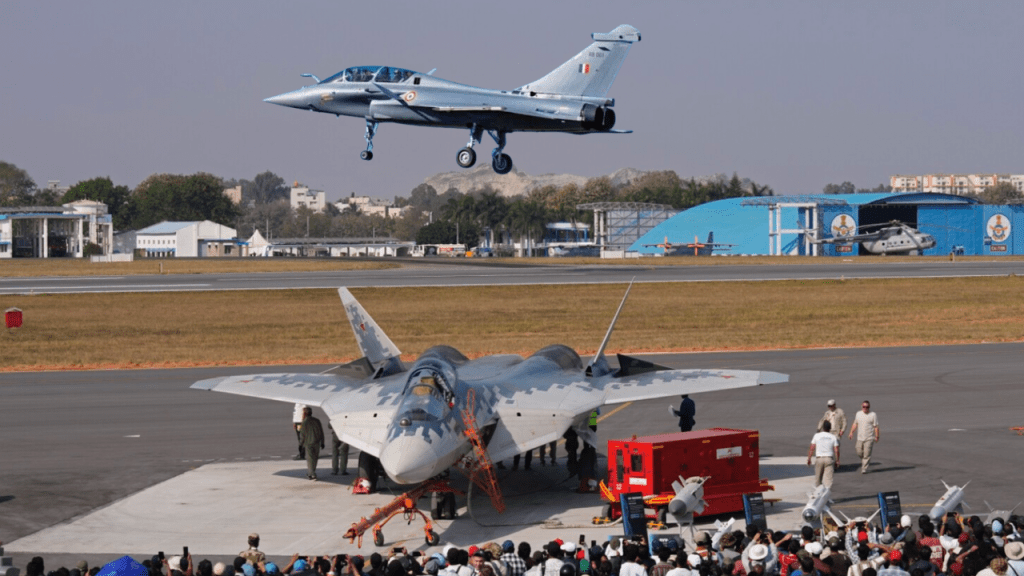
Currently, the Indian Air Force (IAF) has 28 operational fighter squadrons, including Su-30MKI (12 squadrons), MiG-29UPG (3), SEPECAT Jaguar (6), Mirage-2000 (3), LCA Tejas Mk1 (2), and Rafale (2). Starting from 2030, MiG-29, Jaguar, and Mirage-2000 squadrons will begin retiring, with complete retirement by 2035. To extend the Jaguar fleet’s lifespan until 2035, India recently purchased 20 used Jaguars from the Omani Air Force for spare parts. Despite this, around 11 squadrons, or approximately 250-260 aircraft, will phase out gradually until 2035. This means the IAF will be left with only 17 squadrons by that year.
However, the IAF has ordered 180 Tejas Mk1A fighters (83 + 97) and plans to order 120-130 Tejas Mk2 fighters (six squadrons, with the possibility of increasing orders up to 200 platforms). Now, some numbers — Hindustan Aeronautics Ltd. (HAL) can produce only 24 airframes annually. So, building 180 planes would take about 7.5 years, if there are no delays. The biggest obstacle is General Electric (GE), the supplier of the F404-GE-IN20 turbofan engines.
HAL initially contracted GE to supply 99 F404-GE-IN20 engines, each producing 85 kN, in March 2021. An additional 113 engines were signed in November 2025. The first engine was scheduled for delivery by March 2023 but was only delivered in March 2025. Since then, GE has provided just five engines over nine months. Even if GE delivers two engines per month, full delivery wouldn’t occur before 2032, meaning the Tejas Mk1A project would not be completed until then.
The Tejas-Mk2 will be powered by a GE F414-INS6 engine, generating 98 kN. Negotiations for this engine are ongoing and expected to conclude by the first quarter of 2026. The same engine will power India’s 5th-generation Advanced Medium Fighter Aircraft (AMCA) Mk1 (two squadrons). The AMCA Mk2, which will comprise five squadrons, will be powered by a 120-140 kN engine developed through a joint venture between India’s Defence Research and Development Organisation (DRDO) and Safran of France.
If HAL aims to complete the Tejas Mk1A project by 2032, how will the Tejas Mk2 project commence without increasing capacity? Since the Indian government is involving private companies in the AMCA project, the induction of AMCA Mk1 could have a similar timeline to Tejas Mk2 — around 2035 or later. The engine for the AMCA Mk2 will take approximately 12 years to develop, pushing its induction to 2037 or beyond. Therefore, the timeline for the AMCA’s entry into service could extend to 2040.
The enemies
India’s main adversaries are clear: China, Türkiye, their junior partner Pakistan, and desperate for recognition, Bangladesh. Bangladesh has been repeatedly urged to buy JF-17 or J-10C fighters, despite skepticism about their performance and propaganda surrounding both platforms. Consequently, Bangladesh has wisely decided to acquire 12 Eurofighter Typhoons.
Pakistan has already received 25 J-10C fighters. It is uncertain how many J-10Cs remain after the brief war with India in May 2025 and the recent rumors of a mid-air collision. Following ‘Operation Sindoor,’ Pakistan expressed interest in procuring 40 J-35A fighters, China’s fifth-generation jet. China offered Pakistan a 50% discount and quick delivery, seeing it as a testing ground for unproven fighters. There has been no further development on this story.
Türkiye has faced setbacks with its KAAN fifth-generation fighter program. They struggle to procure a suitable engine, and their own engine is a decade away. As a result, they have decided to give up Russian S-400 air defence systems and rejoin the F-35 program.
China already operates two fifth-generation fighters — the J-20 and J-35, though experts don’t consider them true fifth-generation fighters. China has around 300 J-20s and adds 70-100 new units annually. They are also developing two sixth-generation fighters — Chengdu J-36 and Shenyang J-50. Before we move forward let us have a look at what are the fifth and sixth-generation fighters:
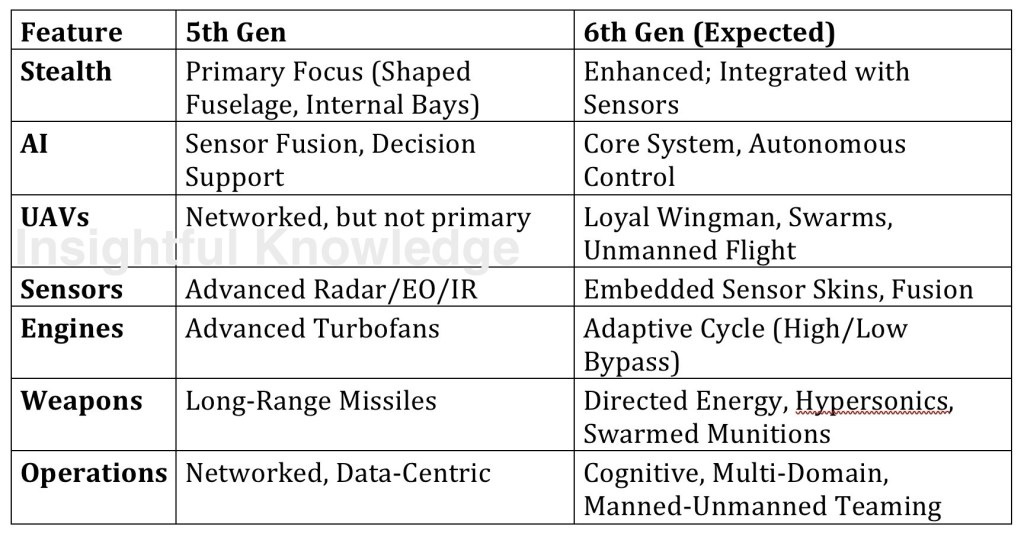
The Indian Air Force dilemma
The overall outlook for the IAF is grim. India is roughly 25 years behind China in fighter aircraft development. India’s interim Multi-Role Fighter Aircraft (MRFA) program has been a series of fits and starts. The IAF has also been inconsistent, frequently changing requirements at the last minute.
Sadly, the current IAF’s capacity is being compared with Pakistan’s. So, what should be the MRFA’s choice? Two main options emerge — the French Rafale or the Russian Su-57.
The Rafale enigma
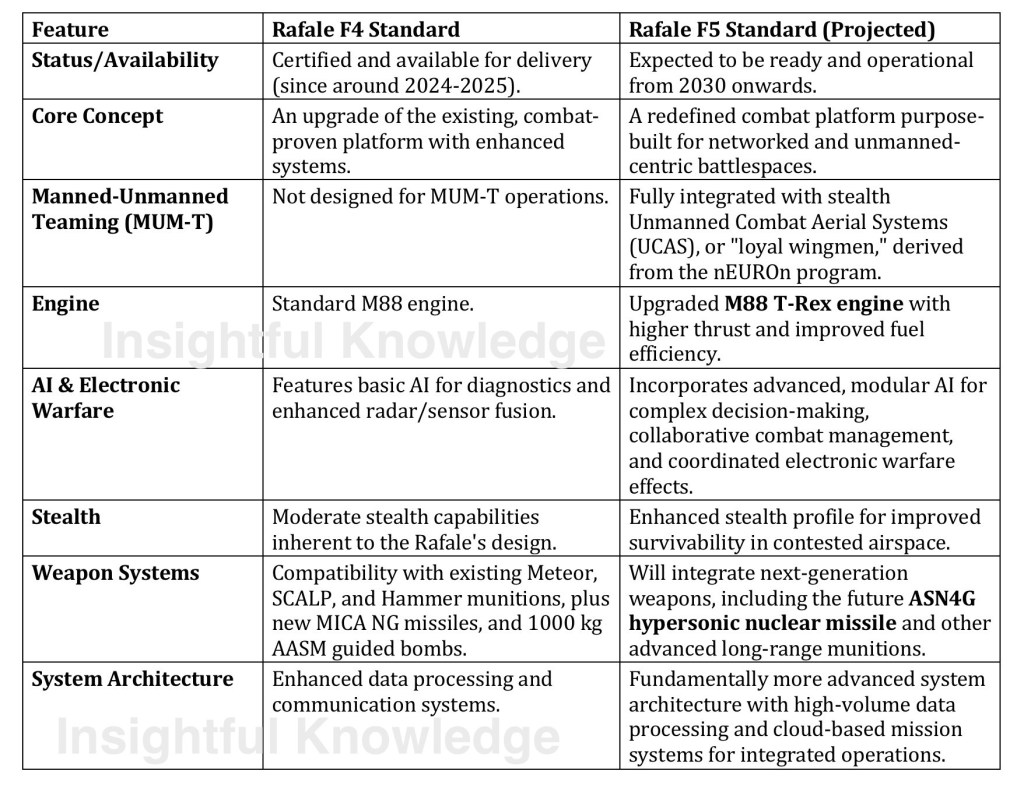
India currently operates 36 Rafale F3-R fighters. France is now offering the F4 variant, with the F5 version expected by 2030. The F4 significantly upgrades the existing platform with better connectivity, sensors, and weapons, making it a more networked fighter with improved electronic warfare, a new helmet display (Scorpion HMDS), an advanced targeting pod (TALIOS), and next-generation weapons like the MICA NG missile and 1000kg Hammer bomb.
The F5 will be a major leap, focusing on manned-unmanned teaming, advanced AI, and integrated systems. It will feature a more powerful M88 T-REX engine, enhanced stealth, and sensors designed to work with drones for complex missions. However, it remains a design suited to a pre-stealth era — capable of dodging, deceiving, and maneuvering, but not disappearing. In modern combat, beyond-visual-range engagements are won by who sees first, acts fastest, and maintains near-invisibility, which the F5’s design does not fully support.
The Su-57 — One Step Forward Two Steps Back
India’s history with the Fifth Generation Fighter Aircraft (FGFA) program dates back to 2007, when India and Russia signed an agreement for joint development. The program faced numerous delays and disagreements, leading India to withdraw in 2018 after investing about $295 million.
India’s concerns included the limited stealth features (only frontal arc) and engines (AL-41F1) unable to achieve supercruise. The projected cost per aircraft was also prohibitively high — around $150–$200 million. Russia was reluctant to share key technologies, thwarting India’s goal of customization. HAL did not receive its fair share of work in development and production. Consequently, doubts also grew about Russia’s commitment, given the slow deployment and progress.
Recently, at the Dubai Airshow, Russia showcased a pre-production Su-57 prototype with open internal weapons bays, revealing insights into its layout. A scale model of the export version, the Su-57E, displayed thrust-vectoring nozzles designed to reduce radar and infrared signatures. Russia also unveiled the new Izdeliye-177S turbofan, a derivative of the AL-41F-1, which could be used in new Su-57 exports or upgraded existing fighters. The cockpit now features a single wide-area display, aligning with global fifth-gen standards. However, despite claims of combat experience over Ukraine and continuous upgrades, details remain sparse. Russia has not addressed India’s persistent concerns about the aircraft’s maturity and the IAF’s request for a detailed familiarization with the fighter jet.
Rafale or Su-57 — The Time for Decision is Now
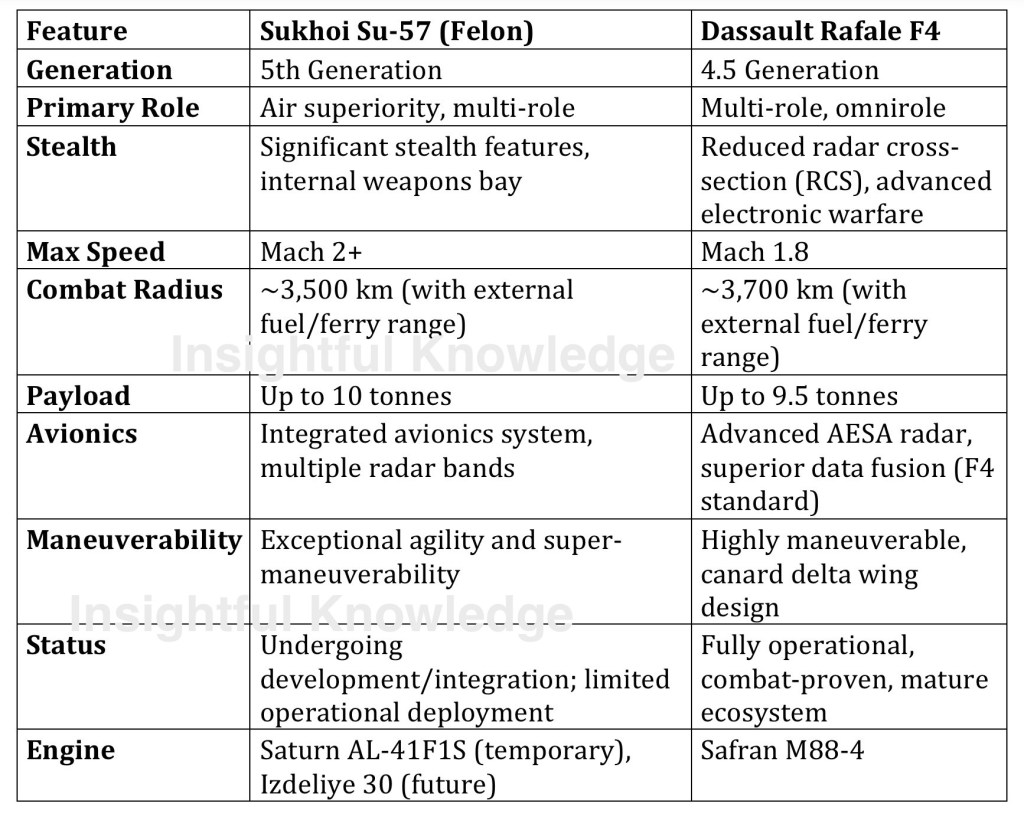
While the Rafale F4/F5 impresses, it is akin to a beautifully restored classic car — elegant and formidable in its own right but out of step with the next wave of air combat. Nations can buy and fly it, getting value, but it’s not suited for a future dominated by sixth-generation fighters.
The Advanced Medium Combat Aircraft (AMCA) program is unlikely to produce a flying prototype anytime soon. The US’s F-35 remains an uncertain partner, despite optimistic remarks. Therefore, what India left with is Su-57 and there is no time left to ignore that offer.
Russia offers immediate access, deep technology, and political insulation, but India has valid reasons to remain skeptical. Russia has overpromised in the past and underdelivered on critical technologies, exemplified by the S-400 system. Nonetheless, historically, Russia has been more open to technology transfers than the West.
Today, the Indian Air Force faces a critical juncture. It needs to prepare for future battles, but past mistakes and delays mean it is still living in yesterday’s tomorrow, rather than being ready for the world of tomorrow.


 Insightful Geopolitics
Leave a reply to Commander Sandeep Dhawan (Veteran) Cancel reply