
In the last few weeks, the Indian civil aviation has witnessed as many as 450 GPS jamming and spoofing cases. Now these could be due to Pakistani military activities or the Indian electronic warfare units deployed to jam the Global Positioning Systems (GPS) of Pakistani military aircraft. The Indian military units could also be conducting trials deep inside Indian borders, especially to secure the capital, New Delhi.
However, this has created issues for flights within India flying over cities in the vicinity. Though as of now there is no major passenger safety issue involved, the flights are forced to fly a little longer due to problems encountered by the navigation aids inside the cockpit.
A source from the civil aviation ministry stated: “Of late, we have received complaints from pilots of different airlines flying over Amritsar, Chandigarh, Srinagar, and as far as Delhi about the sudden signal drops at some points during travel. This forces them to fly a little longer than expected. Airlines are now loading some extra fuel in the flights flying towards this direction, considering the need to move around a bit extra distance whenever needed.” The source further stated that the Directorate General of Civil Aviation is aware of the issue.
As per aviation safety consultant and former pilot Captain Mohan Ranganathan, “All flight management systems use GPS signals, and separations are based on accurate signals. If they are degraded, radar separations and conventional navigation have to be followed. This will cause delays. Airlines and Air Traffic Controllers will have to anticipate disruptions in schedules.”
A military pilot further clarified the issue — “This can happen in any war-ravaged area. It is called a GPS-denied airspace. Defence aircraft are mostly fully equipped and won’t be affected by GPS spoofing as the technology and satellites are under our control.”
What are Jamming, Spoofing, and Hacking
During Op Sindoor, India deployed advanced jamming systems along its western border to disrupt the Global Navigation Satellite System (GNSS) signals used by Pakistani military aircraft, significantly degrading their navigation and strike capabilities. The move came after India shut its airspace for Pakistani commercial flights from 30 April onwards. The Indian jamming systems were capable of interfering with multiple satellite-based navigation platforms, including GPS (U.S.), GLONASS (Russia), and Beidou (China)—all of which are used by Pakistani military aircraft.
According to a report by the global civil aviation tracker, Flightradar24, “GPS jamming involves saturating GPS receivers with unknown signals to render the receiver unusable, essentially degrading everyone’s ability to effectively use GPS for navigational issues.” Let us delve into the issue a little deeper, one by one.
Jamming is the intentional interference with GPS transmissions to disrupt signals that aircraft, ships, missiles, and drones depend on for navigation. GPS jamming occurs when a device emits radio signals on the same frequency as GPS satellites, which are more powerful than the satellite signals, making navigation systems ineffective.
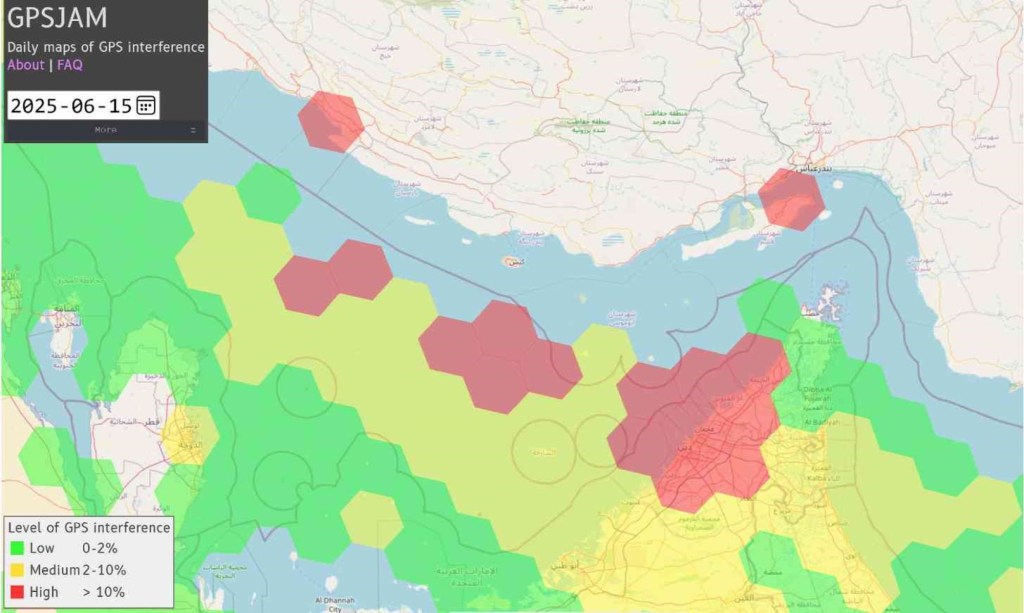
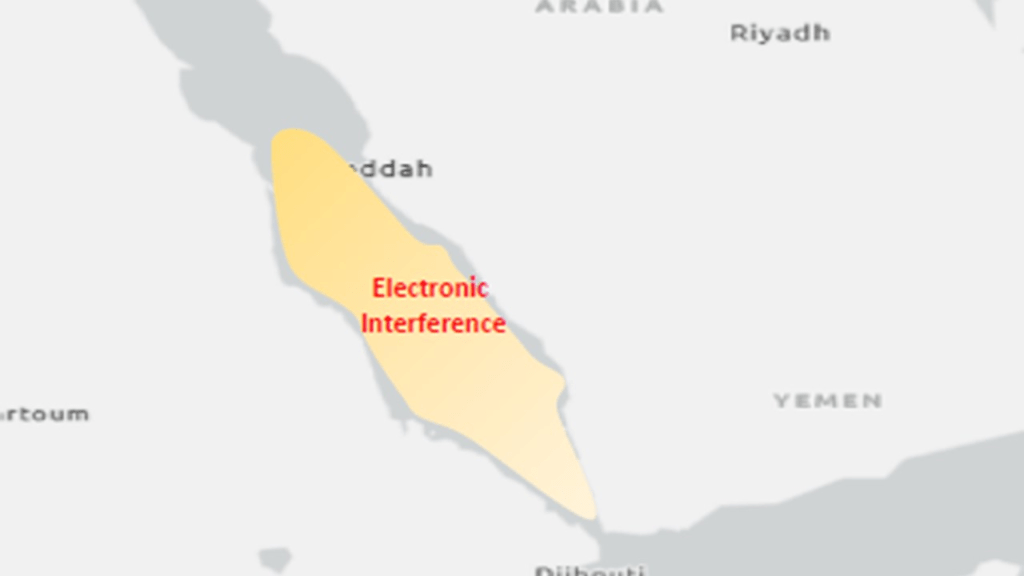
Recent incidents highlight the increasing presence of GPS jamming, especially in high-risk areas such as the Strait of Hormuz, Black Sea, Eastern Mediterranean, Red Sea, and other regional hotspots. Such incidents not only complicate navigation but also raise security and compliance concerns, particularly regarding potential sanctions evasion.
Jamming is often linked to military activities, emphasizing the geopolitical aspects of GPS jamming. In the Black Sea, and of late on the India-Pakistan border where military operations are common, the risk of collateral damage to commercial flights and vessels is higher. The aviation and maritime authorities have urged caution among airline and ship operators.
GPS Spoofing happens when false signals are transmitted to deceive navigation systems. Airborne or shipborne systems lock onto the fake signal, and if the user does not identify it, this can lead to a loss of situational awareness, navigational errors, and increased risk of accidents.
Compliance professionals also face challenges in accurately verifying an airplane or ship’s movements due to GPS jamming and spoofing. This issue is especially pronounced in high-risk areas. Recent incidents underscore the growing prevalence of GPS spoofing and the need for comprehensive mitigation strategies.
High-profile spoofing cases have been reported in the Black Sea, where aircraft and ships’ GPS systems showed them miles inland. More recently, the Joint Maritime Information Center (JMIC) published its latest weekly bulletin dated June 17, noting ongoing reports of electronic interference in the Strait of Hormuz.
GPS hacking involves unauthorized access or manipulation of a platform’s GPS-based navigation systems. Unlike jamming or spoofing, which externally interfere with signals, GPS hacking targets the software or systems processing those signals, potentially gaining control over navigation data or system functions.
Hackers exploit vulnerabilities in onboard systems to alter GPS data, disrupt navigation, or feed false information to operators. This can result in incorrect positioning, course deviations, or interference with route planning and collision avoidance systems. In some cases, hackers might manipulate logs or disable alerts, making detection difficult for the users.
Usually performed remotely, hackers look for vulnerabilities in wireless or satellite communication links to access the platform’s systems. The consequences can be severe, especially in crowded or sensitive airspace or maritime areas. Recent cyber incidents have raised alarms.
The Threat is Real
As many as 1500 jamming and spoofing cases are reported across the globe every day. The spoofing poses a greater threat to unprotected aircraft navigation systems than GPS jamming. In jamming scenarios, an attacker floods the GPS frequency with electromagnetic noise, causing the receiver to lose lock on faint GPS signals. While this isn’t ideal, it’s usually not a high-risk threat because the inertial navigation system can take over until the aircraft exits the jammer’s range. Sometimes, jammed receivers can behave unpredictably, so testing against this threat and understanding how your systems might be affected are important, but overall, the risk remains relatively low.
In a spoofing attack, the attacker broadcasts fake GPS signals that can cause an unprotected receiver to calculate a wildly incorrect position. Even with redundant GPS receivers, both can feed false data to the GPIRS, ADS-B, and eGPWS, leading all of these systems to operate with incorrect position information.
The impact of spoofing can thus be widespread. If it goes undetected or if flight crews are not briefed to expect potential spoofing in certain areas, the danger increases significantly. In worst-case scenarios, the aircraft could go off course, possibly into dangerous airspace, with an increased risk of collision with terrain or other aircraft.
Apart from these extreme cases, spoofed GPS signals can still significantly affect pilots and flight crews. They can cause systems to malfunction, raising workload and reducing operational options and safety margins. Reviewing the transcript of Azerbaijan Flight J2-8243 before the tragic crash highlights how much the workload can escalate when GPS becomes unreliable.
The Way Forward
Currently, India’s GAGAN (GPS-Aided GEO Augmented Navigation), a Satellite-Based Augmentation System (SBAS), does not inherently “avoid” all GPS jamming and spoofing. It improves the overall resilience and integrity of the navigation system, helping to detect and reduce these threats. The government of India needs to examine how GAGAN could make satellite-based navigation more resilient since all aircraft registered in India after July 1, 2021, were required to have GAGAN equipment.
There are many other ways to mitigate the threat of GPS jamming and spoofing. Of course, this would lead to an added financial burden on the airline and ship operators. Some of the recommendations are:
Multi-constellation, Multi-frequency Receivers: Modern receivers can utilize signals from multiple Global Navigation Satellite Systems (GNSS), such as Galileo, GLONASS, and BeiDou, and leverage various frequencies (L1, L2, L5) to detect discrepancies and enhance resistance to single-source interference. Signal
Authentication: New protocols like Galileo’s Open Service Navigation Message Authentication (OS-NMA) and future systems like GPS Chimera employ digital signatures to verify signals are authentic and unaltered.
Advanced Antenna Technology: Controlled Reception Pattern Antennas (CRPAs) and adaptive antenna arrays electronically nullify or filter interfering signals’ directions, allowing legitimate satellite signals to be received.
AI-Powered Detection: Machine learning and sophisticated signal processing techniques are being developed to identify and counteract unusual signal anomalies that may indicate an attack in real-time.


Leave a Reply