
Two years ago, I discussed how India’s neighboring countries were increasingly burdened by debt, which I referred to as the ‘Ring of Debt.’ I also predicted that after this phase, anti-India forces would move into the ‘transition phase,’ followed by the ‘dominance phase.’ With Sheikh Hasina’s government in Bangladesh losing power in 2024, one of India’s strongholds was captured. All the experts thought that now almost every neighboring country of India is, to some extent, a conflict zone. They all overlooked Nepal.
Before we delve into the issue of Nepal, let us briefly look at the whole game plan. In his 2010 book, “Monsoon: The Indian Ocean and the Future of American Power,” Robert D. Kaplan emphasizes the increasing importance of South Asia in shaping global power dynamics in the 21st century. Today, 80% of the world’s oil & gas, 40% of the world’s trade, and $900 billion worth of Chinese cargo pass through the Indian Ocean Region (IOR). Owing to its strategic geographical location, India holds a key position as the dominant player in the IOR. Both the US and China seek to influence India to align with their respective interests, leading to a complex and conflicting situation as India aims to assert its independent growth trajectory. Trump’s tariff strategy and China’s recent courtship of India are part of this larger strategy.
The Methodology
This conflict of interest and desire to control India has given rise to a ring of conflict zones around India. The whole methodology could be divided into various phases. The target country, which in this case is India and the countries surrounding the target country India, face the following:
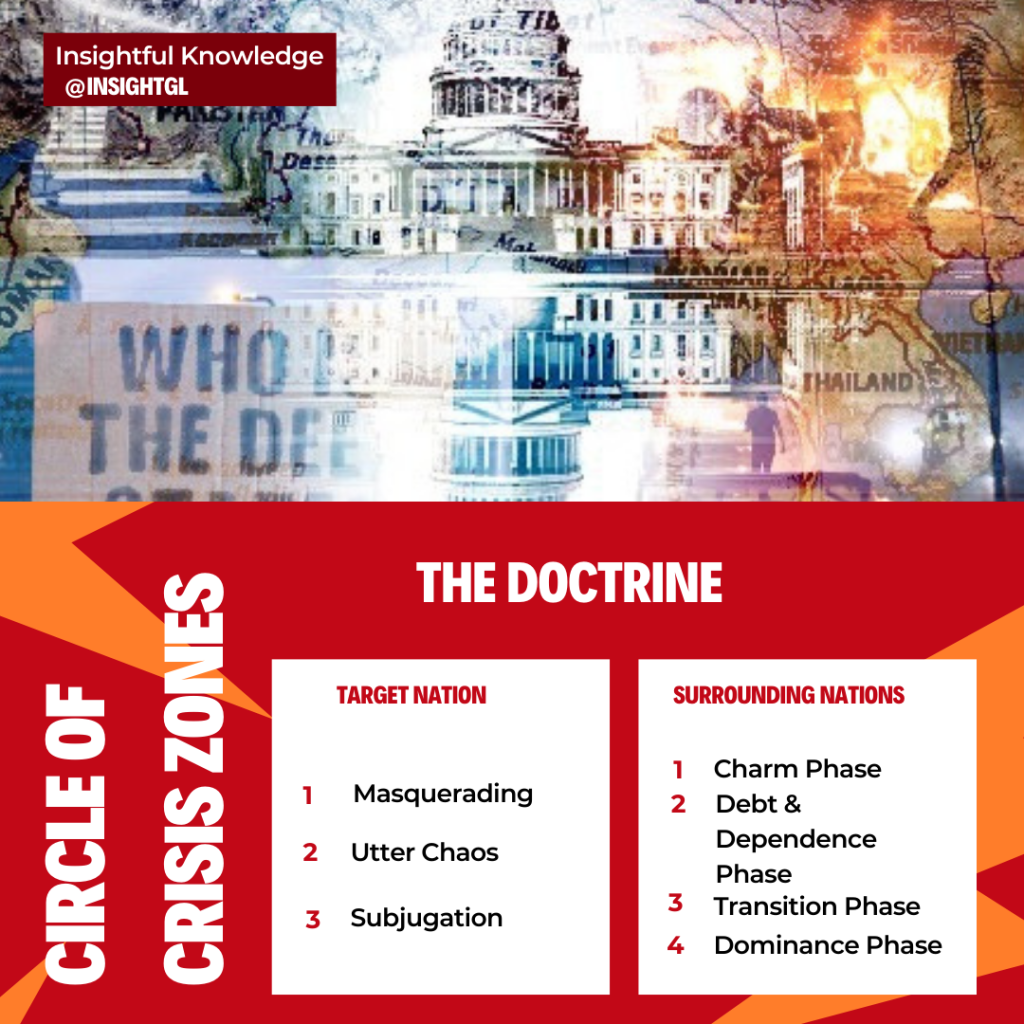
The phase of masquerading is akin to the charm phase, where major powers present themselves as friendly nations while engaging in deceit and manipulation behind the scenes. For instance, India was misled by these dominting countries that were benefiting from this charade. China initially portrayed a friendly image with the slogan “Hindi-Chini Bhai Bhai” (Indians and Chinese are brothers), but under Xi Jinping’s leadership, it revealed its aggressive intentions. Conversely, the USA subtly reassured India by stating, “We consider the US-India relationship to be the most important in the world,” alongside promises of technology transfers and various agreements that were ultimately unattainable.
It’s important to note that just because one phase ends, the next phase does not necessarily start anew. Therefore, while the “Utter Chaos” phase was beginning, the “masquerading” phase continued. The “Utter Chaos” phase ensnares targeted nations in instability; India has been experiencing this phase for over a decade.
During the “Utter Chaos” phase, there is a notable increase in protests, separatist movements, and attacks on the general public, such as Maoist assaults or staged attacks on minorities, alongside riots. Reforms often backfire, positive developments are overlooked, and weaknesses are highlighted on the international stage. Individuals in high-ranking positions may be ridiculed, and their sincerity questioned. A significant aim of this phase is to obstruct advancements in the science and technology community (for example, between 2009 and 2013, 11 Indian nuclear scientists met suspicious deaths).
The Anna Hazare demonstrations in 2011 paralyzed Delhi and affected the Indian National Congress government, while more recent events such as the Citizenship Amendment Act (CAA), the National Register of Citizens (NRC), farmer protests, and the Delhi riots had a similar impact on Delhi and the BJP government from 2019 to 2021. Manipur violence and Pahalgam massacre were also part of this strategy. External powers may initiate or support these movements, assessing the potential for future intervention. They provide financial assistance, spread internal disinformation, and engage in external propaganda via reputable publications.
During this period, India’s neighboring countries experienced ‘debt and dependence phases.’ According to a 2019 report by the Socio-Economic Planning Science, South Asian countries received an astounding $8.9 trillion in official development assistance between 2011 and 2016. USAID:
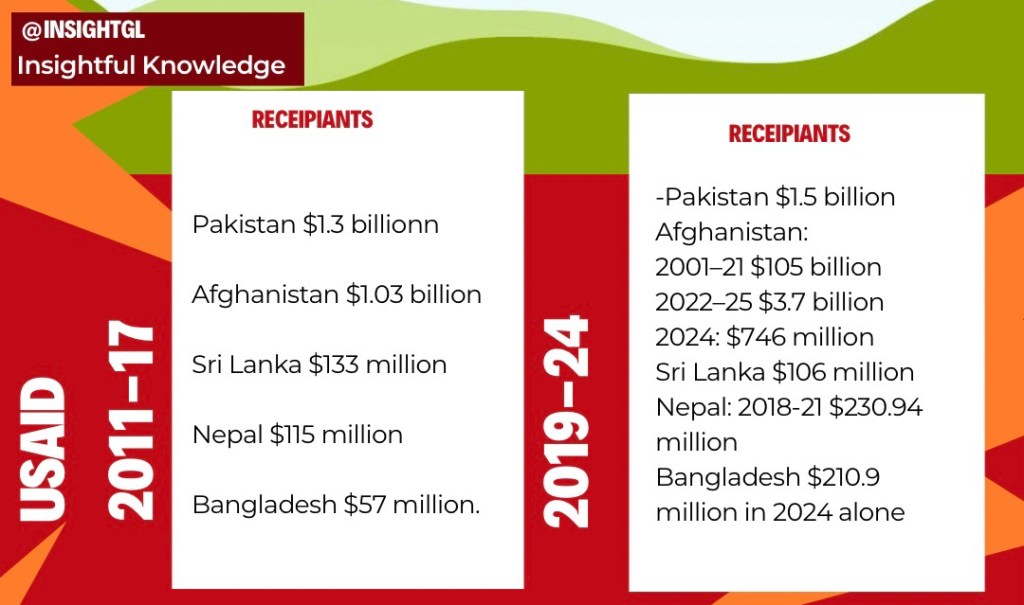
Regarding China, it does not place much belief in aid and assistance, which is why limited data is available in this regard. A report by Taylor and Francis shows that China’s worldwide aid and interest-free loans stood at $5.2 billion in 2015, increased to $6.4 billion in 2019, and then declined to $5.0 billion in 2020.
External debt of the countries surrounding India:
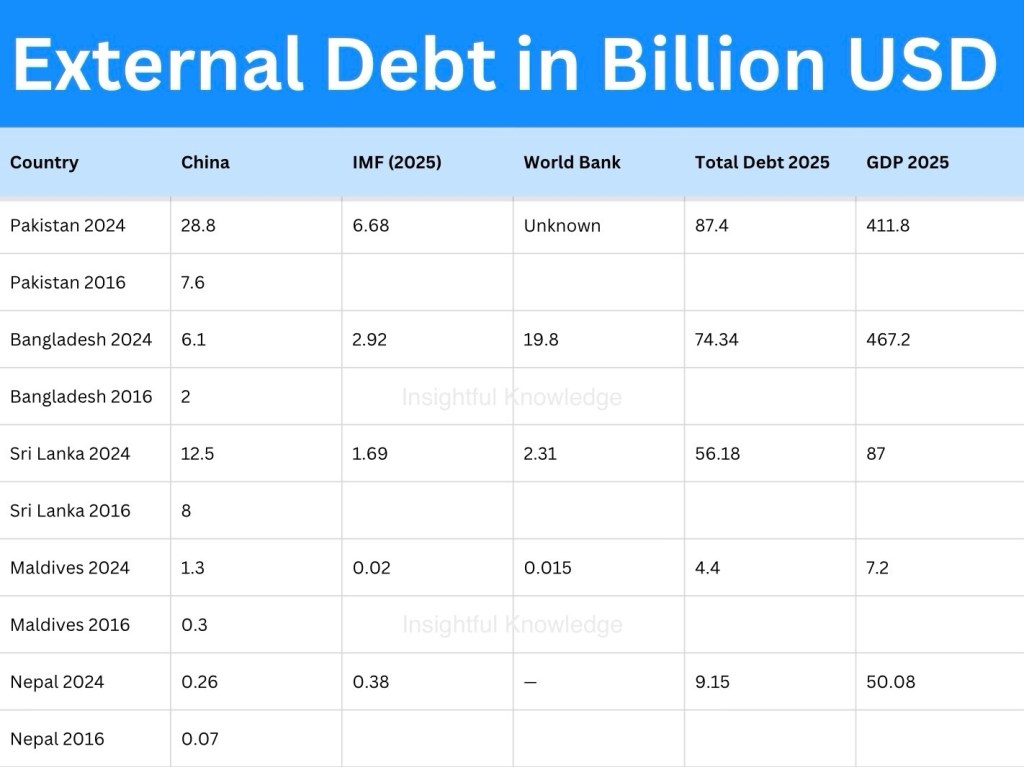
The debt and dependence phase leads to a transition phase, which is similar to the chaos phase. During this phase, regime changes occur to install suitable candidates. For example, Pakistan transitioned from Shehbaz Sharif to Imran Khan and back to Shehbaz Sharif. Unfortunately, Nepal experienced its transition phase twice. Once in 2001, when King Birendra Bir Bikram Shah and his family were systematically murdered, leading to the establishment of a Maoist government. The second one was the latest ‘Gen Z’ revolution. The Maldives went through a similar struggle between Abdulla Yameen, Ibrahim Solih, and Mohamed Muizzu. In Sri Lanka, the rise and fall of the Rajapaksa clan, and in Bangladesh, the ousting of Sheikh Hasina are also notable examples.
The Subjugation and Dominance Phases
The 2024 general elections in India have reduced Narendra Modi’s power, leading to speculation about foreign influences, particularly from the US and China. Reports indicate that soon after the election results were announced, US Consul General Jennifer Larson took the initiative to engage with dissidents and opposition figures in India. This engagement sparked conspiracy theories, especially following her meetings with leaders such as Asaduddin Owaisi and N. Chandrababu Naidu.
Targeting businesses and regulators perceived to be aligned with the ruling party is expected to become a common practice during this phase. A notable example of this strategy is the recent accusations involving the Election Commission of India, as well as the Adani Group and Madhabi Puri Buch, the chairperson of the Securities and Exchange Board of India (SEBI). A US-based investment firm, Hindenburg Research, had targeted both Adani and the SEBI chairperson. Interestingly, since then, Hindenburg has shut down a very profitable company without providing a clear explanation.
Unusual interactions are also part of this strategy. In the wake of the June 2024 elections, a notable US congressional delegation made an unusual visit to the Dalai Lama, raising questions about its purpose amid rising tensions with China. This visit coincided with increased diplomatic activity regarding India from both the US and China.
In July 2024, the US delayed the delivery of crucial F-404 engines for India’s Tejas fighter jets, having supplied only three engines since then. This delay occurred while Modi was absent from a Shanghai Cooperation Organization meeting in Kazakhstan, leading to speculation about US pressure or deeper tensions with China. Furthermore, Modi’s unexpected visit to Russia in August 2024, amid Western criticism, suggested potential dissatisfaction with Western interference. Meanwhile, Chinese influencers in Indian industries began expressing concerns about the lack of Chinese expertise, as India had restricted visa issuance for Chinese nationals following the Galwan skirmish.
Trump’s reelection in January, followed by Modi’s visit to Washington, raised hopes for improved relations between the two nations. However, it soon became apparent that both the US and China were moving toward the phase of dominance over India. Modi’s team seemed aware of the challenges ahead.
Once the U.S. dominance phase reached a critical stage, Indian National Security Advisor Ajit Doval, Defence Minister Rajnath Singh, External Affairs Minister S. Jaishankar, and Modi himself all visited China as part of a balancing act. Notably, Trump’s record tariffs on India, along with China’s restrictions on rare earth elements, magnets, fertilizers, tunnel-boring equipment, and the withdrawal of specialist workers from iPhone factories in India, appeared to be part of the same broader strategy.
Avoiding the Enemy’s Designs
Today, every country in India’s neighborhood is in a state of conflict, including Pakistan, Afghanistan, Nepal, Myanmar, Bangladesh, and Sri Lanka. India has been able to protect Bhutan to some extent. India has also been skillful in avoiding falling into any traps and disrupting the enemy’s efforts to subjugate the country. But for how long?
If India has a weak central government that depends on allies, it may struggle to make tough decisions in the country’s best interest. In the past disruptive powers have taken advantage of such a situation for decades. The emergence of the Bharatiya Janata Party (BJP) in 2014 put a stop to this free run. Therefore, both China and the US would be eager to find leaders and a government that is conducive to their interests.
The Nepal Conundrum
Now, let us look at the present India challenge: the Nepal regime change. Three key players are interested in Nepal: India, China, and the United States. Generally, Nepal has maintained a careful balance in its relationships with India and China, although its ties tend to lean more toward China.
India is unlikely to destabilize Nepal, as such actions would not align with its interests. In fact, Nepal’s former Prime Minister, K.P. Sharma Oli, was scheduled to visit India on September 16. However, this visit was canceled when his government was ousted. Oli also made an important trip to China recently, where he held talks with President Xi Jinping and attended the Shanghai Cooperation Organisation summit, culminating in his participation in the Victory Day military parade in Beijing. Consequently, it is challenging to assess how China perceived Oli’s efforts to maintain a balance with the United States. China is known to react negatively when it feels that a particular government is becoming too aligned with its main rival, the United States.
Another significant player in the region is the United States. Nepal’s relationship with the U.S. has been rocky. In 2017, Nepal signed a Millennium Challenge Corporation (MCC) agreement to receive $500 million in grants. The MCC is a U.S. foreign assistance agency aimed at reducing global poverty and promoting economic development. However, China viewed this grant as a challenge to its Belt and Road Initiative (BRI) program and put immense pressure on Oli’s government to not to accept the grant. However, the agreement was finally ratified by the Nepalese Parliament in February 2022. Subsequently, Chinese state media criticized the U.S., accusing it of exploiting Nepal under the pretense of promoting democracy.
After the ratification of the MCC, Nepal experienced a series of high-level visits from the United States:
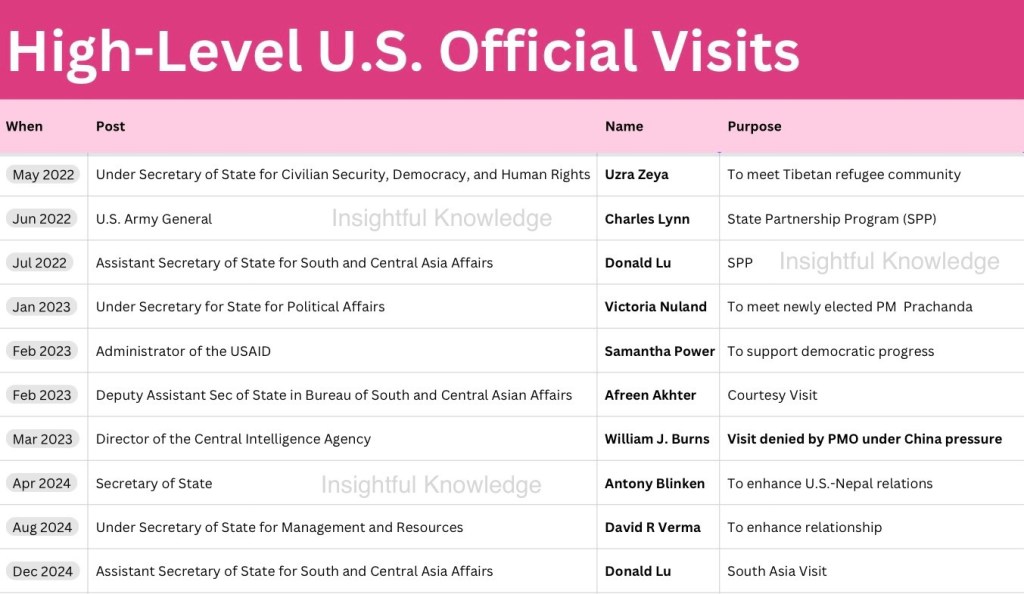
Among the officials who stand out are Donald Lu, Victoria Nuland, and CIA Director William J. Burns. Donald Lu is often referred to as the “Wolf Warrior” diplomat of the U.S. and is recognized as an expert in regime change. He has been known to interfere in the internal affairs of countries such as Albania and Kyrgyzstan, and he played a key role in the removal of Imran Khan. In May 2024, during the busy Lok Sabha elections, Lu made an unexpected visit to India. Rather than landing in New Delhi, he chose to visit Chennai, the capital of Tamil Nadu, a region noted for its Dravidian politics and where the BJP is considered weak. Following the elections, the BJP emerged with diminished strength, and Lu’s visit to Bangladesh contributed to Sheikh Hasina losing her job.
Victoria Nuland was the “mastermind” behind the regime change in Ukraine on February 22, 2014. She orchestrated the effort to topple the democratically elected government of Yanukovych while publicly framing the coup as a triumph for freedom. Meanwhile, reports indicate that CIA Director William J. Burns intended delivering at least 2,000 weapons and several modern vehicles from the U.S. Army to assist Nepal’s security forces, although the exact purpose of this assistance remains uncertain.
Now back to the so-called Gen Z protests that ousted the elected government of Nepal. The violent protests in Nepal on September 10 resulted in the tragic loss of 72 lives, with financial damages expected to exceed $23 billion. Many genuine Gen Z protesters had anticipated only a few thousand participants, but to their surprise, the crowds continued to grow. The question arises: who was coordinating this leaderless movement?
On September 10, around midday, young protesters began to sense danger as crowds moved toward New Baneshwor, the neighborhood that houses parliament. They noticed unfamiliar individuals arriving on motorbikes, who appeared older than the typical Gen Z protesters. Many now believe these individuals were infiltrators sent with the intention of inciting violence. These older individuals attempted to breach security around parliament, escalating the chaos. Some Gen Z protesters feel that while the police deployed tear gas and water cannons, these infiltrators used live ammunition against schoolchildren and peaceful demonstrators.
One tearful Gen Z protester recounted, “I saw people with bottles filled with petrol. They took them from the motorbikes and started attacking the parliament. They even set the Supreme Court on fire. Our friends tried to extinguish the flames with water, knowing it would be futile. They did it to console themselves. Many believe the arsonists came with the intent to destroy these buildings… But who are these people? Videos show that they were all masked.”
It is evident that the peaceful protest was hijacked by well-trained, well-paid militants whose singular aim was to topple the government at any cost.
The good news is that India was not caught napping this time, unlike in Bangladesh. India was proactive and, after the chaos, ensured that anti-India forces like Balendra Shah, the current mayor of Kathmandu, were not appointed interim Prime Minister. His two recent moves—the ban on Bollywood and the Greater Nepal map—show opposition to India. However, time will reveal whether his leanings toward extremist nationalism are driven by ideology or are simply attention-seeking. Because that would decide if India must continue to ensure his defeat or win in the election.
Nevertheless, India must steer clear of falling into the ‘Khwarezmian trap’ at all costs. The Khwarezmian empire included present-day Central Asia, Afghanistan, and Iran. Its diplomatic mistake in the 13th century led to its downfall and subjugation by Genghis Khan. The path forward for India is obvious – it must emphasize skilled diplomacy, alliances, and addressing internal threats. The ‘Circle of Crisis Zones’ surrounding India is not only fully developed but also increasingly complex. Saudi Arabia and nuclear-armed Pakistan’s mutual defense pact, along with Trump’s waiver of sanctions for Iran’s Chabahar Port, clearly indicate this trend. The elephant cannot afford to be lethargic and complacent as its rivals intensify efforts for dominance.


 Insightful Geopolitics
Leave a reply to O anel de zonas de conflito à volta da Índia – Nepal, a última vítima – kota boelo, pensador Cancel reply