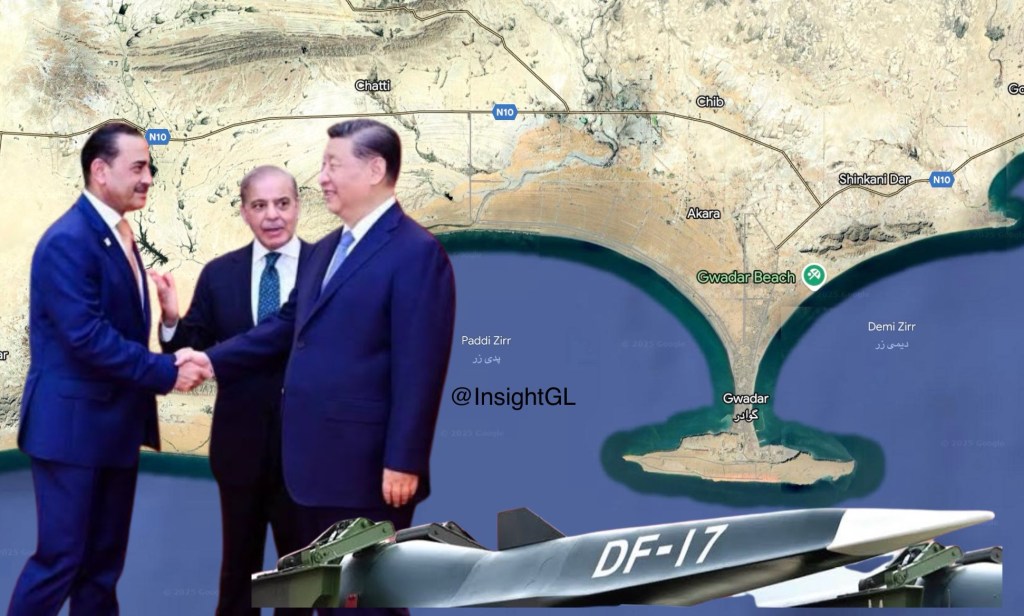
I have been following a significant development that could greatly change the strategic landscape of the Indian subcontinent. Recent reports suggest that Pakistan is in the early stages of negotiations with China to acquire advanced hypersonic missile technology, specifically the DF-17 system integrated with the DF-ZF Hypersonic Glide Vehicle (HGV). In exchange for hypersonic technology and J-35A low-observation fighter jets, China will establish the long-pending military base in the port city of Gwadar that sits right next to the Hormuz Strait and connects with the China-Pakistan Economic Corridor (CPEC).
Pakistan’s pursuit of this next-generation capability is driven by the need to counter India’s increasingly sophisticated multi-layered missile defense network. The acquisition of hypersonic glide vehicle technology, which can evade even the most advanced missile defense systems, could give Pakistan a crucial advantage in both strategic deterrence and rapid precision strike capabilities.
There appear to be two potential options for Pakistan: either a direct transfer of China’s DF-ZF HGV technology or a joint development arrangement. Given the strong military ties between China and Pakistan, history of sharing sensitive technologies with its regional ally, and the People’s Liberation Army’s (PLA) strong desire to be present in the Arabian Sea, it seems that the realization of this missile deal is only a matter of time.
As previously reported by me, China has accounted for 81% of Pakistan’s total arms imports over the past five years, solidifying its role as Islamabad’s primary weapons supplier and strategic partner in light of India’s growing power. This represents a seven percent increase from the previous five-year period (2015–2020), during which 74% of Pakistan’s arms imports originated from China. This growth underscores the increasingly defense-centric nature of their bilateral relations.


If this acquisition is finalized, Pakistan’s acquisition of the DF-17—a missile capable of delivering a hypersonic glide vehicle at speeds between Mach 5 and Mach 10—would fundamentally disrupt the current balance of deterrence between Islamabad and New Delhi. The missile’s range of 2,000 to 2,500 kilometers would place nearly all of India’s strategic command centers, nuclear infrastructure, and high-value urban targets within minutes of a Pakistani launch.
Such a capability would significantly degrade India’s reliance on static air and missile defences, including the Russian-made S-400 Triumf, as well as indigenous systems like the Barak-8, Akash, and under-development Kusha.
From a geopolitical perspective, the transfer of DF-17 to Pakistan would allow China to entrench itself further in the Indian subcontinent’s strategic architecture, leveraging its advanced weapon systems to tip the regional power equation in Islamabad’s favor.
The system’s ability to conduct pre-emptive strikes against India’s mobile assets—including India’s advanced ballistic and cruise missile platforms, and Rafale fighter squadrons—would enhance Pakistan’s strike options in high-tempo conflict scenarios.
Moreover, possession of such a capability would force India to accelerate its own hypersonic weapons programs, including reviving the stalled BrahMos-II project. Regionally, the introduction of hypersonic weapons into Pakistan’s arsenal would escalate the arms race and inject new urgency into Indian military planning, particularly for contingency operations in Jammu and Kashmir, and along the international border.
Western military analysts have warned that the DF-17 could enable Pakistan to execute a “decapitation strike” doctrine—crippling India’s command-and-control infrastructure before retaliatory action could be coordinated, raising the chances of accidental nuclear escalation. Even in conventional warfare, the DF-17 poses a formidable threat; its maneuverability and speed could neutralize radar nodes and point-defence systems within seconds, clearing the path for follow-on air and ground assaults.
If modified for deployment on naval or mobile road-based platforms, the DF-17 could grant Pakistan a flexible, mobile hypersonic strike force that would be extremely difficult for Indian surveillance assets to track, intercept, and destroy.
In strategic terms, a DF-17 acquisition would elevate Pakistan’s military doctrine into the realm of fifth-generation strike warfare, where speed, precision, and first-strike survivability dominate the modern battlefield equation.
What is HGV, HCM, and MIRV
An HGV is an advanced re-entry warhead that detaches from a ballistic missile at high altitude and glides through the atmosphere at hypersonic speeds—above Mach 5—while executing lateral and evasive maneuvers to defeat missile defence systems.
Unlike traditional ballistic missiles that follow predictable parabolic arcs, HGVs re-enter the atmosphere on flatter, low-altitude trajectories, making them far more difficult for radar systems and interceptors to track and neutralize.
After being boosted into the upper atmosphere by a launch vehicle, the HGV separates before reaching orbital velocity, then glides at high speed through the upper atmosphere, descending toward its target with minimal radar visibility.
This combination of extreme speed and low flight path renders existing air defence systems—including THAAD, Patriot, Aegis, and S-400—largely ineffective, as they are designed to counter predictable, high-altitude ballistic threats. China’s DF-ZF, Russia’s Avangard, and the U.S. Common Hypersonic Glide Body (C-HGB) are the most prominent operational and developmental examples of this technology.
The main difference between a hypersonic glide vehicle (HGV) and a hypersonic cruise missile (HCM) lies in their propulsion systems and flight characteristics. HGVs are launched from a rocket and glide toward their target at lower altitudes, allowing them to maneuver to evade defences. In contrast, HCMs are powered throughout their flight by air-breathing engines, such as scramjets.
On the other hand, a Multiple Independently Targetable Reentry Vehicle (MIRV) is a missile system designed to carry multiple warheads, each of which can be directed to separate targets once the missile reaches a specific point in its trajectory. While MIRVs themselves do not maneuver independently, the rocket that releases the warheads is capable of maneuvering to deploy them at different targets.
MIRVs enable a single missile to strike multiple targets, increasing overall destructive capacity and complicating missile defence efforts. Many Intercontinental Ballistic Missiles (ICBMs), such as the Russian R-36M2 and the US Minuteman III, utilize MIRV technology. In contrast, Hypersonic Glide Vehicles (HGVs) are designed to maneuver during flight and aim to evade defences and extend their range.
HGVs pose challenges for missile defense systems due to their unpredictable flight paths, while MIRVs overwhelm defence capabilities by requiring multiple intercept attempts for a single missile. Essentially, HGVs enhance the survivability and effectiveness of a single warhead, while MIRVs increase destructive potential by delivering multiple warheads from a single missile.
The Chinese DF-17
China’s DF-17 is among the world’s first deployed hypersonic missile systems, carrying a glide vehicle, capable of striking targets over 2,500 km away while maintaining maneuverability throughout its descent.
Russia’s Avangard, mounted on its RS-28 Sarmat ICBM, reportedly reaches Mach 27, a velocity which Moscow claims renders it completely impervious to Western defences—a claim echoed by President Vladimir Putin himself. Meanwhile, the U.S. continues the development of its own C-HGB, although the program has suffered multiple test delays and is still not fielded in operational units.
From a doctrinal standpoint, the emergence of HGVs represents a transformation in strategic warfare—ushering in the era of Prompt Global Strike, where key enemy assets can be destroyed with little or no warning.
Strategists warn that HGVs compress decision-making timelines during crises, especially in flashpoints such as the Indian subcontinent, Taiwan, or the Korean Peninsula where miscalculation could lead to immediate escalation.
The Indian Reply
India is not sitting idle. The resurrected BrahMos-II hypersonic cruise missile project is making significant progress, particularly in the integration of a domestically developed scramjet engine. In April 2025, ISRO successfully tested a scramjet combustor for over 1,000 seconds, marking an important step towards achieving hypersonic speeds. Flight testing is expected to occur in 2026 or 2027.
The Extended Trajectory–Long Duration Hypersonic Cruise Missile, ‘Project Vishnu,’ aims to equip the Indian defense forces with a revolutionary missile capable of deep precision strikes at Mach 8 (nearly 11,000 km/h) and an operational range of approximately 1,500 km. This missile can carry both nuclear and conventional warheads ranging from 1,000 to 2,000 kg and features evasive maneuverability during mid-flight.
The ET-LDHCM includes an advanced scramjet engine that enables sustained hypersonic speeds. Furthermore, India has tested its first Multiple Independently Targetable Reentry Vehicle (MIRV) missile, the Agni-V, as part of “Mission Divyastra,” allowing multiple warheads to strike separate targets.
India is also developing Hypersonic Glide Vehicles (HGVs) such as “Dhvani” and the Long-Range Air-to-Surface Missile (LRAShM), which are designed for hypersonic speeds and enhanced maneuverability. Overall, India’s HGV program signifies notable advancements in military capabilities, potentially getting ready to take on any challenges posed by the China-Pakistan Duo.
Conclusion
Recent conflicts have shown that nations equipped with operational Hypersonic Glide Vehicles (HGVs) or Hypersonic Cruise Missiles (HCMs) gain a significant asymmetric advantage. These weapons allow them to strike deep into enemy territory without relying on traditional ballistic missiles or strategic bombers. The spread of HGV technology in volatile regions, such as the Indian subcontinent, raises concerns about destabilization—especially as countries like Pakistan become testing grounds for the latest Chinese weaponry.
Given this situation, India must issue a stern warning to China regarding the deployment of hypersonic technology in the region. Additionally, India should consider the option of conducting pre-emptive strikes on such Pakistani missile storage sites.
HGVs are capable of delivering both nuclear and high-explosive conventional payloads. They are not merely weapons of speed; they are tools of strategic dominance that are transforming deterrence theory and redefining escalation control. The defining arms race of the 21st century will not focus on the sheer number of missiles but rather on who can strike first, faster, and with absolute certainty of impact.


 Insightful Geopolitics
Leave a reply to shailyrawat Cancel reply