On the night of May 6-7, 2025, India conducted attacks on terrorist hideouts located in Pakistan and Pakistan-Occupied Jammu and Kashmir (POJK). India successfully targeted nine terrorist camps during this operation. Over 120 military aircraft from both sides faced each other, but notably, no aircraft crossed the international border or the Line of Control (LOC).
The following day proved to be quite interesting, as Pakistan launched a propaganda campaign. Pakistani Prime Minister Shehbaz Sharif, on record, stated that the Pakistan Air Force (PAF) had shot down five Indian Air Force (IAF) fighters, claiming that three of these were Rafale fighter jets from the French company Dassault. Air Marshal Aurangzeb, the Director General of Public Relations for the PAF, presented a multimedia briefing that resembled a project from a 10th-grade student. Using a map with superimposed fighter jets, he convinced local journalists that this was the real situation, asserting that the PAF had decisively defeated the IAF.
This was followed by a barrage of paid articles and interviews in international publications and on TV channels. It appeared that many media outlets were eager to validate the narratives pushed by the Pakistani-Chinese alliance. The ‘X’ platform (formerly known as Twitter) played a significant role in amplifying this propaganda. Interestingly, ‘X’ had been banned in Pakistan since February 2025. However, on May 6, 2025—the day of the Indian attack—access to the social media platform was restored in Pakistan. This opened the floodgates for a prolonged saga of false narratives, fake videos, images, and propaganda.
The Hero That Wasn’t
The PAF public briefings referred to the J-10C as a high-tech fighter. Air Marshal A.K. Bharti, the Director General of Air Operations for the IAF, took a jab at this during a media briefing by mentioning that the IAF had shot down a couple of Pakistani high-tech fighters. While initial reports suggested that the PAF had ordered 25 J-10Cs, the current inventory indicates only 20 units.
China began developing the J-10 in the early 1980s to create a single-engine multirole fighter to replace the J-7 (the Chinese version of the MiG-21 Fishbed) for air defense, as well as the Q-5 Fantan ground-attack aircraft. The J-10 features a delta wing design with canard foreplanes, a chin-mounted engine intake, and fly-by-wire flight controls. The fighter incorporates many design elements from the Israeli Lavi fighter, although it is larger and heavier to accommodate a bigger Russian engine. At its best, the J-10C is comparable to the F-16 C/B Block 50 in terms of agility, carrying capacity, and size.
Many experts try to downplay the J-10’s heavy reliance on the discontinued Israeli Lavi fighter jet. However, in 2008, Jane’s reported that “Chengdu benefited from significant, direct input from Israel’s Lavi program – including access to the Israel Aircraft Industries (IAI) Lavi aircraft itself. This input included extensive design and performance modeling, wind-tunnel testing, and advanced aerodynamic design input. Chengdu officials at the highest levels stated that they had one of the IAI Lavi prototypes in their facilities.”

The J-10 Variants

Bursting the Myth
The J-10C is classified as a 4+ generation fighter jet at best. Both China and Pakistan take pride in their AESA radar; however, it has been challenging to assess the radar’s capabilities until now, as it had not participated in any combat and its emissions had not been recorded in a war setting. Nonetheless, following Pakistan’s deployment of the J-10C against India, the Indian Air Force (IAF) has gained a wealth of data to analyze the radar and other systems. The IAF must consider whether China supplied an export version of the radar in its fully equipped configuration. Additionally, the electronic countermeasures (ECM) capabilities of the J-10C have also come under scrutiny.
An important development was that the IAF employed several UAVs, such as Lakshya and Banshee Jet-40+, to simulate the electronic signature of Indian fighter jets. Pakistan fell for this tactic and wasted numerous valuable missiles targeting these decoys, believing they were downing actual Indian jets. This not only revealed the positions of the Pakistan Air Force (PAF) fighter jets but also exposed the locations of ground-based radars and air defense systems. Following this miscalculation, at least two J-10Cs and several radar and air defense systems were lost to the IAF. Pakistani Prime Minister’s statement regarding this issue is quite relevant; he mentioned, “We allowed many UAVs to enter our territory and did not retaliate since we didn’t want to expose our air and ground assets.”
Now, let’s discuss another highly publicized asset of the PAF: the PL-15 missile. According to some Pakistani sources, the longest shot made with the PL-15 during the clashes was 112 miles. The non-export variant of the PL-15 has a range exceeding 124 miles, while the export version, known as the PL-15E, has a maximum range of 80 to 90 miles. One can conclude that the missile used by the PAF was the PL-15 and not the PL-15E. This further validates my assessment that the Egyptian Air Force’s IL-76 aircraft was traveling to Muzaffarabad and then making multiple trips to China, acting as a ghost aircraft for military supplies. This information was utilized by many mainstream media houses:
The issue now come to mind is finding a large number of PL-15 missiles, whether intact or crashed, within Indian borders. Several factors may explain this situation:
- The high number of failed launches suggests there may be inherent defects in the missile system.
- PAF pilots might have felt uncertain or fearful, opting to fire at the maximum range of the missile’s capabilities rather than closing in. As a result, when the missile reached its maximum range, it flamed out and often landed softly in an intact state.
- Since the missiles were fired at maximum range and operated in fire-and-forget mode, they lacked the prolonged guidance support from the launching aircraft. Once the missiles reached the unguided phase, their onboard short-range radar activated, making them vulnerable. Consequently, these missiles were successfully intercepted by the Indian air defense systems.
Military and Geopolitical Learnings for India
As someone once said, “The first casualty of war is the truth.” During this brief conflict, Pakistan and China demonstrated their ability to distort the truth. During a press briefing, the Director General of Air Operations for the Indian Air Force acknowledged that there were losses on India’s side. However, there was no acknowledgment of losses from Pakistan. According to credible sources, Pakistan lost six aircraft in the combat, and many more were severely damaged in the Indian BrahMos attacks. Meanwhile, Pakistan continued to spread false claims about shooting down three Rafale fighter jets. There is an old principle that suggests when someone feels guilty, they tend to talk excessively to divert attention. This perfectly describes the situation of Pakistan and its allies.
Coming to the shooting down of the IAF’s Rafale fighter jet:
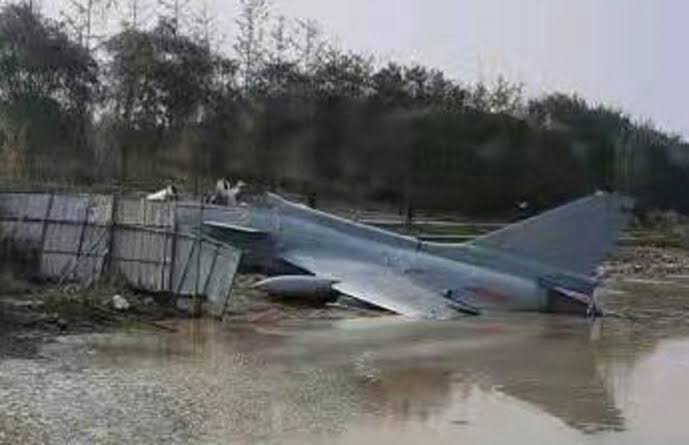
- If the pictures that are being circulated by Pakistan and China are genuine, then they tell a lot. It is clear from the picture that the engine and the tail of the crashed aircraft are a little distance apart. That indicates that the fighter was not shot down but rather, in all probability, simply ran out of fuel, having spent too much time in afterburner and at a low level trying to evade shots and had to eject due to fuel starvation on the way back to base.

- On the IAF Rafales, the word “Rafale” appears in a plain font at the top of the rudder. In the images circulated by Pakistan (and influenced by China), the text is shown in italics.
- Furthermore, there is another inconsistency with the rudder. In photographs of confirmed Indian Rafales, a vertical seam line intersects the top of the rudder at an angle. Conversely, in the images released by Pakistan (again, possibly with Chinese involvement), this vertical seam is shown intersecting the top of the rudder at a right angle.
- Lastly, there is no French intelligence agency that monitors global Rafale crashes, contrary to claims made by publications like CNN. Such false statements only serve to aid Chinese propaganda.
The recent conflict once again highlighted which countries supported India and which ones merely claimed to be a key strategic partner. It exposed the true intentions of countries like China, Turkey, Egypt, and the relatively insignificant Azerbaijan. Additionally, numerous media outlets, without verifying facts, began to sing paeans in the praise of the J-10C fighter jet. Meanwhile, both Russia and the US benefited from discrediting the Rafale while promoting their own Su-57 and F-21 fighters, respectively.
Ultimately, the Indian armed forces demonstrated complete supremacy on the battlefield, despite the Pakistan Air Force (PAF) having conducted extensive exercises with the Qatari Rafale, fully aware of its superiority. Some reports suggest that PAF pilots even flew the Qatari Rafale, although this information remains unconfirmed.
Currently, only China and Pakistan operate J-10C fighters and utilize HQ-9 air defense systems. As a result, no other country has a clear understanding of the performance of these systems in combat. India, having gathered valuable data on Chinese fighters, air defense systems, and Pakistani AEW&C aircraft, should only share this information with countries that have shown unequivocal support, namely Israel and Taiwan.


 Insightful Geopolitics
Leave a reply to Sandeep Vohra Cancel reply