
The 16th chapter of the Bhagavata Purana tells of Lord Krishna subduing Kaliya Naag, a venomous serpent that terrorized villagers. After Krishna’s victory, Kaliya’s wives begged for mercy, and he retreated to his island, causing no further harm. Fast forward to August 1947, a new multi-headed serpent emerged — Pakistan. Since then, Pakistan has committed various nefarious activities, with Indian leaders continually forgiving its transgressions. Kaliya Naag was principled and let off. Should unprincipled nation Pakistan go unchecked, unpunished?
Pakistan’s Psyche
ThePakistani establishment makes every effort to align itself with Arab and Turkic identities and distance itself from the land where its forefathers lived for thousands of years. Therefore, the nation as a whole concocted a lie to mislead its younger generation with fabricated history. In the textbook “A Textbook of Pakistan Studies” by M. D. Zafar, the following claims are made about Pakistan’s origins:
“Pakistan was first established when Arabs, led by Muhammad bin Qasim, occupied Sindh and Multan in 711 AD. Under the Arabs, Pakistan encompassed the Lower Indus Valley. In the 11th century, the Ghaznavid Empire included parts of Pakistan and Afghanistan. By the 12th century, the Ghaznavids lost control of Afghanistan, and their rule was confined to Pakistan. By the 13th century, the territory of Pakistan expanded to include much of Northern India and Bengal. Under the Khiljis, Pakistan extended further south to cover a significant portion of Central India and the Deccan. By the 16th century, what was known as ‘Hindustan’ was entirely absorbed into Pakistan.”
The country restricts discussions on significant historical topics such as Mohenjo-Daro and the Indus Valley Civilization, the Aryan Civilization, and the Mahabharata, in which Sindh and Khyber Pakhtunkhwa play crucial roles.It also suppresses conversations about Hinduism, the thousand-year history of Buddhism and its universities, and the Gandharan civilization, which once spanned what is now Pakistan. As a result, Pakistan is a nation whose foundation is based on a false narrative, and today’s Pakistani generation is a by-product of that narrative.
Military Dictatorships Around the World
There are currently eight countries in the world with full military dictatorships. Pakistan is a hybrid dictatorship with a democratic façade. The GDP, GDP per capita, and GDP growth rates are good indicators of where a country is heading. Following are the financial numbers of nine military dictatorships around the world:

From the above, it is amply clear that a dictatorship may or may not doom a country, but a military dictatorship certainly does that. Today Pakistan stands shoulder-to-shoulder with the world’s financially defunct nations. Then how does it make such big-ticket military purchases? These numbers would baffle anyone.
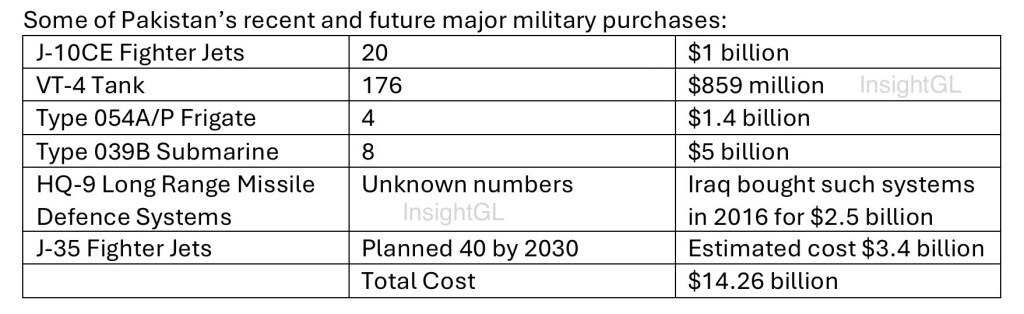
Pakistan’s defence budget for FY 2024-25 is $7.64 billion. Out of this allocation, 53.4% is spent on pay and pension, leaving only $3.56 billion. It is evident that just the above purchases would wipe out the entire defence budget of four years, leaving no funds for any other activities. Since we saw that Pakistan does not have the wherewithal to undertake such massive military acquisitions, that means funds for these huge acquisitions are coming from other sources, such as a foreign country or illicit activities. So, the question remains which is that foreign entity and what are they getting in return?
The Player: Army Chief General Asim Munir
Pakistan Army Chief General Munir’s father was an imam. By 2018 Munir was Chief of Pakistan’s spy agency, the Inter-Service Intelligence (ISI). However, within eight months then Pakistani prime minister Imran Khan replaced him with Lt. Gen. Faiz Hamid. We already know the fate of Imran Khan and Lt. Gen. Faiz Hamid when Munir became the Army Chief. Munir was the architect of the February 2019 terror attack in Pulwama, which claimed the lives of 40 CRPF troopers and triggered a military confrontation between the two countries. By November 2022 he was the Chief of Pakistan Army.
Munir is corrupt to the core just like most Pakistani generals. When Munir was shunted out of the plum ISI post to Corps Commander of Gujranwala, he saw his retirement imminent. Despite filling up his coffers during the short sting of ISI chief, Asim Munir’s greed got the better of him. He demanded a PKR 90 crore bribe from one of Pakistan’s big corporations — Master Tiles. The whole episode came to light when the CEO of Master Tiles wrote a letter to the PM’s office. However, no action was initiated against him. After becoming the Army Chief he involved his family members and relatives in the corrupt practices.


These funds look after the senior officers’ lavish lifestyle, villas in Europe, children’s studies in the U.S. and retirement fund in Dubai, in addition to spreading terrorism in India and other neighboring countries.
The Facilitator: China
When the Indian leaders were brainwashing themselves with Hindi-Chini Bhai-Bhai (Indian and Chinese are brothers), the Chinese leaders were assessing Indian weaknesses. They had studied all the fault lines in the Indian subcontinent left behind by the British Raj. They knew that only a country of India’s size would be able to challenge China in the future. They started looking for a subservient partner to disrupt India’s rise.
That opportunity came soon. The first Pakistani ambassador to China, Major General Nawabzada Agha Mohammad Raza, presented his credentials to Mao in 1951. Mao snubbed him by stating “I have great pleasure in receiving the letter of credentials of the King of Great Britain, Ireland and the British Dominion. Pakistan in its zeal and desire to be called a great power broker, Pakistan kept taking the insults at the hands of Chinese leadership, in a servile manner, on a regular basis, despite the fact China’s per capita income was 30% less than Pakistan at that time. To further prove their loyalty Pakistan transferred Shaksgam Valley in the occupied Jammu and Kashmir to China in 1963.
Today, China is Pakistan’s biggest lender and arms supplier. China owes 22% of Pakistan’s known external debt. However, as per AidData, a US-based research institute the Chinese debt to Pakistan is almost 50% higher and stands at $67.2 billion. Another research takes the figure to a mind-boggling $102 billion as the International Monitory Fund (IMF) doesn’t take into account the short-term loans that are rolled over for decades to avoid showing huge debt to GDP ratio thus affecting the county’s rating.
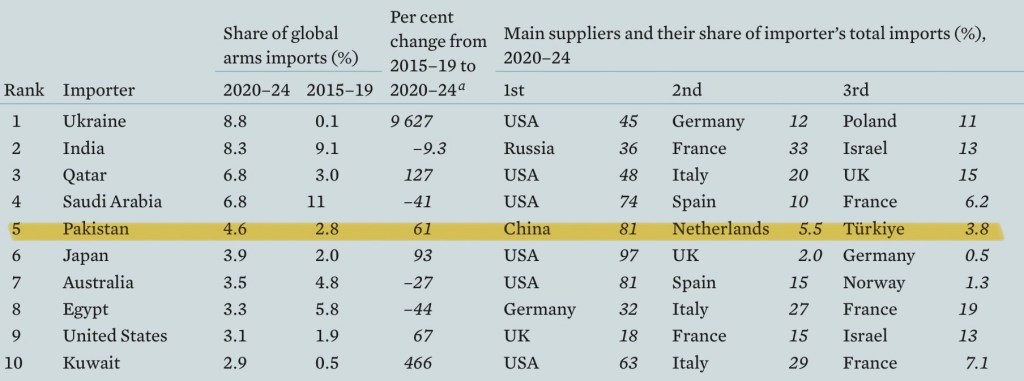
The 1963 pact between China and Pakistan was a turning point. By the early 1980s, almost 75% of tanks being used by the Pakistan Army and 65% of the aircraft used by the Pakistan Air Force (PAF) were of China origin. As per the Stockholm International Peace Research Institute (SIPRI) average percentage share of Chinese origin military equipment in Pakistan rose from 58.2% in 2009-18 to 69.12% in 2014-18 period.
The present data reveals that China supplied 81% of Pakistan’s total arms imports between 2020 and 2024:
The Manipulator: United States
Until 1955, the Indo-US relationship was stable and positive. However, after the Asia-Africa Conference, commonly known as the Bandung Conference (later referred to as the Non-Aligned Movement, or NAM, after 1961), held in Indonesia, the US government became cautious of India. The United States aimed to prevent India’s regional influence from affecting neighboring countries, particularly Pakistan.
The situation worsened following the Sino-Indian War in 1962. When China attacked India, the Indian government sought military assistance from President John F. Kennedy. However, due to the ongoing Cuban Missile Crisis, the United States was unable to provide support, leading to India’s defeat in the war.
In the aftermath, India turned to the Soviet Union for military supplies and equipment, which alarmed US officials and highlighted India’s shifting alliances. Meanwhile, Pakistan played a double game by joining anti-Soviet organizations like the Central Treaty Organization (CENTO) and the Southeast Asia Treaty Organization (SEATO), further impressing the United States.
Pakistan facilitated a connection between the US and China and provided Mujahideen fighters for anti-Soviet operations in Afghanistan, demonstrating its value to the Americans. However, once the Cold War ended, Pakistan’s strategic importance diminished. The US primarily viewed Pakistan as a means to keep India in check while seeking to align India with its interests against China. India, however, did not adhere to the US agenda.
According to some sources, the underwhelming performance of the Bharatiya Janata Party (BJP) in the 2024 general elections was a consequence of interference from Western forces unhappy with Prime Minister Modi. These sources also suggest that an old Eurasian ally warned the BJP about potential interference in the elections in time, which ultimately helped them mitigate the situation.
The Final Solution
Op Sindoor brought destruction but no real solution. In fact, in the midst of the conflict, Pakistan secured a $1 billion loan from the IMF. Such wars ultimately benefit the Pakistan Army, China, Turkey, and other nations. The Indian leadership understood that powerful entities behind the Pahalgam attack wanted India to become entangled in an aimless war. It’s clear that various global forces placed India’s Prime Minister Modi in a challenging situation. He felt he had to pursue a kinetic war strategy to maintain credibility at home, which is exactly what the Pakistan Army and China were hoping for. A full-fledged war would have harmed the Indian economy and undermined India’s aspirations for prosperity.
While many Indian citizens were dissatisfied with the country’s restrained approach, in hindsight, the pause in operations has disrupted China’s strategic plans. Of course, there were other geopolitical factors that contributed to the cessation of operations. Nevertheless, Pakistani Army Chief Asim Munir has solidified his position, even though ideally, a war should have weakened his standing. As a result, India may have won the conflict, but it has lost the narrative.
Currently, there are no established methods to adequately punish a rogue nation. I give few solutions:
- Disintegration of the people’s morale – Liberation of Balochistan and Sindh
- Capture of objects of psychological value – Regain Pakistan occupied Kashmir (POK)
- Destruction of objects of material value – Economy
- All-out Information Warfare – India is lacking here
- Coordination with allies – Operation Sindoor gave a glimpse of allies
- Defeat of its active part (the army, terror hubs)
A comprehensive approach that addresses all the aforementioned elements must be executed with determination and unwavering resolve. Indian leadership must recognize that Pahalgam was not the first, nor will it be the last, terror attack in Jammu and Kashmir (J&K). Therefore, it is crucial to identify and target the real masterminds operating behind the scenes. Religious justifications are merely a façade used to deceive the general public. There are personal ambitions and organizational objectives at play.
In the case of the Pakistan Army, disrupting their drug operations and other illegitimate businesses would significantly limit their funding. Additionally, efforts should be made to encourage internal power struggles within the Army (though that looks tough after Operation Sindoor). If Pakistan remains unchallenged, India will never achieve lasting peace. Therefore, it is crucial to support the armed struggle in Balochistan covertly while endorsing their legitimate causes overtly. This strategy should be followed by interventions in Sindh and Khyber Pakhtunkhwa. Afghanistan and POJK would follow suit.
While Kaliya Naag was a principled entity and stuck to its promise of never terrorizing others, Pakistan is a venous entity. It will continue to pose a threat to India repeatedly. Dismembering the snake is the only way forward.


 Insightful Geopolitics
Leave a reply to indrjitsen Cancel reply