This post of mine would be in three parts, firstly just to avoid it being too lengthy, and secondly due to the situation in today’s geopolitics, which is very dynamic and changing at a very fast pace.
INTRODUCTION
China is on the prowl and counties are sensing the foreboding. Big or small, far or near, every country has the same question ”will China rule the world one day, and how would we deal with that world”. I have often heard this from various quarters that ”we would prefer the rogue US any day to a saner China”. It is a harsh reality, capitalist prosperity leads to military acquisitions. The economic rise of America led to the building of a great navy. Same was the case with the most European powers, post-industrial revolution. Is China going to follow the same pattern, and become a hegemon in the guise of a trading nation? Are these concerns empirical or just insinuations? Do we really need to tame China?
HISTORICAL FACTS
Before we go into the nitty-gritty of the subject, let us look at a small piece of Chinese history. On October 1, 1949, the People’s Republic of China was formally announced, with Mao Zedong as its leader. Despite massive U.S. support for the Nationalist regime, Mao’s forces were victorious in 1949 and drove the Nationalist government onto the island of Taiwan. Communist China was seen by the United States as an ideological foe and a geo-strategic menace.
During the 1940s and 1950s, Richard Nixon had been a vocal cold warrior and had condemned the Democratic administration of Harry S. Truman for “losing” China to the communists in 1949. However, as early as 1967, Nixon had envisaged the re-incorporation of China into the international order. From the beginning of his presidency, Nixon tried to approach the Chinese government in Beijing, initially through an already existing diplomatic channel in Warsaw, but to no avail. The decision was therefore taken to pursue a different venue, through the Pakistani government. Pakistan, which maintained close diplomatic relations with both China and the United States, began to play the role of facilitator, leading ultimately to the setting up of a secret meeting between the US National Security Advisor Henry Kissinger and the Chinese leadership in Beijing on 09 July 1971(this was brought out very clearly in the book ”The Blood Telegram” by Garry J. Bass), followed by a week-long visit by the US President Richard Nixon, from 21-28 February 1972. This opened the US markets to China and beginning of a new chapter in US-China relationship.
US–CHINA RELATIONSHIP
Now coming to US-China economic relationship and the meteoric rise of China. In 1978 then Chinese Premier Deng Xiaoping shifted from Closed Door to Open Door policy, describing it as ’Socialism with Chinese Characteristics’. This opened up China to foreign businesses who wanted to invest in the country. This policy set into motion the economic transformation of modern China. Starting in the 1980s, U.S. lawmakers weakened the essential controls the state put on the financial system. This was not just led by politicians like US President Ronald Reagan, but also by a set of neoliberals like US President Bill Clinton and many others. Clinton promoted a vision of a globalized world with no nation-states impeding the free flow of capital and goods. This lack of assertive public power allowed private power to take its place, as corporations merged and organized trading flows without having to worry about the demands of public institutions.
A relationship between China and American came into existence. Historian Niall Ferguson and economist Moritz Schularick gave it a term ”Chimerica”. A neologism, based on Greek mythology called ”Chimera”. A monstrous fire-breathing hybrid creature, composed of the parts of more than one animal. It is usually depicted as a lion, with the head of a goat arising from its back, and a tail that might end with a snake’s head(reference Wikipedia). China became the world’s factory. It started supplying goods to the USA. Dollars earned from there by China were invested in Wall Street and in buying the US treasury bonds. This gave the American banks free flowing dollars, which they in turn provided to the American populace at cheap rates to buy more white goods supplied by China. Neither US government nor the corporate world realized that they were creating a leviathan which would challenge them one day.
These historical events changed the fortunes of the Chinese people. Chinese per capita income was almost similar to Indian per capita income till 1980, but by 2018 it stands almost four times that of India. China was the world’s leading economy and most urbanized state until the 16th century. Chinese people take a lot of pride in that fact. They have lots of remorse also that China lost is its sheen in the 18th and 19th century. Since 1949, the central leadership and ”Ying Pai”(hawks or eagles) of China have been planning and selling ’Hundred Years Plan’ to dominate the world and bring back the lost glory of China, to Chinese people(. In November 1999, the US embassy in China reported about a military analysis submitted by two Air Force colonels ”Unrestricted Warfare: War and Strategy in the Globalization Era”(full version on fas.org). The analysis recommended that Beijing should use ”Asymmetrical Warfare”(it means everything from catastrophic terrorist attacks to insurgents’ roadside bombs, to the proliferation of weapons of mass destruction (WMD), to advanced computer viruses – ausa.org) to attack the United States. Chinese hawks were pressing for using ancient Chinese doctrinaire ”Thirty-Six Stratagems”(available in detail on changingminds.org). The world was feeding a minotaur for the last 40 years, without having Theseu, the son of Aegeus, to slay it.
CHINA’S GEOGRAPHY AND DISPUTES
At approximately 9.6 million sq kilometers, China is the world’s fourth largest country. It has the longest land border in the world and shares it with 14 countries. However, it stakes its claim over territories of 23 countries. China has the biggest border disputes with India, Russia, and Vietnam. Another hot potato is ”The South China Sea”, where China has a dispute with every existing nation big or small. China estimates large oil and gas reserves in the area. The area also accounts for 30% of the world’s sea traffic. China is building artificial islands in the area and this could become a future flashpoint.
Recent Chinese aggression in the Doklam area of Bhutan is fresh in everyone’s mind. At Doklam world’s two largest armies were face to face for months and the world was praying nervously. However, there are many other issues which are not known to ordinary people. Russian Far East or RFE is being flooded by illegal Chinese people. The Chinese are invading Russia, not with tanks but with suitcases, according to Alexander Shaikin, head of the border control, over 1.5 million Chinese have illegally entered RFE. While Shaikin’s claim is likely exaggerated, increased Chinese migration marks a return of Chinese influence to historically Chinese territories. Unlike Sino-Russian disagreements over Ukraine or India, a territorial dispute over the Russian Far East holds the potential to formally rupture relations between the two continental powers. There are as many as 60,000 Chinese living and working in Pakistan adding to the nervousness of local populace. Howard W. French’s book ”China’s Second Continent – How a Million Migrants Are Building a New Empire in Africa”, claims over a million Chinese live on the African continent. As per local leaders, as of now Pakistani populace and Africans are acquiescent, and matters are under control. However, that’s a fallacy. It is a matter of time when the situation exacerbates and locals realize that their jobs and businesses have been taken over by Chinese. A similar situation is there in all the other countries, where Chinese companies are working on various projects, whether in the neighborhood or around the globe.
XI JINPING – THE BIG BROTHER
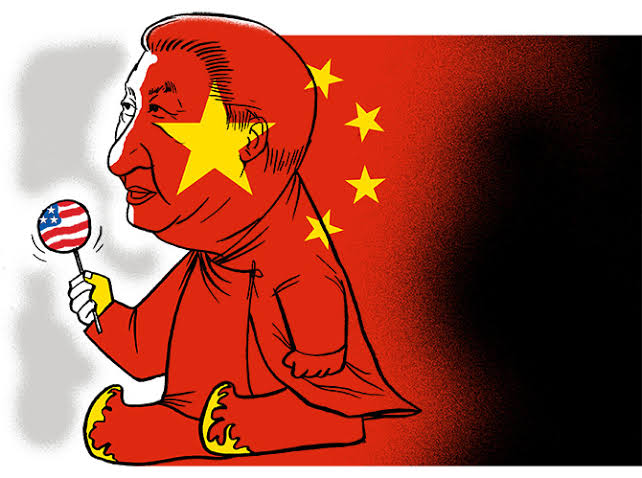
Now let us look at the leadership of present-day China. Today’s China is being ruled by Xi Jinping, the authoritarian, all-powerful Big Brother. He has systematically destroyed all opposition. He has amended the two-term rule for the president. That means he can stay on as president as long as he wishes. In some experts eyes, he has become the most powerful leader after Mao. As per ’J Tepperman’ of foreignpolicy.com ”to maintain his power, Xi and his nomenklatura are repressing dissent and ruling by intimidation. Because bureaucrats and citizens live in fear, they compete to flatter their bosses. Nobody tells the truth, especially when it could make them or their leaders look bad. As a result, cloistered tyrants, their egos bloated by constant, obsequious praise, find themselves increasingly cut off from reality and the rest of the world (think Kim Jong Un, Bashar al-Assad, or Robert Mugabe) and end up ruling by whim and instinct with little sense of what’s actually happening in their own countries. The impact of this ignorance on domestic and foreign policy is disastrous.
Tepperman adds ”Today, Xi is systematically undermining, virtually every feature that made China so distinct and helped it work so well in the past. His efforts may boost his own power and prestige in the short-term and reduce some forms of corruption. On balance, however, Xi’s campaign will have disastrous long-term consequences for his country and the world.
Xi is proving 1949 written, George Orwell’s book ”1984” so true. Orwell states ”One does not establish a dictatorship in order to safeguard a revolution; one makes the revolution in order to establish the dictatorship”.
In the next series, we would take up economic and military issues arising from what we discussed till now.


 Insightful Geopolitics
Leave a reply to bismimats Cancel reply