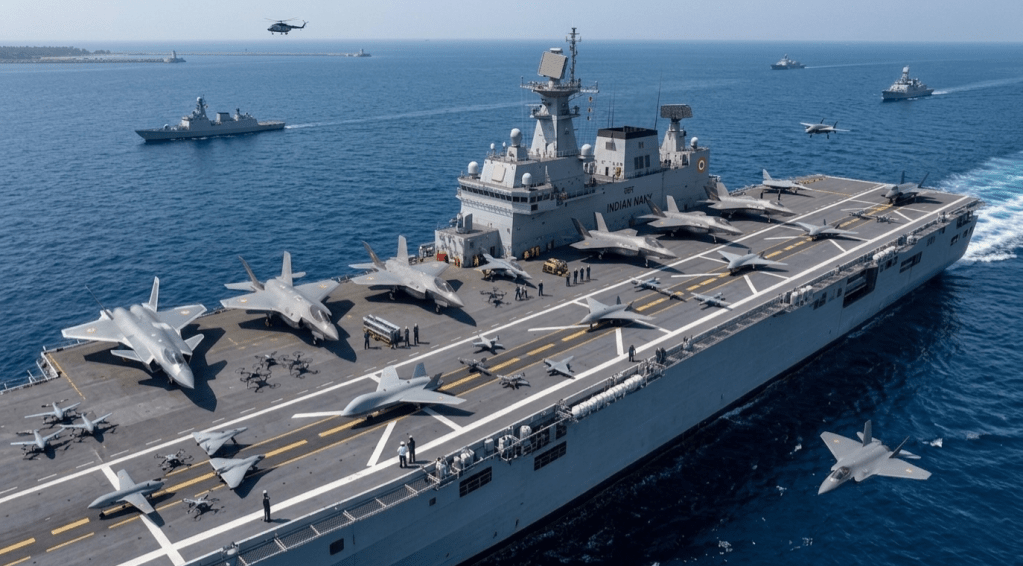
India’s naval ambitions are accelerating at full throttle. A leaked concept image of two carrier-capable Collaborative Combat Aircraft (CCAs) has ignited excitement in aviation circles, suggesting unmanned systems could soon dominate carrier decks. Simultaneously, the Indian Navy’s confirmed order for four massive Landing Platform Docks (LPDs) under the India Navy amphibious vessel project, underscores a drive for amphibious dominance. These moves are not isolated—they weave into a broader strategy for expeditionary warfare, mirroring aggressive unmanned and amphibious expansions by the US and Chinese navies. Together, they position India as a serious Indo-Pacific contender.
Dual CCA Designs: Twin Pillars of Unmanned Carrier Aviation
The concept visual, circulating on defence forums, depicts two distinctly sized unmanned platforms parked on an aircraft carrier deck. Both eclipse the LCA Navy Mk1’s 13.2-meter length, hinting at serious payload and endurance ambitions.
The smaller CCA, roughly LCA sized, appears optimized as a “loyal wingman.” It would handle reconnaissance, electronic warfare, and escort duties alongside manned fighters like the Rafale-M or Twin-Engine Deck-Based Fighter (TEDBF). Larger than the CATS Warrior UCAV, it promises versatility without overwhelming deck space.
The star is the larger drone: wing-folding mechanism screams carrier-ready design. At potentially 20 tons, it evokes heavy-hitters like the US MQ-25 Stingray but with strike teeth. Folding wings maximize hangar efficiency on vessels like INS Vikrant (260m deck) or the upcoming INS Vishal. This beast could loiter for hours, haul precision munitions for anti-ship or land-attack roles, and integrate advanced sensors for network-centric ops.
Both feature twin-engine configurations—a smart call for naval ops. Speculation points to dual HTFE-25 turbofans (25 kN each, totaling 50 kN) from GTRE, suiting subsonic strikes with 2–3-ton payloads. An upgraded Kaveri derivative (dry weight thrust nearing 49-51 kN per engine) could push supercruise or heavier loads. Redundancy trumps all in carrier landings, where engine failure spells disaster.
This layered CCA fleet signals doctrinal evolution. Medium drones swarm for suppression; heavies penetrate deep. They would offload risks from pilots, extend combat radius by 500+ km, and surge sortie rates. DRDO’s Ghatak program provides tech bedrock, with iDEX 2025 prototypes possibly validating designs by 2028.
Project 19 LPDs: Amphibious Giants with Drone Synergy
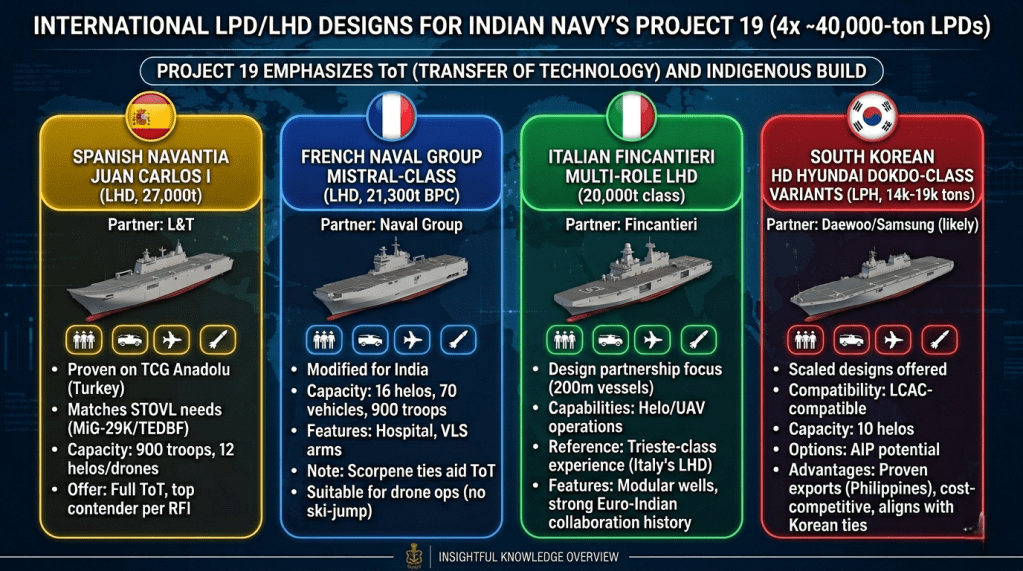
No less transformative is the ₹40,000 crore ($4.8 billion) order for three 40,000-ton LPDs. To be constructed by Larsen & Toubro (L&T) or Mazagon Dock Shipbuilders Ltd (MDL), these replace the aging USS Trenton-derived Jalashwa trio. Delivery starts 2032, with 60-70% indigenous content.
Each LPD packs:
- Aviation suite: Spots for 10-12 helicopters (MH-60R Seahawks, Ka-31 AEW, ALH Dhruv), plus UAV bays for tactical drones—and potentially the new CCAs.
- Well deck: 2 LCACs (Landing Craft Air Cushion) for 30-knot beach runs, carrying tanks or 100 troops.
- Troop capacity: 500-800 marines, 30 BMP-II IFVs or T-90 tanks.
- Propulsion: 4 GE LM2500 gas turbines (80 MW total), 22+ knots speed, 8,000 nm range.
- Extras: 50-bed hospital, C4ISR centers, vertical launch systems for Barak-8 missiles.
These “floating bases” enable sustained ops in the Bay of Bengal, off Lakshadweep, the Malacca Strait, or the Arabian Sea. Crucially, their expansive decks (200m) host CCAs for organic airpower, turning LPDs into mini carriers for amphibious assaults.
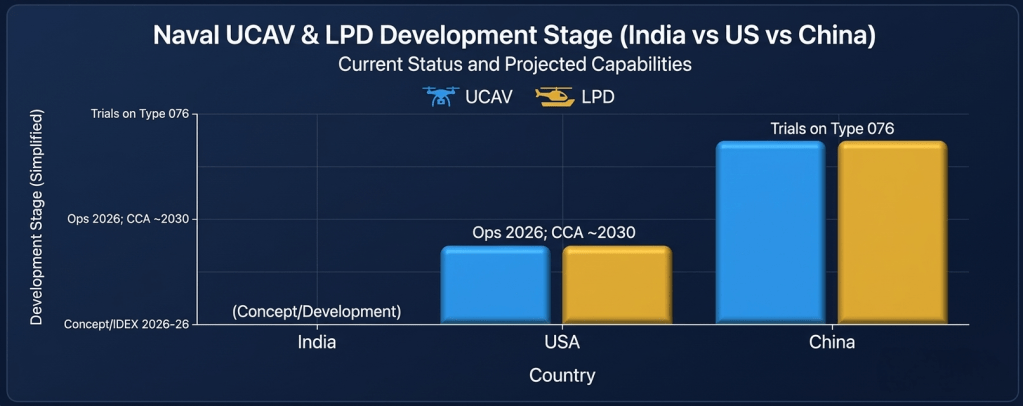
The Perfect Pair: CCAs + LPDs = Expeditionary Dominance
Synergy is the game-changer Carrier-based CCAs provide standoff strikes and ISR for LPD groups, while LPD drones scout ahead for carrier strikes. In a Taiwan-like scenario, Indian LPDs could seize islands, backed by CCA swarms neutralizing PLAN threats.
This duo bolsters Anti-Access/Area Denial (A2/AD). CCAs saturate enemy defences; LPDs project Army divisions rapidly. By 2040, with 4-5 carriers and 6+ LPDs, India could sustain two carrier strike groups plus amphibious task forces—rivaling superpowers.
Challenges loom: Kaveri engine delays (thrust now 49-51 kN dry), CCA autonomy certification, and integration with AMCA/NGAD-like networks. Budgets strain at ₹1.2 lakh crore annual outlay, but PLI schemes and private partners (Tata, L&T) help.
US Navy: Loyal Wingman Pioneers
America leads unmanned carrier aviation. The MQ-25 Stingray (Boeing), operational since 2021, refuels F-35Cs and extends range by 500 nm. Collaborative Combat Aircraft (CCA) program accelerates: two vendors (General Atomics/Anduril, Boeing) compete for 1,000+ units by 2030.
NGAD (Next Gen Air Dominance) pairs with CCAs for “family of systems.” Heavy CCAs (20-ton class) loom, akin to India’s larger design, for penetrating strikes. US LPDs like America-class (LHA-6+) already fly F-35Bs and MQ-8C Fire Scouts, proving the hybrid model.
China’s PLAN: Mass-Produced Drones and LPD Swarms
China matches scale with speed. The GJ-11 Sharp Sword UCAV, twin-engine stealth bomber, tests carrier traps on Liaoning/Shandong. WZ-10 armed UAVs and upcoming “Gyrfalcon” CCAs feature folding wings for Fujian (Type 003, EMALS catapults).
PLAN’s Type 076 LPD (80,000 tons) integrates drones, helicopters, and possibly catapults —blurring LPD/carrier lines. With 6 LPDs (Type 075) building, China eyes swarm tactics: 100+ cheap UCAVs overwhelming foes. Kaveri-like WS-19 engines power stealthy heavies. India counters with indigenous edge: no export reliance, tailored for IOR hotspots.
Strategic Imperative: Indo-Pacific Balance
India’s push responds to encirclement. China’s String of Pearls (Gwadar, Djibouti) and carrier fleet (6 by 2030) threaten sea lanes. Pakistan’s Type 039B submarines add pressure. CCAs/LPDs secure 70% oil imports via IOR.
Doctrinally, this shifts from defensive to offensive: “Sagar Doctrine” evolves into expeditionary navy. Simulations show CCA-LPD teams repelling PLAN incursions effectively.
Road Ahead: Timelines and Bets
- 2026-28: CCA wind-tunnel tests, LPD steel cuts.
- 2030-32: First CCA carrier trials, LPD Number 1 delivery.
- 2035+: Operational squadrons (24 medium + 12 heavy CCAs per carrier group).
Success hinges on DRDO-HAL synergy, FDI inflows, push to the Indian start-up ecosystem, and trials at INS Vikramaditya. If realized, India joins the elite: unmanned carriers as force multipliers.
This dual-track revolution—CCAs for skies, LPDs for seas—heralds India’s naval renaissance. From concept sketches to steel behemoths, the message is clear: the Indian Navy is all-in on tomorrow’s wars.
 Insightful Geopolitics
Leave a Reply