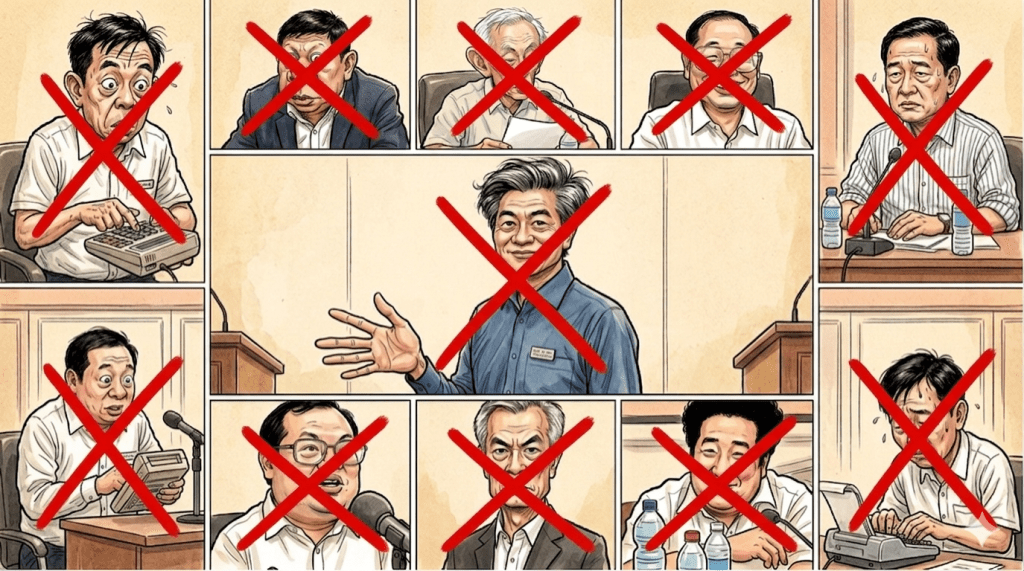
The Psychology of State-Induced Attrition
Fear psychosis is a potent disruptor of scientific advancement. By impairing concentration, fracturing logical deduction, and stripping away objectivity, severe stress leads to critical errors in data interpretation and experimental design. In the hyper-specialized world of defense research, this environment triggers social withdrawal and a paralyzing reluctance to collaborate.
In the long term, untreated mental strain within academia fuels burnout and systemic attrition. For most nations, this loss of skilled human capital is a catastrophe to to be avoided; for the People’s Republic of China, however, it is a calculated byproduct of political hygiene. President-for-life Xi Jinping prioritizes ideological purity and absolute control over short-term technical disruptions, viewing these purges as a “scorched earth” necessity to eradicate the “soil” of corruption. To Xi, a loyal scientist is infinitely more valuable than a brilliant one who harbors his own ambition.
Mechanisms of the Purge: Loyalty Over Logic
Xi Jinping’s campaigns target the intersection of military leadership, scientific brilliance, and industrial power. Framed as a crusade against “serious violations of discipline,” these actions have escalated since 2023. The objective is threefold: enforce unyielding loyalty, root out graft that compromises combat readiness, and align every state institution with the Party’s shifting priorities.
The targets are high-profile: from top-ranking PLA officers like Zhang Youxia and Liu Zhenli to the “immortals” of the scientific community. Since late 2024, a systematic scrubbing of the Chinese Academy of Engineering (CAE) website has served as a grim leading indicator. In China’s opaque system, the deletion of a digital biography is often the first public sign of a scientist’s downfall before they are formally stripped of their titles by the National People’s Congress (NPC).
A Timeline of Vanishing Expertise
The removals reached a fever pitch between late 2025 and early 2026, targeting the architects of China’s most sensitive defense technologies:
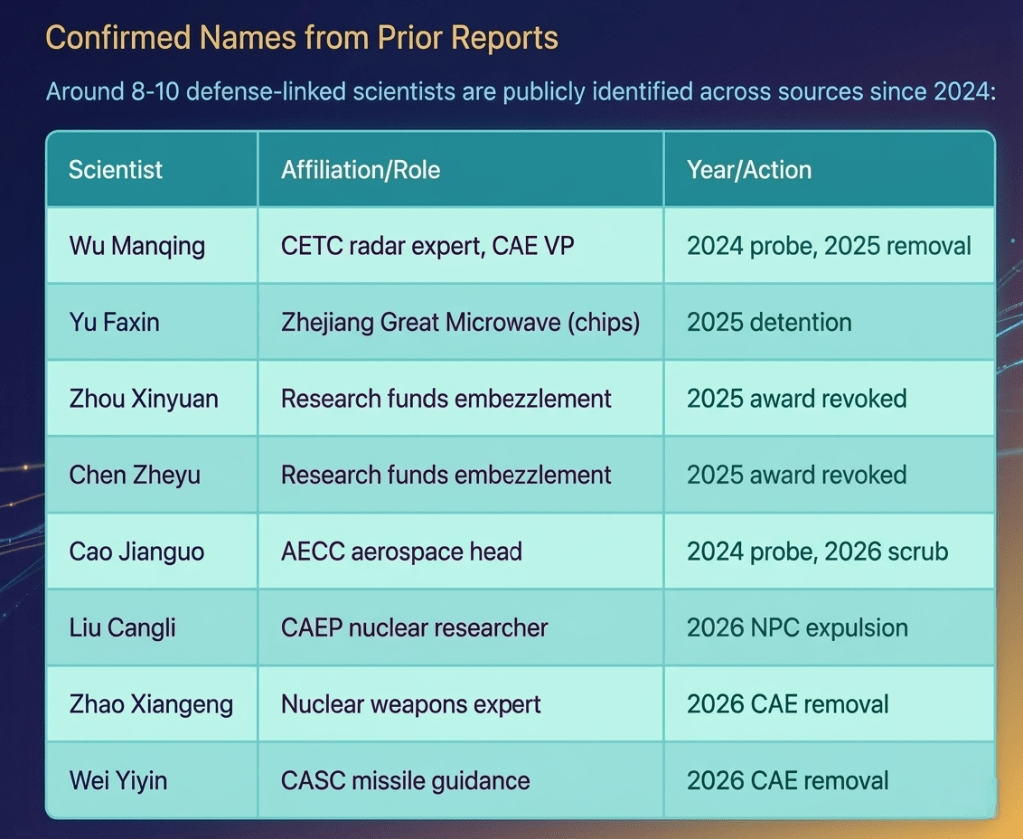
-Wu Manqing (60): A premier radar specialist and former General Manager of CETC. His work was foundational to the KJ-500 early warning aircraft. He was quietly removed as CAE Vice President in July 2025.
-Zhao Xiangeng (72) & Wei Yiyin (63): Experts in nuclear weaponry and missile guidance, respectively. Both saw their digital footprints erased simultaneously around March 15, 2026.
-Cao Jianguo: The former head of the Aero Engine Corporation of China (AECC); his profile was scrubbed in early 2026 following his expulsion from the NPC.
-Liu Cangli: A prominent nuclear weapons researcher and former director of the China Academy of Engineering Physics (CAEP), officially expelled in February 2026.
-Luo Qi & Zhou Xinmin: High-ranking figures from the CNNC and AVIC who have recently vanished from internal rosters.
The Anatomy of the “Web Scrub”
The disappearance of these figures follows a predictable, repetitive pattern:
1. Defense Sector Laser-Focus: Targets are drawn exclusively from the “Big Four” state-owned conglomerates (CETC, CASC, AVIC, CNNC) or elite institutes like the CAEP.
2. Digital Execution: In a state without a free press, a 404 error on a biography page serves as a proxy for an arrest.
3. The Military-Industrial Link: These purges are rarely isolated; they are the “tail” of larger investigations into the military brass. When a General falls for procurement fraud, the scientist who signed off on the faulty tech usually follows.
Impact on Readiness: A Dual-Edged Sword
This “cleansing” has created significant turbulence. Since 2023, investigations have removed over 100 senior PLA officers and defense executives, affecting 52% of top-tier positions. The International Institute for Strategic Studies (IISS) has noted “serious deficiencies” in command structures, highlighted by a staggering nine-month leadership gap in the Eastern Theater Command during 2025.
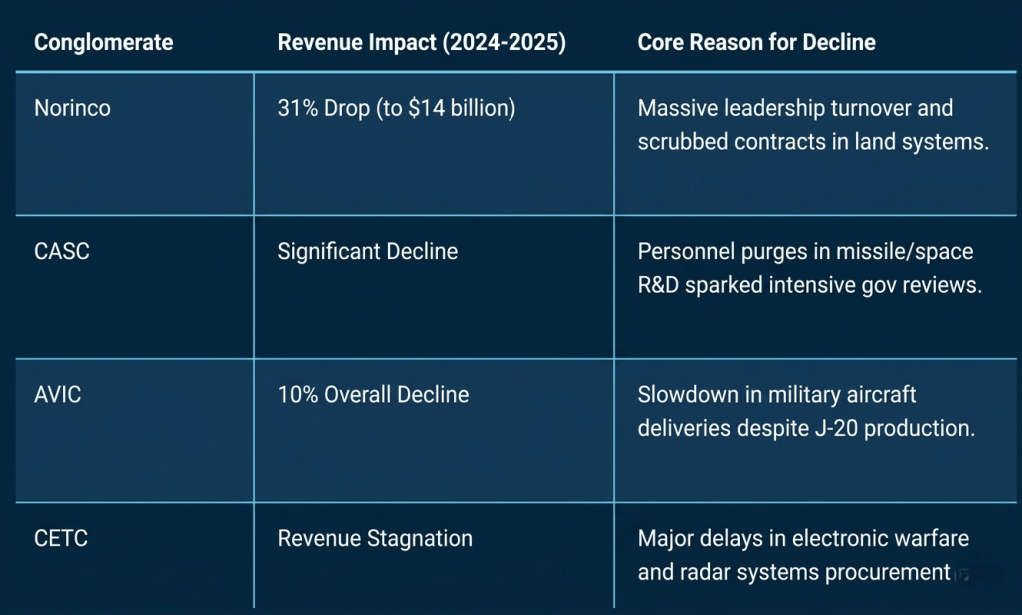
The financial and innovative toll is equally stark. Corruption probes froze major arms contracts in 2024, causing revenue drops between 10% and 31% for giants like Norinco, leading to market contraction. A new culture of risk aversion has slowed R&D pipelines, potentially delaying 2027 modernization goals for hypersonic and radar systems. People in hushed voices are calling it an innovation stagnation. The mitigation strategy is simple, China is pushing for a “reverse brain drain,” using R&D funding (2.8% of GDP) to lure overseas talent while rapidly promoting younger, politically vetted scientists to fill the vacancies.
The 2027 Centennial and the Taiwan Factor
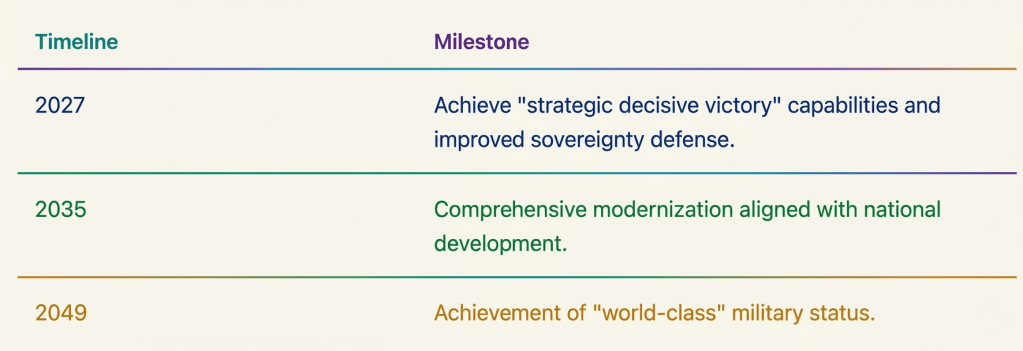
Xi’s “2027 Centennial Military Building Goal” demands the integration of mechanization with AI-driven “intelligentization.” Despite the tactical “churn” caused by the purges, Pentagon reports from 2025 and 2026 suggest that China’s strategic momentum remains formidable. Expansion in nuclear forces, the naval fleet (400+ ships), and the DF-27 hypersonic missile program continues.
However, the purges have further exposed deep-seated vulnerabilities:
1. The “Five Incapables”: The PLA still struggles with poor judgment, decision-making, and planning among officers.
2. Logistical Fragility: Leadership vacuums have delayed complex drills; for instance, the 2025 Taiwan exercises took 12-19 days, compared to just four days in 2024.
3. Invasion Risks: While Xi renains wary of a high-risk Taiwan invasion amidst this internal turmoil—likely reducing the odds of a conflict in the next 2-3 years—the instability increases the risk of a “miscalculation” during coercive drills.
The Purge Catalyst: Equipment Failure in Indo-Pak & Iran War
The anti-corruption campaign has outdone its origins as a corrective measure, evolving into a state of “continuous revolution” that defines the modern Chinese political landscape. As the 2027 Party Congress nears, the widening net—now swallowing even evidently loyal stalwarts like Zhang Youxia. This serves as a definitive signal that Xi Jinping will tolerate no shadow of a competing power center. For the Chinese Communist Party, this systemic purge is no longer a transient fever but a permanent mechanism of governance; it is the ultimate “cage” for power. By prioritizing absolute ideological unity over technical autonomy, the Party ensures it remains the sole owener of China’s trajectory, deliberately accepting a steep scientific cost to secure an uncontested political future.
Simultaneously, the geopolitical reputation of Chinese military hardware has seen a period of profound humiliation as global experts highlight a pattern of high-profile operational failures. From the inability of Venezuela’s anti-stealth radars to provide a credible defense to the systematic neutralization of Iranian SAM batteries during Western and Israeli precision strikes, Beijing’s hardware is faltering in its most critical theaters of engagement. This performance gap evokes an embarrassing “déjà vu” of the four-day Indo-Pak war, where Chinese-engineered systems similarly buckled under high-intensity pressure. As the purge hollows out the Chinese scientific elite, the disconnect between the Party’s political ambitions and the actual reliability of its technology becomes an unavoidable liability on the world stage.
 Insightful Geopolitics
Leave a Reply