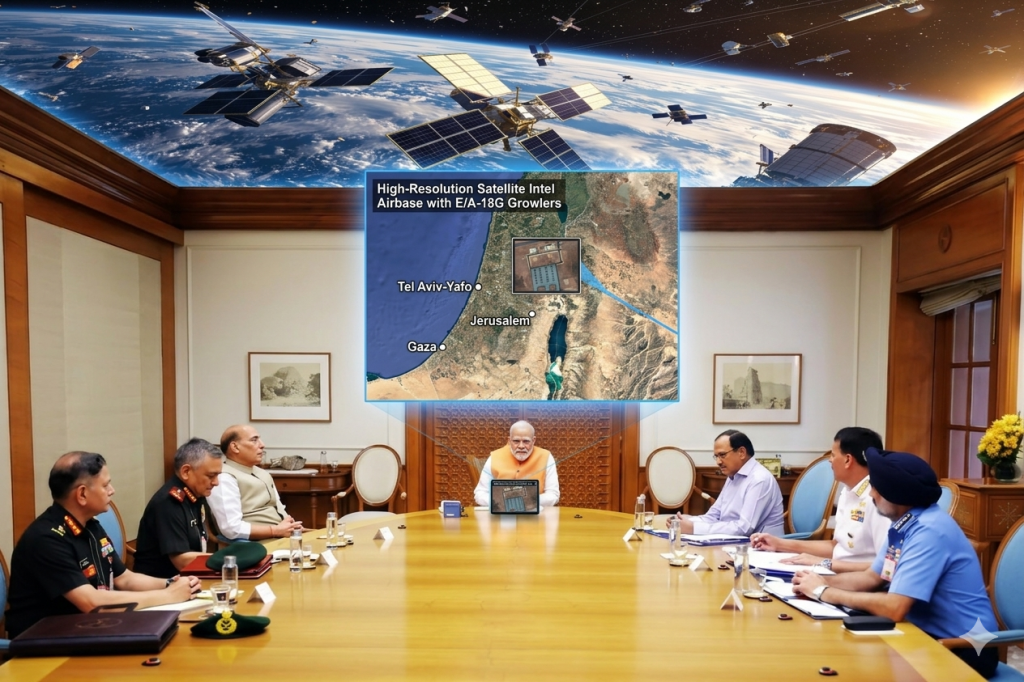
On 28 February 2026, Operation Epic Fury commenced, prompting MizarVision—a Chinese AI firm—to release AI-annotated satellite imagery. The visuals pinpointed US F-22 Raptors at Israel’s Ovda Air Base, alongside allied defences in Jordan and Saudi Arabia. This revelation laid bare force postures and logistics chains, compelling defence planners to rethink secrecy protocols and power projection strategies. US analysts labeled it “proxy intelligence”: American commercial satellite data refined by Chinese AI, which aligned seamlessly with Iranian targeting needs and eroded stealth edges across the Middle East.
The incident underscored two critical shifts: the dominance of satellite-based Intelligence, Surveillance, and Reconnaissance (ISR), and AI’s unprecedented ability to transform raw imagery into actionable insights at breakneck speeds.
The Indian Perspective
Operation Sindoor, launched in May 2025 after the Pahalgam terror attack, proved a tactical and strategic success. Yet it exposed key vulnerabilities: Chinese satellite feeds had provided Pakistani forces with superior real-time intelligence, underscoring the limits of India’s surveillance architecture. In high-intensity, mobile conflicts, a handful of high-quality, low-revisit satellites simply fall short. India needed a denser sensor mesh—a “swarm” capability like that popularized by China’s Jilin-1. This realization directly spurred the ongoing SBS-3 program (52 satellites).
India had long recognized these gaps, even before Sindoor. A pivotal step came in 2020, when the government opened the space sector to private industry, dismantling ISRO’s near-monopoly. To match swarm-model competitors, India couldn’t rely on ISRO’s deliberate, mission-by-mission pace. Rather than ignoring the issues, it proactively pinpointed “blind spots” hampering real-time decision-making. Key shortcomings included:
- Lack of All-Weather & Night-Time Imaging: During the conflict, India’s existing electro-optical satellite fleet struggled to capture clear imagery in cloudy or dark conditions. This limitation forced India to temporarily rely on commercial satellite data from US-based companies to plan its responses.
- Low Revisit Frequency: The time gap between satellite passes over specific targets was measured in days rather than hours, which slowed down the military’s ability to monitor enemy movements in near-real time.
- Intelligence Integration Bottlenecks: The operation underscored a persistent issue with “fragmented intelligence.” Multiple agencies held pieces of critical information, but the lack of a unified, AI-powered platform meant that actionable insights did not always reach commanders in the necessary timeframe.
The China Challenge
The Jilin-1 constellation, China’s largest commercial remote sensing network operated by Chang Guang Satellite Technology Limited (CGSTL), launched in October 2015 and marks a pivotal shift from bulky single satellites to swarms of nimble, small ones. By early 2026, it boasts over 115 active satellites, with ambitions for 300, including the latest GaoFen models delivering sub-meter resolution (0.3–0.5m)—sharp enough to identify specific vehicle models from orbit.
A standout capability is 4K high-definition video tracking of dynamic targets, such as aircraft during takeoff (e.g., Operation Sindoor), moving ships, or real-time car traffic. With 115 satellites enabling 15–20 minutes global revisit rates as of 2024–2025, Jilin-1 achieves true persistent surveillance.
Public releases of its imagery—capturing sensitive foreign military assets—reflect a deliberate escalation by Chinese firms like MizarVision, signaling technical parity with the West. Initially civilian-focused (2015–2021) for land surveys, agriculture, and disaster response, the program exploded past 100 satellites by 2022–2024, with “proof-of-concept” demos of motion tracking. From early 2026, releases turned frequent and strategic: evolving from “Look what we built” to “Look what we see.”
Beyond optical sensors, the fleet incorporates hyperspectral (for chemical signatures and vegetation health), infrared (night/thermal imaging), and SAR (cloud-penetrating radar).
The Indian Story
It’s a common misconception that India “did nothing” on space-based surveillance from 2015 onward. In reality, India’s strategy shifted fundamentally toward precision over quantity. Why didn’t India launch a “Jilin-1 style” swarm immediately to counter China? The answer lies in divergent paths: China poured funds into Chang Guang Satellite Technology for a commercial-military hybrid, flooding low Earth orbit (LEO) with cheap, disposable satellites to prioritize temporal resolution—frequent revisits at lower quality. India, by contrast, pursued a “Precision Strategy,” favoring spatial resolution (e.g., 25cm clarity on a single high-value target) over a constant low-resolution “video” stream, as preferred by its intelligence and military planners.
The Ministry of Defence then fast-tracked upgrades to slash reliance on foreign commercial data. Space-Based Surveillance-3 (SBS-3) will deploy 52 dedicated military satellites, evolving from electro-optical to Synthetic Aperture Radar (SAR) for cloud-penetrating, night-capable imaging. This constellation aims to shrink surveillance gaps from days to just hours, delivering near-persistent coverage of border hotspots—though not China’s every-15-minute rate from its 115+ swarm. For India, 52 satellites target critical blind spots exposed in the 2025 border conflict, enabling a massive OODA loop leap: from days-long delays in Observe-Orient-Decide-Act to real-time tactical responses.
A military commander knows this matters: adversaries currently exploit satellite-pass gaps to reposition, camouflage, and hide. Hours-long intervals compress that window dramatically. India’s hybrid LEO-GEO setup blends high-resolution tactical snaps with GEO’s wide-area “staring” over strategic sectors.
India rejects China’s quantity-first gamble for sound reasons. Scaling from 24-hour to 2-hour revisits yields huge gains; pushing to 15 minutes demands exponentially more satellites (100–150+), cost, and complexity for marginal intel value. Instead, India embeds onboard AI for in-orbit change detection—flagging new vehicle tracks or ship maneuvers to cue follow-ups. The design also stresses resilient interconnectivity and hardening, yielding high-integrity data under attack, where China’s swarm risks “swarming” countermeasures.
Enter Indian Navy
India bridges the “revisit gap” in Indian Ocean surveillance by integrating satellites with P-8I Poseidon aircraft through a “Trigger-Cue-Action” workflow. This approach multiplies the strengths of both assets, as satellites can’t continuously monitor every ocean square inch every 15 minutes.
Satellites like GSAT-7/Rukmini—and upcoming dedicated surveillance platforms—scan vast areas using radar or AIS ship-tracking. When they detect anomalies, such as “dark vessels” with transponders off or suspicious formations in chokepoints, they trigger automated alerts to the Maritime Operations Centre (MOC).
The MOC fuses this data with other intelligence, then cues the nearest P-8I from bases like INS Rajali or INS Baaz. On arrival, the P-8I’s APY-10 radar, high-resolution EO/IR cameras, and sonobuoys enable low-altitude vessel ID, submarine detection, and a high-fidelity tactical picture—capabilities satellites lack. This feeds back via secure satellite links to the Navy Enterprise Wide Network (NEWN), creating a shared digital map visible to ships, aircraft, and commanders in real time.
Acting as a “mobile sensor hub,” the P-8I delivers 8–10 hours of persistent, human-in-the-loop surveillance over localized threats, overcoming satellite limitations like clouds or orbit gaps. Its active radar and acoustics ensure coverage regardless of conditions.
Under Stage-3 of the Strategic Battlefield Surveillance (SBS-3), integration advances with direct-to-cockpit data feeds and “AI on the edge” processing aboard satellites. This bypasses ground controllers, alerting P-8Is to anomalies in seconds for near-instant threat interception.
In The End
India didn’t “fail” to act—it prioritized different strategic needs, positioning itself advantageously for the future. By launching its “52-satellite armada” now, India skips the experimental phase China endured with Jilin-1’s basic optical cameras. From day one, this constellation integrates cutting-edge AI-on-board processing, quantum-secure communications, and hybrid SAR-optical sensors. Leveraging private firms like Pixxel accelerates deployment far beyond what ISRO alone could achieve. Ultimately, success hinges on sustained funding and agile course corrections as technology evolves faster than we can fully grasp.


 Insightful Geopolitics
Leave a Reply