The concept of hybrid warfare is closely associated with Russia’s current chief of the general staff, General Valery Gerasimov. In a 2013 article published in a Russian defense industry journal, he outlined the key elements of what has come to be known as the ‘Gerasimov Doctrine.’ In this article, Gerasimov described a form of whole-of-government warfare that blurs the boundaries between peacetime and wartime, best characterized as a fusion of various elements of soft and hard power across multiple domains. Essentially, the Gerasimov Doctrine represents a state of permanent conflict.
Russia’s annexation of Crimea and its special operations in Ukraine have emphasized hybrid warfare as a crucial component of its military strategy and foreign policy. The Kremlin’s use of information and disinformation to sway public opinion in Europe and the U.S.—including interference in the 2016 presidential election and the promotion of fringe political movements—has reinforced the belief that the Gerasimov Doctrine drives Russian foreign policy. However, this belief can be misleading.
The so-called doctrine is not the primary driver of Russian national security policy. Rather, it serves as an operational concept for the Russian national security establishment to support its ongoing confrontation with the West. Instead of representing a new doctrine, Gerasimov’s work reflects a strategy to implement a long-standing doctrine that has shaped Russian foreign and defense policies for over three decades: ‘the Primakov Doctrine.’
What is the Primakov Doctrine
Yevgeny Primakov was fluent in Arabic and began his career as a foreign correspondent in the Middle East. He later led Russia’s Institute of Oriental Studies and the Institute of World Economy and International Relations. In 1989, he became the chairman of one chamber of the Supreme Soviet, and in 1990, he was appointed to the Presidential Council. Primakov was the head of the Foreign Intelligence Service until 1996, when President Yeltsin appointed him as foreign minister. He held the position of Prime Minister of Russia from 1998 to 1999.

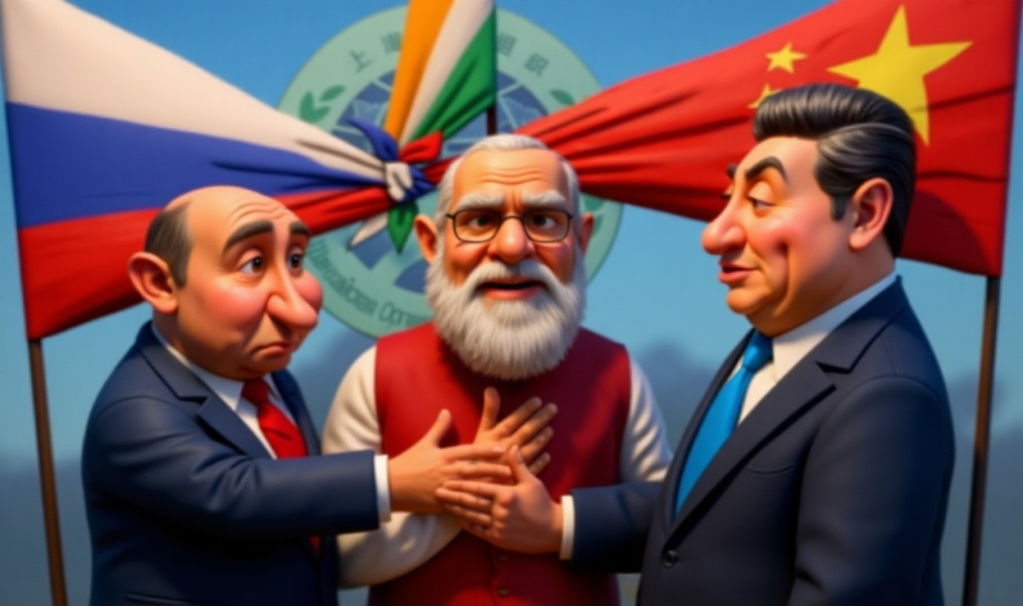
The Primakov Doctrine states that Russian foreign policy should strive toward a multipolar world managed by a concert of major powers—Russia, India, China, and the United States. According to this vision, Russia should not try to compete with the United States single-handedly; rather, Moscow should seek to constrain the United States with the help of other major powers and to position itself as an indispensable actor with a vote and a veto, whose consent is necessary to settle any key issue facing the international community.
Another essential aspect is the opposition to NATO expansion and ongoing efforts to weaken transatlantic institutions and the U.S.-led international order. A partnership with China is another fundamental component. Together, these elements are major pillars of Russian foreign policy today.
Russian hybrid warfare and hard power capabilities have been developed and utilized to support the Primakov doctrine. Hybrid warfare serves as a tool for risk management in this context, employed when traditional hard power options are considered too risky or costly, or otherwise impractical. While hybrid tools can act as substitutes for hard power, the potential for military force always looms in the background when these hybrid strategies are deployed.
Primakov and India
Primakov had understood the importance of India well and contributed significantly to Indian studies while heading Moscow’s Institute of Oriental Studies. As SVR chief in the early 1990s, he improved ties between Delhi and Moscow when India was a low priority for Russia under the Minister of Foreign Affairs Kozyrev.
During Yeltsin’s presidency, India-Russia relations faced challenges, including currency issues, declining trade, defense supply disruptions, etc. Yeltsin’s official visit to India in January 1993, managed by Primakov, helped address these irritants.
When Primakov replaced Kozyrev in 1996, India was his first international visit, indicating a policy shift towards South Asia. Despite plans for annual summits post-Yeltsin’s 1993 visit, these did not materialize. Primakov’s December 1998 visit to India marked a milestone, emphasizing ‘continuity’ in bilateral relations and introducing the concept of a strategic triangle involving Russia, India, and China (RIC) amid global geopolitical shifts.
Strategic Triangle RIC and Its Relevance
Initially, both Beijing and New Delhi reacted coldly to Primakov’s proposal for a trilateral cooperation triangle, primarily due to vague details and a lack of strategic trust, especially following India’s 1998 Pokhran-II nuclear test. Both nations viewed the triangle as a potential constraint to their foreign policies aimed at counterbalancing the United States.
Despite these challenges, the foreign ministers of Russia, India, and China met for the first time at the UN General Assembly in September 2003. From 2003 to 2021, they held 20 rounds of high-level consultations, demonstrating the RIC’s relevance amid tensions between India and China. The format expanded to include various mechanisms such as national security adviser consultations and Track 2 dialogues.
The 2006 RIC leaders’ summit in Saint Petersburg led to the formation of the Brazil-Russia-India-China (BRIC) group, which later included South Africa. While some common ground was found, the consultations rarely achieved substantive outcomes, and China remained uncooperative on issues like terrorism, consistently blocking India’s efforts in various international platforms, etc.
The RIC meetings aimed to coordinate positions on regional and global issues but did not evolve into a strategic forum due to several factors. Firstly, Moscow envisioned the RIC as a way to shape a new world order, while China opposed India’s push for reformed multilateralism. Secondly, tensions in the India-China relationship limited RIC interactions, hindering deeper engagement among the three countries. As Russian and Chinese interests aligned, India began to feel like an outsider, especially regarding the Belt and Road Initiative (BRI), which India opposed since part of CPEC passes through Pakistan-occupied Jammu and Kashmir (POJK).
Since the last RIC ministerial videoconference in November 2021, the geopolitical landscape in Eurasia has changed significantly. Russia’s war in Ukraine has diminished its influence in Central Asia and the South Caucasus. The three RIC countries—Russia, India, and China—have each engaged with the Taliban in different ways, with only Moscow officially recognizing the regime. Their varying responses to the Hamas attack on Israel and the conflicts in Gaza and Iran have also underscored their different approaches. Both India and China are focused on maintaining economic ties with the United States and are unlikely to challenge those relationships.
Trump’s Role as a Catalyst
In May 2025, Russia’s Foreign Minister Sergey Lavrov expressed interest in reviving the Russia-India-China (RIC) troika, noting its history of over 20 meetings at the ministerial level. In July 2025, Russia’s Deputy Foreign Minister Andrey Rudenko mentioned ongoing negotiations with China and India to reinstate this format, emphasizing its importance for Moscow’s interests.
The improving relations between India and China, highlighted by External Affairs Minister S. Jaishankar’s visit to Beijing, suggest that a revival of the RIC dialogue is plausible. The reciprocal visit by the Chinese foreign minister further supports this possibility.
U.S. trade policy under President Trump has significantly impacted the situation. His administration’s tariffs and the often erratic statements from senior officials have strained relations between India and the U.S. Although similar concerns were raised during the last RIC meeting in 2019, these relations have deteriorated since Trump’s inauguration in January 2025.
Together, India, Russia, and China could form a Eurasian counterweight to Western dominance, promoting a multipolar world through existing organizations such as BRICS and the SCO. Nonetheless, for the RIC troika to succeed, the three nations must align on their strategic priorities, which leaves their future uncertain for now.
During a press briefing, Randhir Jaiswal, spokesperson for the Indian Ministry of External Affairs, reaffirmed India’s stance on the RIC format. He stated, “This consultative format allows the three countries to discuss global and regional issues of mutual interest. As for when the next RIC meeting will take place, that will be coordinated among the three countries at a mutually convenient time.”
Jaiswal clarified that no meeting has been agreed upon yet, and there are currently no discussions taking place regarding the scheduling of a new RIC session. This indicates that Indian Prime Minister Modi’s attendance at the SCO meeting in China was a warning shot directed at the U.S. It also demonstrates that while India is engaging with China, it still does not fully trust China, and an anti-U.S. stance does not align with India’s interests.
In the End
India’s recent foreign affairs strategy focuses on balanced engagement with multiple powers, particularly technologically advanced democracies, despite tense ties with the United States. Aligning closely with China at this juncture would not be in India’s interest.
India maintains strong ties with Russia for defense and energy but is gradually diversifying away from Russian arms in favor of more modern suppliers and indigenisation. On the other hand, China poses a complex challenge due to border disputes and perceived threats. While Modi in his first term sought closer relations with China, a shift occurred due to Chinese intransigence and U.S. engagement.
To sustain growth, India needs foreign investment and technology transfers, which China wouldn’t provide, and Russia doesn’t possess. The current U.S. challenge is not permanent, and a potential agreement could ease tensions.
India also has alternatives beyond choosing between the U.S. and China; it can deepen security ties with Australia, Japan, and South Korea, and pursue relationships with European nations and advanced Middle Eastern powers like Israel and the UAE.
While these efforts may not fully compensate for a strained U.S. partnership, Modi should continue engaging with democracies rather than turning to a Chinese alternative. Despite challenges, there are still many global leaders willing to collaborate with India.
Although the RIC concept continues to be popular in diplomatic discussions, establishing a meaningful trilateral partnership would require substantial reassurance from China. China’s past behavior has not been very promising, and there is no guarantee that it won’t betray India if it perceives that India is stepping out of line. For now, India should maintain its commitment to multilateralism while considering the Primakov Doctrine in this context.


 Insightful Geopolitics
Leave a Reply